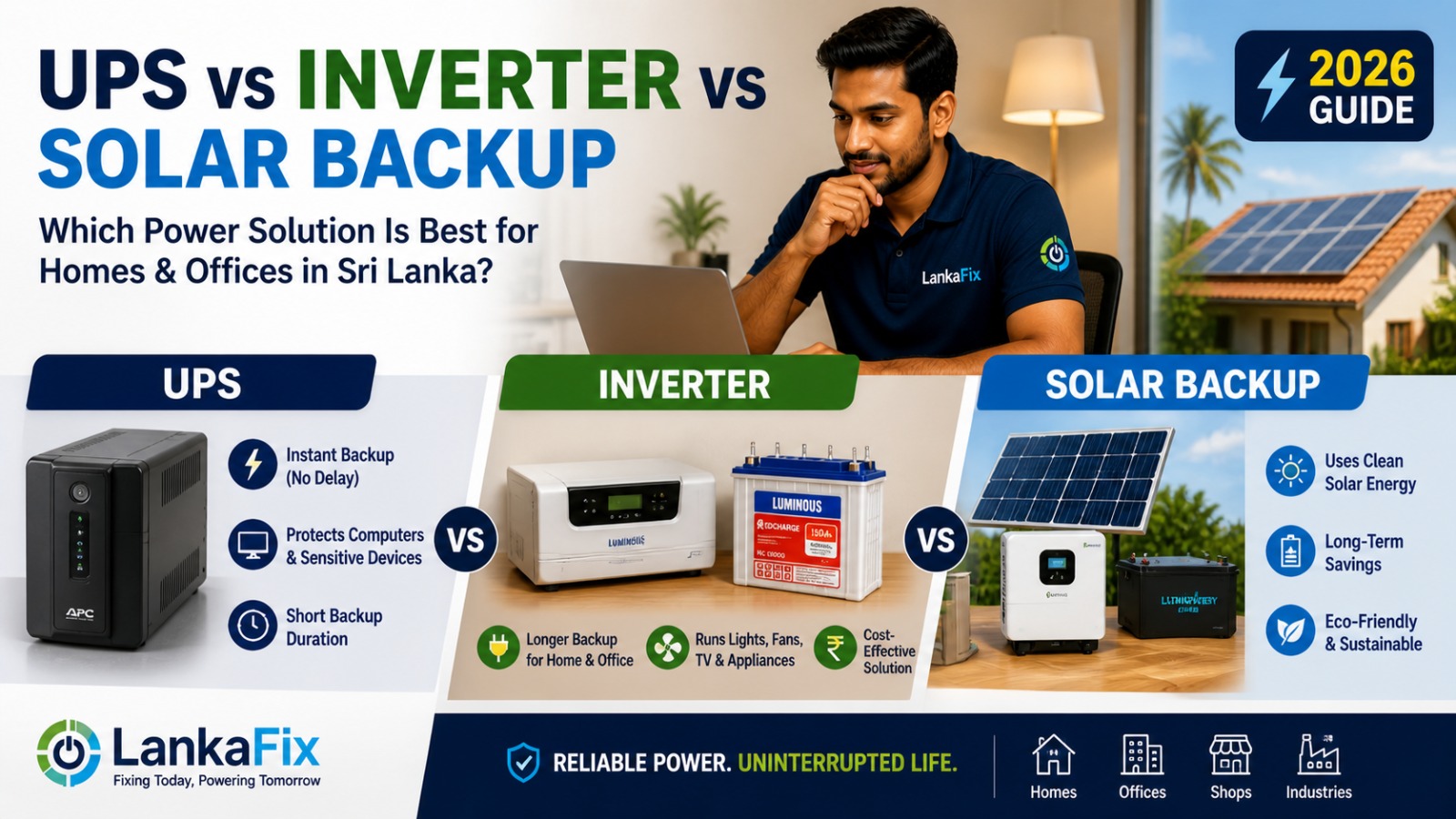
Power interruptions, voltage fluctuations, and rising electricity costs are common challenges faced by households and businesses across Sri Lanka. Whether you work from home, run a retail shop, manage an office, or operate critical equipment, having a reliable backup power solution is essential for productivity and safety. This comprehensive guide explains the differences between UPS systems, inverters, and solar backup solutions. It provides practical insights into installation costs, performance, maintenance, and suitability for Sri Lankan conditions. By understanding these options, consumers and businesses can make informed decisions to ensure uninterrupted power supply and long-term savings. Why Backup Power Solutions Are Important in Sri Lanka Power reliability is critical for daily life and business operations. Unexpected power failures can cause data loss, equipment damage, business disruption, and reduced productivity. Key benefits of backup power systems include:
Continuous operation during power outages
Protection of electronic devices from voltage fluctuations
Improved productivity and business continuity
Enhanced safety and comfort at home
Reduced downtime for IT and communication systems What Is a UPS (Uninterruptible Power Supply)? A UPS is a device that provides instant backup power when electricity fails. It is commonly used for computers, servers, routers, and security systems. UPS units provide short-term power to allow safe shutdown of equipment or continued operation for a limited period. What Is an Inverter? An inverter converts battery power into electricity to supply power during outages. Inverters are widely used in homes and offices to operate lights, fans, televisions, and small appliances. They provide longer backup duration than UPS systems but require a short switching time when power fails. What Is Solar Backup Power? Solar backup systems use solar panels to generate electricity from sunlight and store energy in batteries. These systems provide renewable energy and can reduce electricity bills significantly. Solar backup is ideal for homes and businesses seeking long-term energy independence and sustainability. Key Differences Between UPS, Inverter, and Solar Systems UPS:
Instant power backup (no delay)
Short backup duration
Ideal for computers and sensitive electronics Inverter:
Moderate switching delay
Longer backup duration
Suitable for home appliances and office equipment Solar:
Uses renewable energy
Long-term cost savings
Environmentally friendly solution Estimated Cost of Backup Power Solutions in Sri Lanka (2026) Typical installation costs may include:
Basic UPS system: LKR 15,000 – 45,000
Home inverter system: LKR 65,000 – 180,000
Solar backup system (small home): LKR 250,000 – 650,000
Solar system (commercial setup): LKR 750,000 – 2,500,000 Note: Prices vary depending on capacity, battery type, brand, and installation requirements. Which Power Solution Is Best for Your Needs? Choose a UPS if:
You need instant backup for computers or servers
You require protection from sudden shutdowns
Backup duration requirement is short Choose an Inverter if:
You want backup power for lights and household appliances
You need longer backup duration
You want a cost-effective solution Choose Solar if:
You want to reduce electricity bills
You require long-term backup power
You prefer environmentally friendly energy Factors to Consider Before Installing a Backup Power System
Total power consumption requirements
Duration of backup needed
Available installation space
Budget and long-term cost savings
Type of equipment to be powered
Maintenance and battery replacement costs Maintenance Tips for Backup Power Systems Regular maintenance ensures reliability and safety:
Check battery condition periodically
Keep equipment in a cool and dry environment
Schedule professional inspection annually
Replace batteries as recommended by manufacturer
Ensure proper ventilation around equipment Professional Recommendation for Sri Lankan Homes and Businesses Selecting the right backup power solution depends on your usage pattern, budget, and reliability requirements. Consulting a qualified technician helps ensure proper system sizing, safe installation, and long-term performance. Investing in a reliable backup system protects valuable equipment and supports uninterrupted daily operations. Conclusion UPS, inverter, and solar systems each serve different purposes. Understanding their advantages, costs, and applications helps consumers choose the most suitable solution. With proper planning and professional installation, backup power systems can provide peace of mind, productivity, and energy savings for years to come.
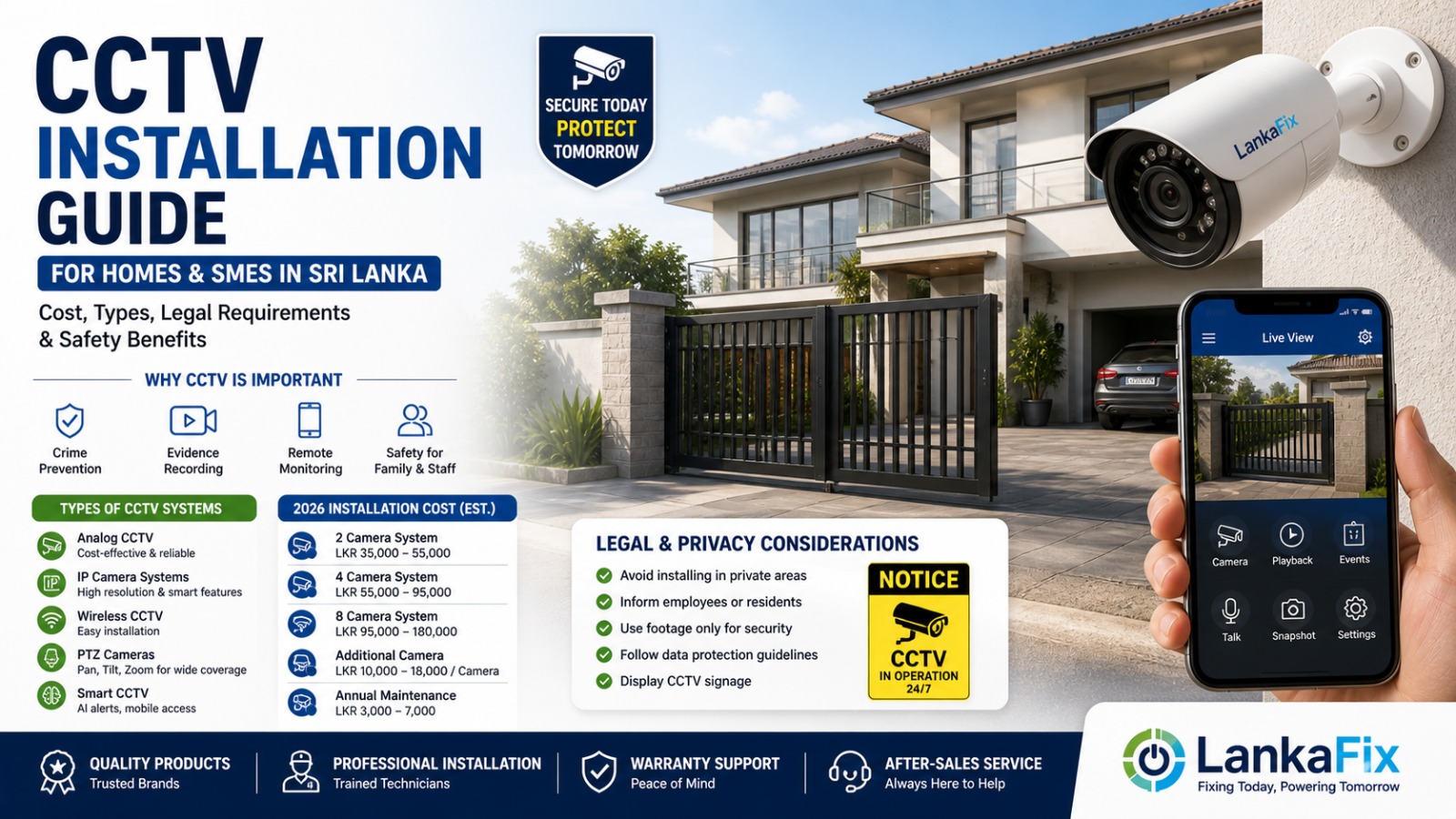
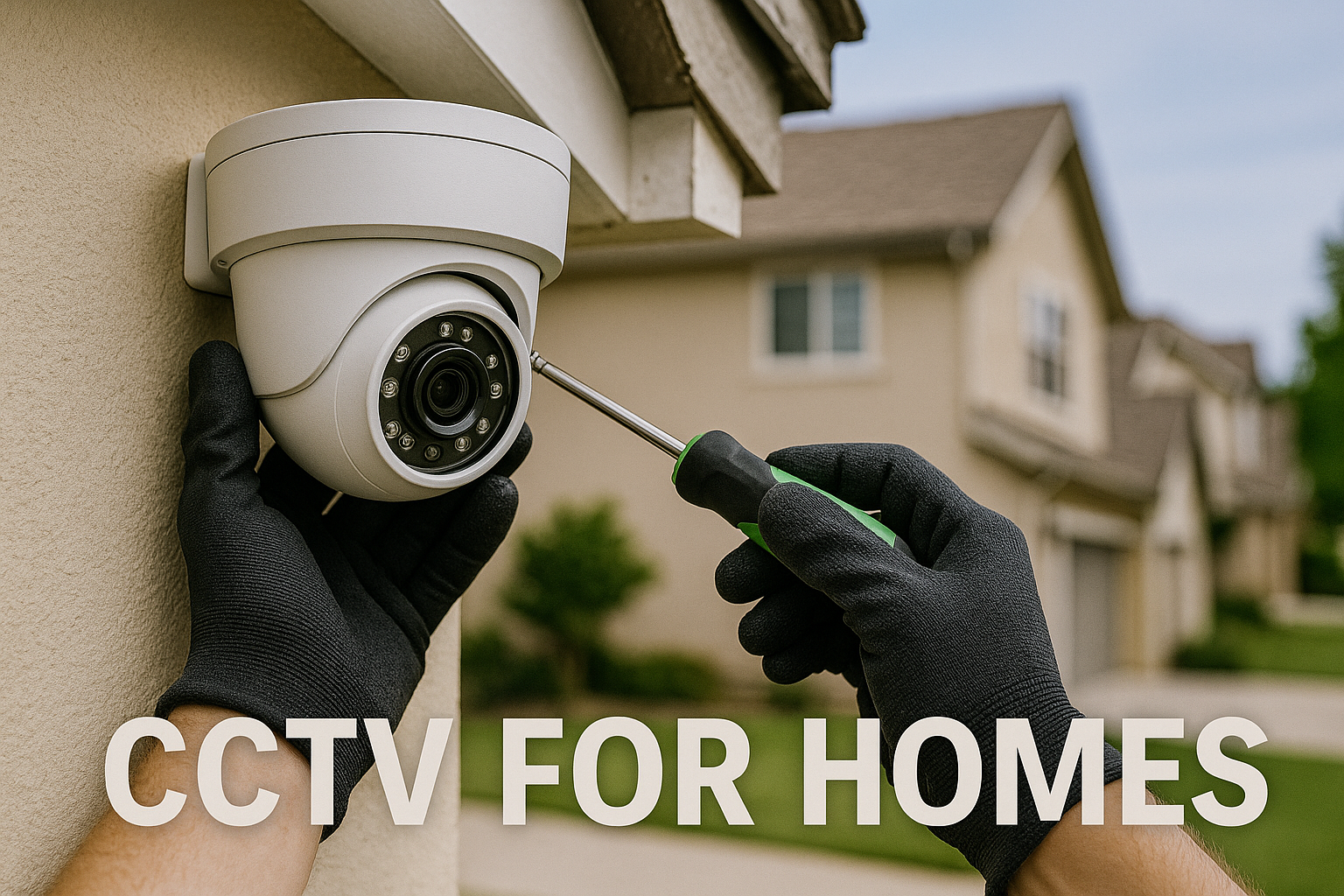
Security has become a top priority for homeowners and business owners across Sri Lanka. With increasing concerns about theft, property damage, and safety, Closed-Circuit Television (CCTV) systems have become one of the most reliable and affordable security solutions. This comprehensive guide explains everything you need to know about CCTV installation in Sri Lanka, including system types, installation costs, legal considerations, and practical recommendations. It is designed to help families, small businesses, offices, retail shops, warehouses, and institutions make informed decisions when investing in security systems. Why CCTV Installation Is Important in Sri Lanka CCTV systems provide continuous monitoring and act as a strong deterrent against crime. They also help improve safety, accountability, and operational efficiency. Key benefits include:
Crime prevention and theft reduction
Evidence collection in case of incidents
Remote monitoring from mobile devices
Employee and customer safety
Business operational monitoring
Insurance and compliance support Common Places Where CCTV Is Installed CCTV systems are widely used in:
Houses and apartments
Retail shops and supermarkets
Offices and corporate buildings
Warehouses and factories
Schools and educational institutions
Hotels and restaurants
Parking areas and entrances Types of CCTV Systems Available in Sri Lanka
Analog CCTV Systems – Basic and cost-effective systems suitable for small premises.
IP Camera Systems – Advanced systems with high-resolution video and remote access.
Wireless CCTV Systems – Easy installation with minimal wiring requirements.
PTZ Cameras (Pan-Tilt-Zoom) – Cameras that can rotate and zoom for large coverage areas.
Smart CCTV Systems – Systems integrated with mobile apps, motion detection, and alerts. Estimated CCTV Installation Cost in Sri Lanka (2026) Below are typical price ranges for CCTV installation:
2-camera system installation: LKR 35,000 – 55,000
4-camera system installation: LKR 55,000 – 95,000
8-camera system installation: LKR 95,000 – 180,000
Additional camera installation: LKR 10,000 – 18,000 per camera
Maintenance and servicing: LKR 3,000 – 7,000 annually Note: Prices may vary depending on camera quality, brand, storage capacity, and installation complexity. Factors That Affect CCTV Installation Cost Several factors determine the final cost:
Number of cameras required
Type and resolution of cameras
Length of wiring and installation difficulty
Storage capacity and recording duration
Indoor vs outdoor installation
Remote viewing and mobile access features
Warranty and after-sales support Legal and Privacy Considerations in Sri Lanka Before installing CCTV, it is important to follow legal and ethical guidelines:
Avoid placing cameras in private areas such as bathrooms or changing rooms
Inform employees or residents about CCTV monitoring
Use recorded footage only for security purposes
Follow workplace and data protection policies
Ensure proper signage indicating CCTV surveillance How to Choose the Right CCTV System Consider the following factors when selecting a system:
Coverage area size
Lighting conditions (day/night)
Internet connectivity availability
Required video quality (HD, Full HD, 4K)
Budget and maintenance cost
Future expansion needs Maintenance Tips for CCTV Systems Regular maintenance ensures long-term reliability:
Clean camera lenses periodically
Check wiring connections
Update system software and firmware
Test recording and playback functions
Replace faulty components promptly When Should You Upgrade Your CCTV System? Consider upgrading if:
Video quality is poor or outdated
Storage capacity is insufficient
Remote monitoring features are missing
The system frequently fails
Security risks have increased Professional Recommendation for Sri Lankan Homes & Businesses Installing a reliable CCTV system is one of the most effective investments in safety and security. Professional installation ensures proper camera placement, secure wiring, and long-term performance. Choosing a trusted service provider with warranty support and technical expertise is essential for protecting your property and peace of mind. Conclusion CCTV installation is no longer a luxury but a necessity for modern homes and businesses in Sri Lanka. Understanding system types, installation costs, and maintenance practices will help you make a smart and cost-effective decision. With proper planning and professional support, a CCTV system can provide
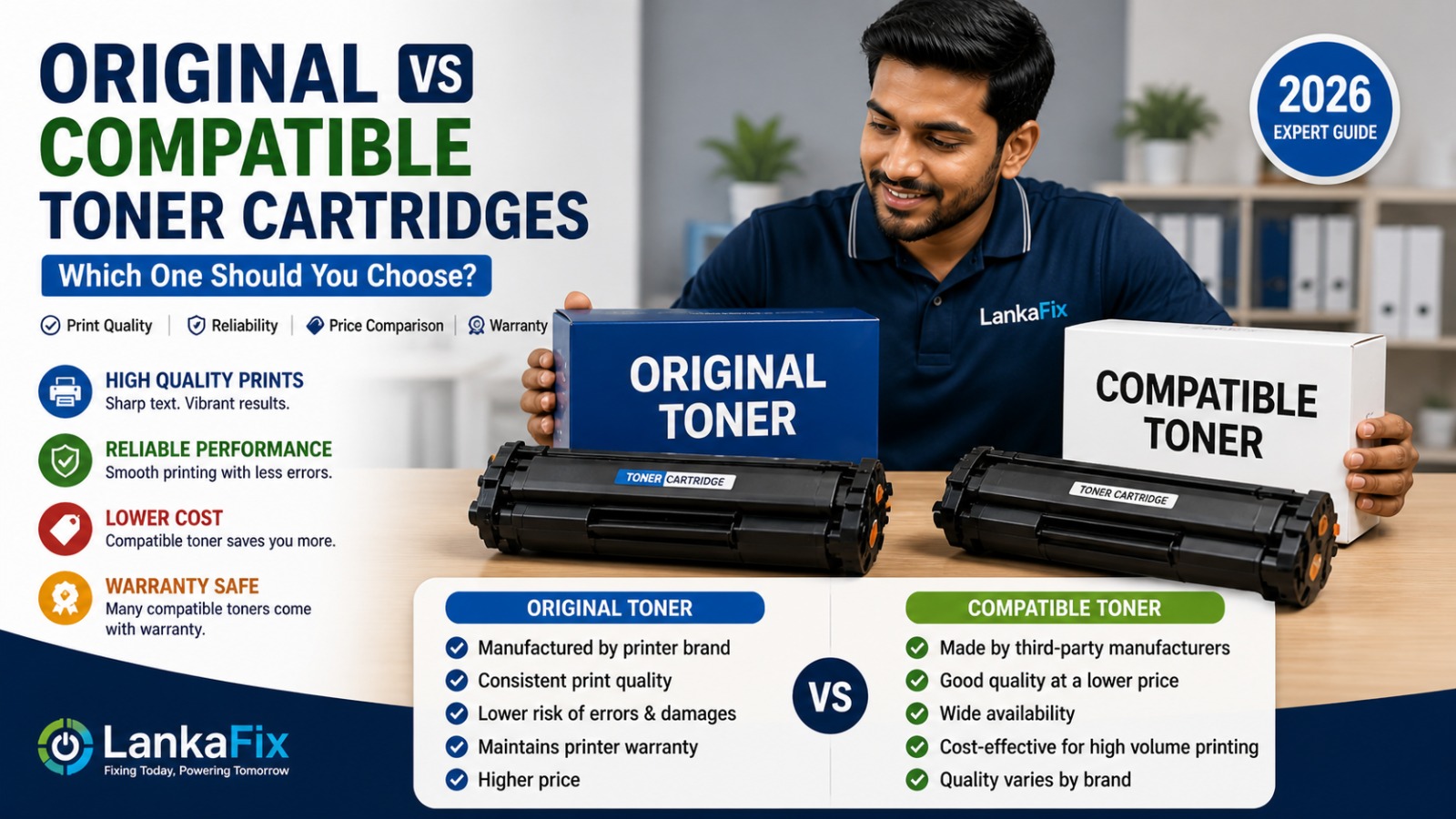
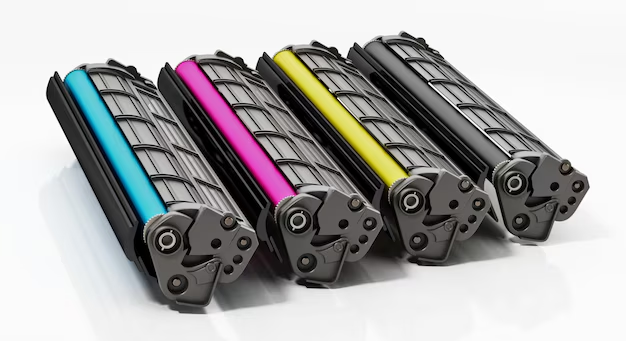
Choosing the right toner for your printer is one of the most important decisions for businesses and home users in Sri Lanka. Many customers wonder whether to buy Original Equipment Manufacturer (OEM) toner or compatible toner cartridges. This comprehensive guide explains the differences, costs, benefits, risks, and practical recommendations to help you make an informed decision.
What Is Original (OEM) Toner?
Original toner, also known as OEM toner, is manufactured by the same brand that produces the printer, such as Canon, HP, Epson, Brother, Xerox, Toshiba, or Pantum. These toners are designed specifically for the printer model and are tested to meet manufacturer standards for quality, performance, and reliability.
What Is Compatible Toner?
Compatible toner is manufactured by third-party companies and designed to work with specific printer models. These cartridges are usually more affordable than OEM products and are widely used in offices to reduce printing costs. However, quality can vary depending on the manufacturer and production standards.
Key Differences Between Original and Compatible Toner
1. Print Quality – OEM toner generally delivers consistent and professional print results. 2. Reliability – OEM cartridges are less likely to cause printer errors or leakage. 3. Cost – Compatible toner is usually cheaper than OEM toner. 4. Warranty – Using OEM toner helps maintain printer warranty conditions. 5. Longevity – OEM toner typically lasts longer and performs consistently.
Cost Comparison in Sri Lanka (Estimated 2026)
The price difference between OEM and compatible toner varies depending on brand and model. Below is a general comparison example: – Original toner: LKR 9,000 – LKR 18,000 – Compatible toner: LKR 2,500 – LKR 6,500 Businesses must consider total cost of ownership, including maintenance and reliability.
Advantages of Original Toner
– High print quality and sharp text – Reliable performance with minimal downtime – Manufacturer warranty protection – Lower risk of printer damage – Consistent page yield and performance
Advantages of Compatible Toner
– Lower upfront cost – Suitable for high-volume printing environments – Widely available in the market – Cost-effective for budget-conscious users
Risks of Low-Quality Compatible Toner
Not all compatible toner is the same. Poor-quality cartridges may cause: – Print defects such as streaks or faded text – Toner leakage inside the printer – Damage to drum or fuser units – Frequent service calls – Reduced printer lifespan
When Should You Choose Original Toner?
Choose OEM toner if: – You require professional-quality prints – The printer is under warranty – The printer is used for official documents or contracts – Reliability and uptime are critical for your business
When Should You Choose Compatible Toner?
Choose compatible toner if: – You print large volumes daily – Cost reduction is a priority – The printer is out of warranty – You purchase from a trusted supplier with warranty support
How to Identify a Reliable Toner Supplier in Sri Lanka
1. Provides VAT invoices 2. Offers warranty or replacement guarantee 3. Supplies genuine or certified products 4. Has positive customer reviews 5. Provides technical support and after-sales service
Tips to Reduce Printing Costs Without Sacrificing Quality
1. Use the correct print settings 2. Maintain your printer regularly 3. Choose the right toner type for your usage 4. Avoid extremely cheap cartridges 5. Monitor monthly print volume
Conclusion
Both original and compatible toner have their advantages. The best choice depends on your printing volume, budget, and reliability requirements. Businesses should focus on long-term value rather than just the initial purchase price. Selecting the right toner supplier and maintaining your printer properly can significantly reduce costs and improve productivity.
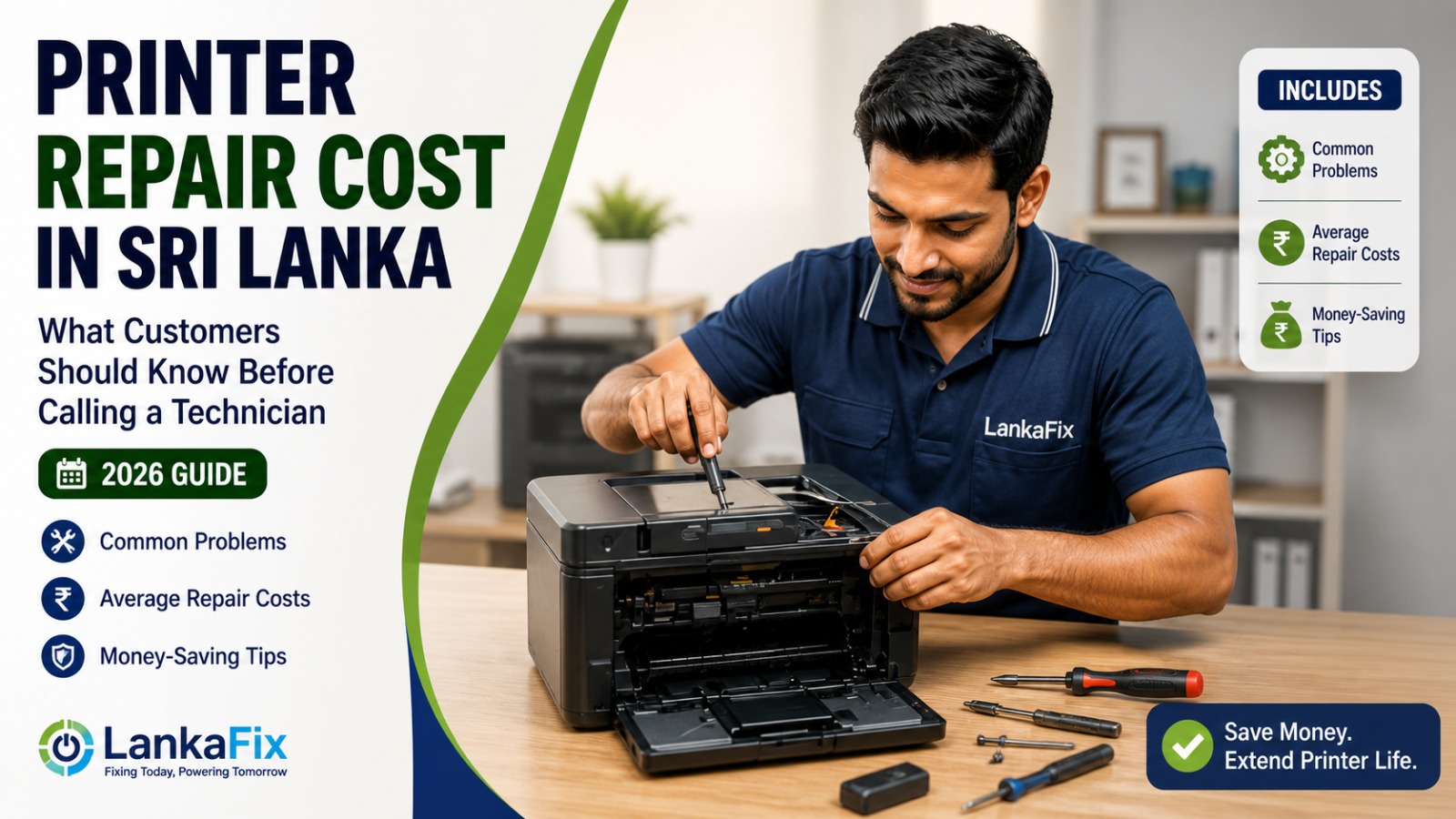
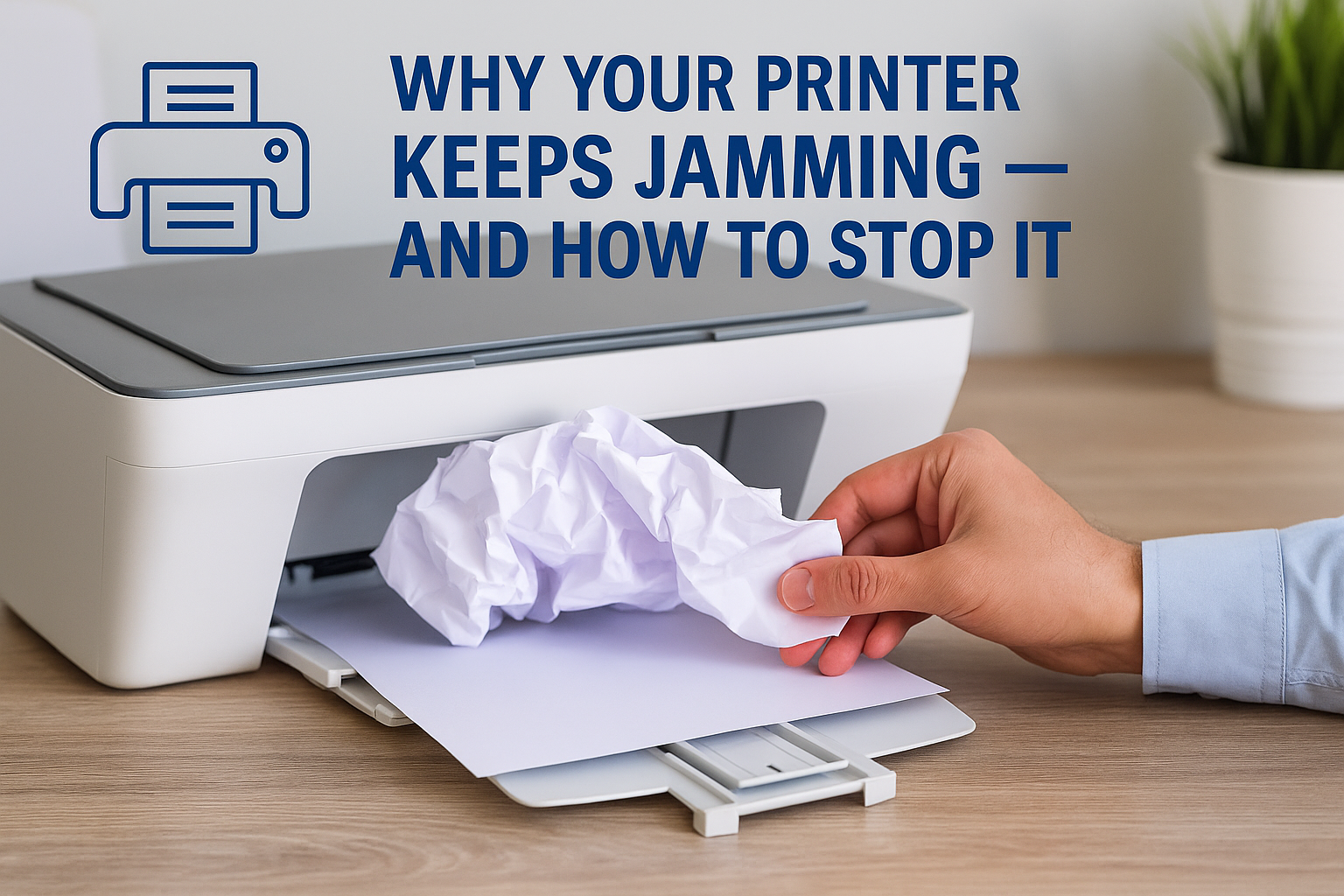
Printers are essential devices in homes, schools, and offices across Sri Lanka. However, like any machine, printers can develop faults due to wear and tear, dust, paper quality, power issues, or improper usage. Before calling a technician, many customers ask the same question: How much will printer repair cost in Sri Lanka? This comprehensive guide explains typical repair costs, common problems, service tips, and how to reduce long-term expenses.
Common Printer Problems in Sri Lanka
Some of the most frequent printer issues reported by customers include: – Paper jams and feeding errors – Faded or streaky print quality – Printer not powering on – Ink or toner cartridge recognition errors – Slow printing or connectivity issues – Scanner or copier malfunction – Wireless connection failure – Error messages on display panels
Average Printer Repair Cost in Sri Lanka (2026 Estimated Range)
Below is a general estimate of common printer repair costs in Sri Lanka. Prices may vary depending on brand, model, and location.
Factors That Affect Printer Repair Cost
Several factors determine the final repair cost: 1. Printer type (Inkjet vs Laser vs Copier) 2. Brand and model availability of spare parts 3. Severity of the fault 4. Whether parts need replacement 5. Technician travel distance 6. Urgency of repair (same-day or emergency service) 7. Warranty coverage status
When Should You Repair Instead of Replace?
Repair your printer if: – The repair cost is less than 50% of the printer value – The printer is less than 5 years old – Spare parts are readily available – The printer is a business-critical device
Consider replacing your printer if: – The repair cost exceeds the printer value – The device is very old or discontinued – Frequent breakdowns occur – Energy consumption is too high
Tips to Reduce Printer Repair Costs
1. Use genuine ink and toner 2. Clean the printer regularly 3. Avoid low-quality paper 4. Turn off the printer properly 5. Service the printer annually 6. Keep the printer in a dust-free environment 7. Avoid overloading paper trays
How Long Does Printer Repair Take in Sri Lanka?
Typical repair time ranges from 30 minutes to 48 hours depending on the issue: – Minor issue: 30–60 minutes – Medium repair: 2–4 hours – Major repair with parts replacement: 1–2 days
Why Choose a Professional Printer Technician
Hiring a qualified technician ensures: – Accurate diagnosis – Safe repair procedures – Warranty protection – Genuine spare parts usage – Reduced risk of future breakdowns
Conclusion
Understanding printer repair costs helps customers make informed decisions and avoid unexpected expenses. Regular maintenance and early troubleshooting can significantly extend the lifespan of your printer and reduce downtime.
A slow laptop or PC is one of the most frustrating tech problems faced by Sri Lankan users—students, office workers, freelancers, business owners, gamers, and even home users. Whether you bought your device recently or several years ago, slow performance can interrupt work, reduce productivity, and even damage internal components if ignored.
The good news? In 2025, more than 80% of slow laptops in Sri Lanka can be fixed easily without replacing the device.
This guide by LankaFix Tech Tips & Trends explains why laptops slow down, how to fix them step-by-step, which upgrades offer the highest performance boost, and when you should consider professional assistance.
1. Why Laptops Slow Down (Sri Lanka 2025)
There are 10 common reasons why laptops and PCs slow down in Sri Lanka:
A slow laptop doesn’t mean it’s time for a replacement. In Sri Lanka, more than 80% of slow devices can be revived with simple upgrades, cleaning, and optimization—often at a fraction of the cost of buying new.
By understanding the causes, applying the right fixes, and relying on trusted professionals through LankaFix, you can extend your device’s life, improve speed, and save money.
Fast, smooth, efficient tech begins with proper care—and LankaFix is here to help you every step of the way.
Smart homes are no longer a futuristic luxury. In 2025, Sri Lankan families—from Colombo apartments to rural homes in Kurunegala—are rapidly adopting smart devices to improve comfort, security, and energy savings. Unlike years ago, building a smart home no longer requires expensive hubs, complex wiring, or premium gadgets worth thousands of rupees.
Today, with just Rs. 50,000, any household can create a modern, connected, energy-efficient living environment using affordable smart devices compatible with Wi-Fi, Google Assistant, Alexa, and smartphone apps.
This complete LankaFix guide explains how to build a smart home under Rs. 50,000, which devices to choose, how to install them, and how to find trusted smart home service providers in Sri Lanka.
1. Why Smart Home Technology Is Growing Fast in Sri Lanka (2025)
Several factors are driving the boom:
1. Affordable Smart Devices
Brands like TP-Link, Xiaomi, Tapo, IMOU, Ezviz, and Tuya have made automation extremely accessible.
2. Increased Internet Penetration
Fiber broadband, 4G++, 5G pilots, and Starlink coverage have improved connectivity islandwide.
3. Remote Monitoring Demand
From checking on kids to monitoring properties and pets, families want smarter solutions.
4. Rising Energy Costs
Smart devices help reduce electricity usage with timers, schedules, and consumption insights.
5. Easy DIY Installation
Most smart home devices only require: ✔ Wi-Fi ✔ Smartphone ✔ Basic setup ✔ LankaFix technician support (optional)
2. What Can You Automate for Under Rs. 50,000?
Here is what a Sri Lankan family realistically can achieve on a budget:
Smart lighting for the living room or bedrooms
Remote control for appliances (AC, fans, TV, iron, water pump)
Automated curtain opening/closing
CCTV camera monitoring
Smart door locks
Motion sensors for security
Gas leak alarms
Smart plugs and scheduling
Wi-Fi control of the entire home environment
All of these can be achieved in the 50,000 or less price bracket.
Let’s break down the best value-for-money options.
3. Top 10 Budget Smart Home Devices for Sri Lankan Families (2025)
These devices are chosen based on affordability, durability, brand reliability, and local availability.
1. Smart Bulbs (Rs. 1,500–3,500 each)
Brands: Tapo, Xiaomi Mi, Philips Wiz
What it does:
Change brightness
Change color
Control via smartphone
Schedules for morning/evening
Ideal for bedrooms & living rooms
Best For:
Families wanting to start small.
2. Smart Wi-Fi Plugs (Rs. 2,000–4,000 each)
Brands: TP-Link Tapo, Xiaomi, Tuya
What it does:
Turns appliances on/off
Energy monitoring
Timers for iron, kettle, rice cooker
Perfect for preventing small fires
Best For:
AC
Fans
Water heaters
Fish tanks
Christmas lights
3. Smart LED Light Strips (Rs. 2,500–6,000)
Ideal for modern ambience.
What it does:
Room illumination from under TVs, desks, beds
RGB colors
Music sync modes
A popular choice in Sri Lankan apartments.
4. Smart IR Remote Controller (Rs. 4,500–7,000)
Brands: BroadLink, Xiaomi, Tapo
What it does:
Control non-smart appliances such as:
TV
AC
Set-top box
Home theatre
DVD player
Best For:
Homes with older appliances that need modern control.
5. Wi-Fi Security Cameras (Rs. 6,000–18,000)
Brands: IMOU, Ezviz, Tapo, Xiaomi
What it does:
Live view
Motion alerts
360° rotation (PTZ models)
Night vision
Cloud or SD recording
Best For:
Indoor monitoring of babies, elderly, or house staff.
6. Smart Door Sensors (Rs. 2,500–5,000)
Alerts when windows or doors open.
Best For:
Home security
Child safety
7. Smart Motion Sensors (Rs. 2,500–5,500)
Automatically turn lights on/off.
8. Wi-Fi Gas Leak Detectors (Rs. 4,500–8,000)
Alerts on LPG leakage.
Best For:
Kitchens and small restaurants.
9. Automated Curtain Motor (Rs. 15,000–35,000)
Smart curtain systems have become massively popular in Sri Lanka.
What it does:
Remote open/close
Schedule at sunrise
Voice control
10. Smart Door Lock (Rs. 18,000–45,000)
Fingerprint + PIN + RFID + Wi-Fi unlock.
Best For:
Apartments, private rooms, and home offices.
4. Smart Home Under Rs. 50,000 — Three Complete Packages (LankaFix Recommended)
Below are specially-designed budget packages for real Sri Lankan families.
PACKAGE 1: Smart Starter Kit (Rs. 18,000–25,000)
Perfect for beginners.
Includes:
2 × Smart Bulbs
1 × Smart Wi-Fi Plug
1 × Smart Indoor Camera
1 × Smart IR Remote
Benefits:
Control lights via phone
Control TV/AC from anywhere
See inside your home
Energy savings
Zero wiring
PACKAGE 2: Family Smart Home Kit (Rs. 35,000–45,000)
Designed for families with children or elderly parents.
Includes:
3 × Smart Bulbs
1 × Smart Camera (PTZ)
2 × Smart Plugs
1 × Door Sensor
1 × Smart IR Remote
Benefits:
Full living room automation
Night mode for kids
Safety alerts
Energy monitoring
Simple setup
PACKAGE 3: Modern Apartment Automation Kit (Rs. 40,000–50,000)
Perfect for new apartments in Colombo, Kandy, or Galle.
Includes:
2 × Smart Bulbs
1 × LED Strip
1 × Smart Door Lock (budget)
1 × Smart IR Remote
1 × Motion Sensor
Benefits:
Stylish ambience
Modern entry security
App automation
Zero wiring
5. How to Set Up a Smart Home (Step-by-Step Guide)
Smart home installation is easier than most people think.
Step 1: Check Your Wi-Fi Coverage
Minimum requirement:
2.4 GHz Wi-Fi (most devices need this)
10–20 Mbps connection
Step 2: Choose Your Smart Home App Ecosystem
Most devices now support:
Google Home
Alexa
Tapo
Mi Home
Tuya Smart
Pick one ecosystem and stick to it.
Step 3: Start With the Most Useful Devices
Recommended order:
Smart bulb
IR remote
Smart plug
Smart camera
Door sensor
Step 4: Automate Based on Your Routine
Examples:
6:00 AM — Curtains open automatically
7:00 PM — Lights turn on
10:00 PM — AC turns off
When leaving home — All devices turn off
Step 5: Add Security Features
Cameras
Door sensors
Motion alarms
Smart locks
6. Benefits of Smart Homes for Sri Lankan Families
1. Energy Savings
Smart plugs and schedules reduce wasted electricity.
2. Safety & Monitoring
Monitor kids, elderly parents, and pets from anywhere.
3. Convenience & Comfort
Control your home through your phone or voice assistant.
Cause: Poor bandwidth Solution: Ensure 2.4 GHz split band
Problem 3: App synchronization problem
Cause: Multi-ecosystem mixing Solution: Use 1–2 main ecosystems only
8. Smart Home Security Tips for Sri Lanka
Change default passwords
Use strong Wi-Fi passwords
Enable 2FA
Avoid unknown brand devices
Update firmware regularly
Secure camera placement
9. Cost to Maintain a Smart Home in Sri Lanka
Maintenance is minimal.
Device replacement (very rare): Rs. 1,500–15,000
Electricity usage: Ultra-low
Occasional technician help: Rs. 1,500–3,000
LankaFix service providers: On-demand support
10. How LankaFix Helps You Build a Smart Home
LankaFix connects you with trusted Smart Home installers across Sri Lanka.
What You Get Through LankaFix:
Verified installers
Genuine devices
Competitive prices
Installation + configuration
Routine maintenance
WhatsApp support
Consultation on best devices
Apartment and house automation plans
Whether you want to automate a single room or your whole home, LankaFix provides the most convenient, trustworthy path.
Conclusion
Smart home technology is now fully accessible to Sri Lankan families. With just Rs. 50,000, any household can enjoy modern automation, improved security, and energy-saving features that enhance everyday living.
The key is choosing the right devices, installing them correctly, and using a reliable service network—exactly what LankaFix provides.
Transform your home into a smart, modern, connected environment — affordably and safely.
keywords: smart home on a budget, smart home under 50000, budget smart home ideas, affordable smart home, cheap smart home setup, smart home Sri Lanka, Sri Lanka smart home 2025, low cost home automation, budget home automation system, smart home for families, smart home for apartments, smart home for small houses, WiFi smart home devices, smart home without wiring, DIY smart home setup, smart home for beginners, best smart home devices 2025, budget smart devices Sri Lanka, cheap smart devices Sri Lanka, smart lighting system Sri Lanka, smart bulb Sri Lanka, WiFi smart bulb, smart plug Sri Lanka, WiFi smart plug, smart IR remote Sri Lanka, smart curtain motor Sri Lanka, smart door lock Sri Lanka, fingerprint door lock Sri Lanka, smart security camera Sri Lanka, WiFi CCTV Sri Lanka, indoor security camera Sri Lanka, motion sensor Sri Lanka, smart motion sensor, smart door sensor Sri Lanka, gas leak detector Sri Lanka, WiFi gas detector, home security automation Sri Lanka, smart home security system, budget home security system, smart lock for apartment, smart home for renters, smart home for homeowners, Google Home compatible devices, Alexa smart home devices, Tuya smart home system, Mi Home smart devices, Tapo smart devices Sri Lanka, IMOU camera Sri Lanka, Ezviz camera Sri Lanka, TP-Link smart plug Sri Lanka, Xiaomi smart home Sri Lanka, smart home energy saving, smart home electricity saving, smart home timers, scheduled home automation, voice control smart home, smartphone controlled home, remote home monitoring, home automation for kids safety, elderly monitoring smart home, pet monitoring camera Sri Lanka, smart home installation Sri Lanka, smart home setup guide Sri Lanka, smart home packages Sri Lanka, smart home starter kit Sri Lanka, family smart home package, apartment automation Sri Lanka, modern apartment smart home, smart home under budget Sri Lanka, smart home cost Sri Lanka, smart home maintenance cost Sri Lanka, smart home troubleshooting Sri Lanka, smart home WiFi problems, smart home security tips, smart home password safety, home automation service Sri Lanka, smart home technicians Sri Lanka, LankaFix smart home, LankaFix automation, smart home installers Sri Lanka, home automation company Sri Lanka, smart house Sri Lanka, connected home Sri Lanka, internet of things home Sri Lanka, IoT smart home Sri Lanka, smart living Sri Lanka, future home technology Sri Lanka, home automation 2025, smart home trends 2025, budget smart home 2025
In 2025, Sri Lankan families, students, and small businesses are facing a very real problem:
Printing costs are rising every year.
Genuine cartridges are expensive. Ink tanks require high up-front investment. Cheap refills damage printheads. And many homes use printers that are not designed for frequent printing.
But today, for the first time in Sri Lanka, there is a proven, engineered, and warranty-protected solution that brings printing costs down to Rs. 1.50 per page — without the risks of traditional refills or low-grade CISS kits.
That solution is:
SmartFix XRC — Extended Refill & Control
A revolutionary printing upgrade program that transforms Canon and HP cartridge printers into high-efficiency, high-yield, low-cost printing machines, delivering:
95% cost savings
4,500–6,000 pages per refill cycle
Smart auto-reset technology
Humidity-calibrated ink system
2-Year SmartFix Warranty
Better durability than ink tanks
Cheaper monthly cost than any other printing method in Sri Lanka
This article explains how XRC works, who it’s ideal for, how much you save, and why it is the future of home and SME printing.
1. Why Are Printing Costs So High in Sri Lanka?
To understand why the XRC system is a breakthrough, you must first understand why printing is expensive for many Sri Lankan households.
1. Genuine cartridges are expensive
Canon PG-47: Rs. 4,500–6,500
Canon CL-57: Rs. 7,500–11,500
HP 680/682: Rs. 6,500–10,000
Average cost per page: Rs. 12–25
2. Ink tank printers require high initial investment
Canon G2430 / G3411 / G3010: Rs. 50,000–85,000
Some advanced models exceed Rs. 100,000
Not ideal for families who need an affordable entry point.
3. Local refill inks damage printheads
Cheap aftermarket inks cause:
Printhead burn
Blocked nozzles
Ink bleeding
Permanent damage
Repair cost: Rs. 12,000–25,000
4. Idle usage destroys ink tanks
Most Sri Lankan households print only occasionally.
Ink tanks require consistent usage, or else printheads dry and burn.
5. Sri Lanka’s humidity ruins cheap refills
Humidity causes:
Ink expansion
Color imbalance
Cartridge swelling
Pressure issues
This is why 60–70% of cheap CISS kits fail within 3–6 months.
These problems created a massive gap in the market — until SmartFix XRC arrived.
2. What Is SmartFix XRC? (Extended Refill & Control)
SmartFix XRC is Sri Lanka’s first engineered upgrade system designed to give cartridge printers the same low-cost efficiency as high-end ink tank printers — but with more reliability.
XRC Is NOT:
✘ Not a cheap CISS ✘ Not a low-quality refill ✘ Not a risky DIY modification ✘ Not a temporary hack
XRC IS:
✔ A professionally engineered upgrade ✔ A humidity-calibrated refill ecosystem ✔ A chip-controlled system with auto-reset ✔ A pressure-balanced tank mechanism ✔ Carried out by trained SmartFix technicians ✔ Comes with a 2-year warranty
It transforms your existing printer into a 6,000-page powerhouse with Rs. 1.50 printing.
3. Which Printers Are Compatible With XRC?
Canon Ink Efficient Series
Canon E410
Canon E470
Canon E480
Canon TS3640
Canon MG2570S
These printers use PG-47 and CL-57 cartridges, making them perfect for XRC upgrades.
HP Ink Advantage Series
HP 680
HP 682
Popular in Sri Lanka for students and homes.
4. How SmartFix XRC Works (Technical Breakdown)
XRC is based on 4 engineering components:
1. External Tank with Controlled Pressure System
Unlike traditional CISS systems that force ink into the printhead, XRC uses a balanced pressure chamber, ensuring:
No over-supply
No ink starvation
No leakage
You get cleaner, more reliable printing.
2. Smart Auto-Reset Chip
Cartridge printers require chip recognition.
SmartFix engineers integrate a chip that auto-resets, allowing:
Continuous printing
No error messages
No “ink low” warnings
Seamless monitoring
This eliminates 80% of the typical cartridge frustration.
3. Humidity-Calibrated Ink Formula
Sri Lanka’s humidity causes swelling, clogging, and printhead damage.
SmartFix XRC uses a calibrated ink blend engineered to resist:
High humidity
Salt in coastal regions
Temperature fluctuations
This protects the printhead long-term.
4. Warranty-Protected Installation
Only certified XRC technicians perform:
Carriage pressure calibration
Nozzle alignment
Tube tension balancing
Colour indexing
Printhead temperature monitoring
This ensures a professional, safe installation, protected by a 2-Year Warranty on:
Tank
Tubes
Calibration
Chip
Labour
5. Real Cost Savings: XRC vs Ink Tank vs Cartridges
Cost Per Page Comparison (2025)
Printing Method
Cost Per Page
Page Yield
Genuine Cartridge
Rs. 12–25
150–400 pages
Compatible Cartridge
Rs. 8–12
200–400 pages
Ink Tank Printer
Rs. 1.50–2.00
5,000–7,000 pages
SmartFix XRC
Rs. 1.50
4,500–6,000 pages
Sample Monthly Cost (200 pages/month)
Method
Monthly Cost
Annual Cost
Genuine Cartridge
Rs. 2,400–5,000
Rs. 28,000–60,000
Compatible Cartridge
Rs. 1,600–2,400
Rs. 19,000–28,000
Ink Tank
Rs. 300–400
Rs. 3,600–4,800
SmartFix XRC
Rs. 300
Rs. 3,600
Savings with XRC:
✔ Up to 95% vs cartridges ✔ Up to 90% vs compatible cartridges ✔ Same running cost as ink tanks ✔ Lower repair cost than ink tanks ✔ No printhead damage
6. Why XRC Is Better Than Ink Tank Printing
Ink tanks are good—until they fail.
Ink tank printheads burn due to:
Infrequent printing
Cheap refill inks
Idle periods
Humidity clogging
Ink starvation
XRC solves all of these.
XRC Advantages Over Ink Tanks:
✔ No printhead burn ✔ No costly printhead replacements ✔ No mandatory weekly printing ✔ No idle damage ✔ Lower capital investment ✔ Lower repair risk ✔ Better for households & students
7. Who Should Upgrade to SmartFix XRC?
The XRC program is the ideal solution for:
1. Students
Assignments School work Tuition handouts Project printouts
Recommended Printers:
Canon E410
Canon MG2570S
HP Ink Advantage
XRC gives Rs. 1.50 per page, ideal for monthly school printing.
2. Homes & Families
Home documents Family albums Kids’ homework Airline tickets Boarding passes
With proper care, XRC printers last 3–5 years easily.
12. How LankaFix Helps You with XRC Installation & Support
SmartFix XRC is exclusively available through the LankaFix partner network, ensuring:
✔ Certified Technicians
✔ Genuine XRC systems
✔ 2-Year Warranty
✔ Islandwide coverage
✔ Transparent pricing
✔ Fast installation
✔ Online booking
✔ WhatsApp consultations
✔ After-sales support
LankaFix connects you with the country’s best repair and installation specialists.
13. Final Summary
SmartFix XRC is Sri Lanka’s most powerful, affordable, and reliable printing solution for 2025, delivering:
⭐ 95% reduced printing cost
⭐ Rs. 1.50 per page
⭐ 4,500–6,000 page yield
⭐ Safe, engineered, professional system
⭐ 2-Year Warranty
⭐ Compatible with Canon & HP printers
⭐ No printhead damage
⭐ Perfect for students, homes, and SMEs
Printing has never been this affordable, convenient, or stress-free.
Conclusion
Sri Lanka finally has a printing solution designed for real Sri Lankan needs — high humidity, tight budgets, student printing loads, and low-frequency usage.
With XRC, printing becomes:
Cheaper
Safer
More durable
More consistent
More reliable
And LankaFix ensures the entire journey—from installation to aftercare—is handled by professionals.
Keyword: low cost printing, cheap printing, reduce printing cost, printing cost saving, cheapest printing solution, low cost printer solution, budget printing system, how to reduce printer ink cost, cheapest way to print at home, affordable printing for students, low cost printing for small business, home printing cost reduction, printing cost per page, cheapest printer running cost, best printer for low cost printing, Canon low cost printing solution, HP low cost ink system, Canon cartridge refill system, HP cartridge refill system, Canon PG-47 refill system, Canon CL-57 refill solution, HP 680 refill system, HP 682 refill system, best refill system for Canon printers, best refill system for HP printers, student printing solution, cheap printing for students, home printer low ink cost, best printer for school work, low cost homework printing, tuition printing solution, assignment printing low cost, student budget printing, small business printing solution, cheap invoice printing, low cost label printing, printing solution for online sellers, courier label printing low cost, billing printing low cost, business document printing cheap, cartridge vs ink tank printer cost, printhead damage solution, CISS vs cartridge refill, printing cost per page comparison, printer maintenance cost, ink tank vs cartridge printer, cheap ink damage solution, humidity safe ink system, save 95% printing cost, Rs 1.50 printing per page, cheapest printing in Sri Lanka, low cost printing trick, secret to low cost printing, printing life hack, reduce printing bill fast, printer cost saving hack, low cost printing system, budget printer upgrade, smart refill system for printers, cartridge printing cost solution, low cost printing technology, refill system for home printers, advanced cartridge refill system, smart ink refill technology, cheapest printer ink, budget printing system for home, low cost printing for office, cheap office printing solution, printer ink saving tips, refill vs cartridge cost, affordable printing technology, best refill ink system, student home printing setup, low investment printing business, low cost bulk printing, high yield printing solution, cartridge printer upgrade, printer ink cost reduction, cheap color printing solution, monochrome printing low cost, refill ink system comparison, best printer ink alternative, printer refill business keywords, low maintenance printing solution, smart printing system 2025, next generation printing solution
Security is no longer a luxury—it is a necessity. With rising concerns around burglary, theft, workplace misconduct, property disputes, and home safety, the demand for reliable CCTV surveillance systems in Sri Lanka has grown rapidly. Whether it is a small shop in Maharagama, a café in Kandy, a warehouse in Ja-Ela, or a home in Galle, Sri Lankans increasingly rely on CCTV to protect their families, belongings, and businesses.
Yet, many consumers still struggle with three critical questions:
1. Which CCTV system should I buy?
2. How much will it cost in Sri Lanka?
3. Who can install it properly and reliably?
This comprehensive 2025 Sri Lanka guide—powered by LankaFix.com—provides a complete breakdown of CCTV types, features, pricing, installation guidelines, and expert recommendations for households and SMEs.
1. Why CCTV Has Become Essential in Sri Lanka (2025)
a) Increasing Safety Awareness
From homes to retail stores, people are more aware of burglary risks, employee misconduct, vandalism, and neighborhood disputes.
b) Insurance & Legal Protection
Video evidence is often required by insurance companies or during police investigations.
c) Remote Monitoring Is Now Easy
Thanks to 4G, 5G, and fibre internet, users can monitor homes and shops from anywhere.
d) Affordable Prices & High-Quality Options
CCTV systems are no longer expensive. Good-quality 4-camera packages start from Rs. 45,000–75,000.
e) Peace of Mind
Parents monitor children at home, business owners monitor staff, and shop owners monitor customers and cashier counters.
CCTV is now a daily life necessity, not a luxury.
2. CCTV System Types in Sri Lanka (2025 Comparison)
There are two main categories:
A) DVR-Based (Analog) CCTV Systems
These use coaxial cables (BNC) and a DVR recorder.
Pros:
Affordable
Stable recording
Long cable distances
Great for shops, homes, small offices
Cons:
Slightly lower clarity than IP
Harder to expand beyond 8–16 channels
Best For:
Homes
Retail shops
Basic surveillance
Indoor and outdoor coverage
B) NVR-Based (IP Camera) Systems
These use LAN cables and an NVR recorder.
Pros:
High-quality video (2MP–8MP, even 4K)
Easy expansion
Smart features (AI motion detection, face detection, line crossing)
Cons:
More expensive
Requires network knowledge
Best For:
Large houses
Offices with multiple floors
Warehouses
High-security environments
Smart home setups
3. Camera Types & Which One You Should Choose
Understanding camera types is important for coverage and clarity.
1. Dome Cameras
Stylish, compact
Ideal for indoor
People cannot identify direction of lens
Best For: Living rooms, offices, corridors.
2. Bullet Cameras
Long-range
Good for outdoors
Visible deterrent
Best For: Gates, gardens, parking areas, boundary walls.
3. PTZ Cameras (Pan-Tilt-Zoom)
Remote movement
360° coverage
Zoom capability
Ideal for monitoring large areas
Best For: Warehouses, parking lots, large houses, apartments.
4. Wi-Fi Cameras (Standalone Intelligent Cams)
No DVR/NVR needed
Connects to home Wi-Fi
Cloud/mobile recording
Best For:
Inside rooms
Small households
Baby monitoring
Elderly monitoring
4. Key Features to Look for in a CCTV System (2025)
1. Camera Resolution (Clarity)
2MP (1080p) – basic and affordable
4MP – clearer
5MP Ultra HD – highly recommended
8MP / 4K – premium solution
Recommended for 2025:5MP for Home & SME
2. Night Vision (IR Range)
Vital for outdoor recording.
IR 20m – basic
IR 40m – mid-range
IR 60m+ – premium cameras
3. Storage Capacity (HDD)
The heart of your system.
For continuous 24/7 recording:
Cameras
HDD Size
4 Cams
1TB – 2TB
8 Cams
2TB – 4TB
16 Cams
4TB – 6TB
4. Mobile App Access
Check for:
Live view
Playback
Alerts
Multi-location access
Cloud backup
Brands like Hikvision, Dahua, and Ezviz offer excellent apps.
7. How Many Cameras Do You Need? (House & SME Guide)
For Homes in Sri Lanka:
Gate / entrance
Living room
Back yard
Staircase or hallway
Total recommended:3–4 cameras
For Small Businesses:
Entrance
Cashier counter
Stock room
Staff area
Total recommended:4–6 cameras
For Offices (Multiple Floors):
Reception
Workspaces
Pantry area
Server room
Parking area
Total recommended:8–16 cameras
8. DVR vs NVR — Which Should You Choose?
Feature
DVR (Analog)
NVR (IP)
Video Quality
Good
Excellent
Cost
Low
Moderate
Installation
Easy
Requires network knowledge
Scalability
Limited
Highly scalable
Best For
Homes, shops
Offices, warehouses
Recommendation:
Homes & Small Shops → DVR
SMEs & Large Houses → NVR
9. How to Choose the Right CCTV System (Step-by-Step)
Step 1: Identify your purpose
Home safety?
Business surveillance?
Staff monitoring?
Property protection?
Step 2: Decide the number of cameras
Step 3: Select camera resolution
Step 4: Choose between DVR or NVR
Step 5: Plan cable routes & storage requirements
Step 6: Ensure stable internet for remote viewing
Step 7: Select a trusted installation partner
10. Common CCTV Problems in Sri Lanka (And Solutions)
1. Night vision not working
→ IR lights damaged, replace camera.
2. Cameras not showing on mobile
→ Network configuration required.
3. No recording after power outage
→ HDD or power supply issue.
4. Blurry images during daytime
→ Lens focus issue or dirty housing.
5. Frequent disconnections (Wi-Fi cameras)
→ Weak router signal; consider LAN cameras.
11. How LankaFix.com Helps You Get the Best CCTV Solution
LankaFix is Sri Lanka’s growing Tech Services Marketplace, connecting consumers with the most reliable, verified, and professional CCTV service providers island-wide.
With LankaFix, you get:
Trusted installation partners
Competitive pricing
Genuine products
Faster service
Skilled technicians
Full islandwide coverage
Customer support
CCTV maintenance plans
Mobile-friendly booking system
Verified partner performance ratings
Services Available:
New CCTV installation
CCTV repairs
Monthly maintenance
Network setup
DVR/NVR replacement
Smart Wi-Fi camera installation
Cable rewiring
Remote access configuration
LankaFix ensures you receive quality, reliability, and safety—all in one platform.
12. Final Recommendations (2025 Summary)
For Homes:
4-channel DVR system
5MP cameras
1TB storage
2 outdoor + 2 indoor cameras
Mobile app monitoring
For Small Businesses:
4–8 channel DVR/NVR
5MP+ cameras
2TB storage
Strong night vision
Cashier-focused cameras
For Offices / SMEs:
8–16 channel NVR
5MP–8MP cameras
PTZ cameras for outdoor areas
AI alerts
Secure networking
Conclusion
CCTV is one of the smartest and most reliable security investments any Sri Lankan household or business can make in 2025. With affordable technology, higher clarity, mobile monitoring, and professional service availability, choosing the right system is now easier than ever.
However, successful CCTV setup requires:
The right system
The right technology
The right installation partner
LankaFix ensures access to the best installers, competitive prices, and trusted support—making your home or business safer, smarter, and better protected.
keywords:home CCTV, business CCTV, CCTV installation guide, CCTV systems, CCTV cost 2025, DVR CCTV, NVR CCTV, IP camera, analog CCTV, WiFi security camera, best CCTV, affordable CCTV, CCTV camera price, CCTV packages, CCTV maintenance, CCTV repair, CCTV monitoring, remote CCTV access, mobile CCTV app, CCTV for home, CCTV for small business, CCTV for office, CCTV for shop, CCTV for warehouse, CCTV for apartment, CCTV dome camera, CCTV bullet camera, CCTV PTZ camera, CCTV night vision, CCTV 2MP camera, CCTV 4MP camera, CCTV 5MP camera, CCTV 8MP camera, CCTV 4K camera, IP66 waterproof camera, IP67 CCTV camera, CCTV motion detection, CCTV face detection, CCTV AI detection, CCTV intrusion alert, CCTV line crossing alert, CCTV recording system, CCTV storage HDD, CCTV network setup, CCTV cabling, CCTV installation cost, CCTV labour cost, security camera guide, home security cameras, business security cameras, smart home security, video surveillance, remote video surveillance, CCTV troubleshooting, CCTV upgrade, CCTV brand, CCTV deals, cheap CCTV, affordable home security, CCTV for shops, CCTV for restaurants, CCTV for retail, CCTV for warehouses, CCTV for offices, CCTV for parking, CCTV for gates, CCTV for driveways, CCTV for pets, CCTV for baby monitoring, CCTV for elder monitoring, surveillance camera buying guide, security camera upgrades, CCTV system comparison, CCTV vs smart cameras, wired CCTV system, wireless CCTV system.
For millions of Sri Lankan households, students, SMEs, and professionals, the printer has become an essential home and office device. Whether it’s printing school assignments, A4 invoices, tax documents, photo albums, or business proposals, a reliable printer is crucial for everyday productivity.
Yet by 2025, many consumers face a common dilemma:
As we approach 2025, the choice between Printer Repair and purchasing a new device has become increasingly relevant for many consumers.
“Should I repair my existing printer… or buy a brand-new one?”
With increasing usage, fluctuating ink/toner prices, economic shifts, and new technology such as SmartFix XRC emerging, making the right choice has become more complex—but also more important.
This guide also emphasizes that understanding the benefits of Printer Repair can significantly impact your decision-making process.
This comprehensive LankaFix guide offers a clear, data-driven, Sri Lanka–specific comparison of printing costs, repair value, longevity, and replacement options. Whether you own a Canon, HP, Epson, Brother, or Pantum printer, this guide will help you make the most cost-effective decision for 2025.
1. Understanding the Sri Lankan Printer Market in 2025
Understanding the Importance of Printer Repair in 2025
The Sri Lankan printing market has changed dramatically in the last 24 months. Economic factors, import regulations, supply shortages, and new printing technologies have reshaped how consumers evaluate printers.
Key Market Trends in 2025
Ink tank printers now dominate homes due to the belief that “ink tank = cheapest printing.”
Cartridge models are resurging through innovations like SmartFix XRC (Extended Refill & Control).
Repair services are booming, especially for printers older than 3 years.
Used and refurbished printers have become popular among small offices and freelancers.
Now let’s examine how each of these issues ties into the repair vs replacement decision.
3. When Repairing Is the Better Option
Repairing your printer is significantly cheaper and often practical when the printer is structurally sound, and parts are available.
Repair Makes Sense When:
✔ The cost of repair is less than 30–40% of the value of a new printer
Example: If a new Canon E410 costs Rs. 32,900 and repair is Rs. 6,000–10,000, repairing is still the most economical option.
✔ The printer is less than 3 years old
Most printers have a 3–5-year functional life when properly serviced.
✔ Only consumable parts are damaged
Paper roller
Sensors
Encoder strip
Printhead clogging (not burnt)
Carriage belt All these are straightforward repairs.
✔ You own a mid-range laser printer (Canon, HP, Brother)
Laser printers have long lifespans. A repair costing Rs. 5,000–12,000 is cheaper than replacing a Rs. 90,000–150,000 device.
✔ You use the printer regularly, avoiding ink drying issues
Daily/weekly users get excellent value from repairing.
✔ The printer is a business workhorse
If your business relies on printing (billing, courier labels, invoices), downtime is costly. Repairing is the quickest way to resume operations.
Average Repair Costs in Sri Lanka (2025)
Issue
Typical Cost (LKR)
Repair or Replace?
Paper feeding issue
2,500 – 6,000
Repair
Printhead cleaning
3,500 – 8,000
Repair
Printhead replacement
12,000 – 25,000
Replace for ink tank; repair for cartridge models
Power board repair
8,500 – 15,000
Depends on printer value
Firmware issue
1,500 – 3,500
Repair
Carriage unit issue
4,000 – 9,000
Repair
4. When Buying a New Printer Is the Better Option
🟥 1. When the printhead is permanently damaged (Ink Tank Models)
Ink tank models like G2010, G3010, G3411 suffer irreversible printhead damage from:
long idle periods
cheap refill inks
dried ink
burnt resistors due to clogs
Replacement Cost:
A printhead alone can cost Rs. 20,000–30,000, often making a new printer the smarter choice.
🟥 2. When major boards are burned
Motherboard
Formatter board
Logic board Repairing is extremely expensive and risky on older models.
🟥 3. When the printer is older than 4–5 years
Technology changes every 2–3 years. Older printers may be slow, noisy, and inefficient.
🟥 4. When genuine inks/toners become too costly
Example:
Canon GI-790 (ink tank bottle) is Rs. 4,000–5,500
Canon PG-47 cartridge was historically expensive
Laser toners (HP 117A, Canon 054) now cost Rs. 20,000–30,000
High consumable costs often justify switching to XRC or a cheaper-to-run printer.
🟥 5. When your print volume has increased
If your requirement changed from 50 pages/month to 300–800 pages, upgrading is more practical.
5. Cartridge Printers vs Ink Tank Printers vs XRC (2025 Cost Comparison)
This section is the MOST important for Lankan consumers.
Ink Tank Printers
Pros
Low cost per page (Rs. 1–2)
High page yields (6,000 prints)
Popular among students and SMEs
Cons
Vulnerable to printhead damage
High replacement cost if unused
Average Price: Rs. 50,000–85,000
Cartridge Printers
Pros
Low initial cost
Compact
Easy to maintain
No long idle damage
Cons
Higher cost per page
Frequent cartridge replacements
Average Price: Rs. 29,000–35,000
SmartFix XRC (Extended Refill & Control) — The Game Changer
Why XRC changes everything:
Cost per page as low as Rs. 1.50
Yields 4,500–6,000 pages per refill
No printhead damage
Works on budget cartridge models like Canon E410, E470, TS3640
High ROI for households & SMEs
Cheaper than both ink tank and genuine cartridges
XRC essentially turns a low-cost cartridge printer into a super-efficient printing machine.
Cost Comparison (2025)
Category
Cost Per Page
Monthly Printing Cost (200 pages)
Ink Tank (GI bottles)
Rs. 1.50–2.00
Rs. 300–400
Standard Cartridge
Rs. 8–20
Rs. 1,600–4,000
SmartFix XRC
Rs. 1.50
Rs. 300
6. Cost Benefit Analysis — Repair vs Replace
Here is a simple formula:
Repair your printer if:
Repair < 40% of new printer value
Printer < 3 years old
Only minor parts need replacing
Replace your printer if:
Repair > 50% of new printer value
Printhead damaged
Printer older than 4–5 years
You want lower long-term printing costs
7. Printer Recommendations Based on User Type
For Students
Best Option:
Canon E410 (with SmartFix XRC)
Canon G2430 (ink tank)
For Home Offices / Freelancers
Best Option:
Canon TS3640 (with XRC)
Canon G3010 / G3020
Brother DCP laser printers
For SMEs / Companies
Best Option:
Canon MF275dw (Laser)
HP LaserJet Pro series
Durable toner-based systems
8. Red Flags: When Not to Repair
Consider replacement if:
You’ve repaired the same issue more than twice
Parts are unavailable or obsolete
The printer overheats regularly
Ink leakage is severe
Motherboard repair is recommended
Print quality continues to degrade
9. How LankaFix.com Helps You Make the Best Decision
LankaFix is Sri Lanka’s emerging tech services marketplace, connecting you to the most trusted printer repair experts, genuine products, XRC systems, consumables, and professional advice.
With LankaFix, you can:
Diagnose your issue online
Compare repair quotes
Request a technician home visit
Buy genuine printers & ink
Upgrade to SmartFix XRC
Chat instantly with experts
One platform – all your printing needs.
10. Conclusion: Repair or Replace? Here’s the 2025 Verdict
Repair → if your issue is small, recent, and inexpensive
Replace → if your printer is old, inefficient, or heavily damaged
Choose XRC → if you want the lowest printing cost in Sri Lanka
Whether you own a home printer or manage a small business, your goal is simple: reliable, affordable, and hassle-free printing.
With the right choice—and LankaFix support—you can save money, increase efficiency, and avoid unnecessary breakdowns in 2025.
Understanding Printer Repair Options
keywords:printer repair, printer repair cost, printer repair service, printer troubleshooting, printer not printing, printhead cleaning, printhead replacement, cartridge printer, ink tank printer, inkjet printer, laser printer, toner refill, cartridge refill, printhead blockage, printer power board repair, printer motherboard repair, paper jam fix, printer maintenance, printer service center, printer diagnostics, printer connectivity issues, printer WiFi problem, printer firmware issue, cartridge recognition error, compatible cartridges, genuine cartridges, toner price, ink price, printer cost comparison, repair vs replace printer, when to repair printer, when to replace printer, cost per page comparison, printer page yield, high-yield cartridges, extended refill system, refillable ink system, printing cost 2025, print efficiency, printer longevity, printer lifespan, printer buying guide, best home printers, best office printers, student printer, SME printer, business printer, low-cost printing, economical printing solutions, ink drying problem, printhead damage, clogged printhead, printer roller issue, printer sensor issue, carriage belt issue, motherboard damage, power surge printer damage, printer overheating, used printers, refurbished printers, printer ROI, printer productivity, printer value guide, 2025 printer trends, global printer market, smart refill system, XRC refill system, printer upgrade guide, high-volume printing, low-volume printing, cost-effective printing, print quality issues, ink leakage problem, laser toner refill, extended cartridge life, printing technology 2025, budget printers, compact printers, multi-function printers, all-in-one printer, wireless printers, mobile printing, cloud printing.
When one or two players dominate a tech category, prices stay higher than they should, variety shrinks, and support can get… lazy. Sri Lanka’s open-market approach allows licensed, compliant non-exclusive importers to challenge that—lowering prices, widening choice, and improving service. This article explains the harm of monopoly pricing and how lawful open-market imports protect consumers.
Smart Office compliance at a glance (Sri Lanka): • TRCSL approvals where devices fall under RTTE/telecom scope • Import & Export Control licensing (as needed) • Ministry of Defence approvals (where applicable) • Correct HS classification and Customs clearance • VAT-registered with IRD and issuing Tax Invoices to eligible buyers. trc.gov.lkStep by Step TradeSrilanka Trade PortalSri Lanka Customs+2Sri Lanka Customs+2ird.gov.lk
1) Monopoly pricing: why it’s bad for consumers
Higher prices & restricted output: A dominant seller can keep prices above competitive levels, creating deadweight loss—society loses trades that would’ve happened at fairer prices. (Core result in competition economics.)
Less innovation & quality: With little rivalry, the incentive to upgrade products, keep parts in stock, and respond fast declines.
Worse service incentives: If customers can’t switch easily, service quality suffers. Sri Lanka’s consumer law explicitly aims to maintain and promote effective competition and ensure access to goods at competitive prices. Sri Lanka Customscaa.gov.lk
2) What “open-market, licensed importing” means (and why it matters)
Open-market policy doesn’t mean “anything goes.” It means more than one compliant player can import genuine goods—so long as they follow the rules:
Correct HS classification & duties at Sri Lanka Customs. (The Commodity Classification Branch and the National Tariff Guides govern HS coding.) Sri Lanka Customs+2Sri Lanka Customs+2
Import & Export Control licences where required. (Documented step-by-step procedures are published on Sri Lanka’s Trade Portal.) Srilanka Trade PortalStep by Step Trade+1
4) How licensed open-market imports fix monopoly pain points
a) Price pressure, not price wars When more compliant players compete, mark-ups compress. Consumers pay closer to the true landed-cost-plus-reasonable-margin, not a monopoly price.
b) Choice and availability Competition diversifies sourcing, reducing stockouts and letting buyers choose features/brands across price tiers.
c) Better service incentives If customers can switch, sellers have to earn retention—by stocking parts, giving clear warranty terms, and issuing proper documentation (VAT invoices, serial tracking).
All of this aligns with the CAA’s objective to maintain and promote effective competition and ensure access at competitive prices. Sri Lanka Customs
5) Smart Office’s compliance promise (what you can expect)
Right product, right paperwork
HS classification done right; duties and levies paid at clearance. Sri Lanka Customs+1
Import & Export Control licensing where required by the consolidated control lists. Srilanka Trade Portal
TRCSL approvals for RTTE/network gear (where applicable), so your devices are legally usable and safe. trc.gov.lk
VAT transparency—Tax Invoice issued (if you’re eligible), supporting your input VAT and audit trail. ird.gov.lk
Clear service & warranty—Smart Office states warranty terms up front and supports local servicing/parts to the extent permitted by brands and Sri Lankan law.
Fair pricing—Open-market competition without cutting corners.
6) Buyer’s checklist: getting the benefits without the risks
Ask for a VAT “Tax Invoice”. If the seller is VAT-registered, they must issue one; this matters for businesses claiming input VAT. ird.gov.lk
Check approvals for controlled items. For routers, PABXs, wireless gear, or anything that plugs into networks, ask about TRCSL Type Approval/clearance. trc.gov.lkStep by Step Trade
Don’t ignore paperwork. Missing HS/permits or no VAT invoice is a red flag—even if the sticker price looks low. Srilanka Trade Portal
7) TL;DR
Monopoly pricing hurts consumers via higher prices, less innovation, and weaker service.
Smart Office operates in that space—fully licensed and VAT-compliant—to deliver value-for-money without cutting corners.
Sources & Further Reading (Official/Primary)
Consumer Affairs Authority Act, No. 9 of 2003 — objects include promoting competition and ensuring access to goods at competitive prices. caa.gov.lk
Sri Lanka Customs — Commodity Classification Branch and National Imports Tariff guides on correct HS code usage and tariff structure. Sri Lanka Customs+1
In today’s fast-paced digital world, technology is the backbone of both personal and professional life. From smart home devices to office automation systems, the demand for innovative tech solutions is skyrocketing. However, with this surge comes a critical concern: authenticity and compliance. Counterfeit products, unlicensed software, and non-compliant hardware not only pose security risks but can also lead to legal troubles and financial losses. This is where Smart Office Pvt Ltd steps in as a beacon of reliability in Sri Lanka’s tech landscape. Through its platform, LankaFix, Smart Office ensures that every product and service delivered is licensed, legal, and trusted—empowering users with genuine tech under full compliance.
In this comprehensive article, we’ll explore the ethos behind Smart Office, the importance of compliance in tech, how the company achieves this standard, the benefits it offers to consumers and businesses, and real-world examples of its impact. Whether you’re a homeowner looking to automate your space or a business owner seeking robust IT solutions, understanding Smart Office’s approach can help you make informed, secure choices.
Understanding Smart Office: A Pioneer in Sri Lanka’s Tech Ecosystem
Smart Office Pvt Ltd, the driving force behind LankaFix.com, is a leading IT solutions provider based in Sri Lanka. Founded with a mission to deliver innovation and quality, the company specializes in smart home and office solutions, device repairs, CCTV installations, and a wide array of genuine tech products. Headquartered at No. 4/1, Woodland Avenue, Kohuwala, Nugegoda, Smart Office has built a reputation for reliability, offering services that range from electronics repair to custom tech integrations.
At its core, Smart Office is committed to transforming spaces into intelligent environments. Their product lineup includes smart office automation tools, money counters, CCTV systems, and more—all sourced from reputable manufacturers and backed by certifications like CE, RoHS, and FCC. Unlike fly-by-night vendors, Smart Office emphasizes full compliance with local and international regulations, ensuring that every item sold or serviced meets legal standards. This dedication stems from a deep understanding of the Sri Lankan market, where access to genuine tech can be challenging amid a prevalence of counterfeit goods.
The Critical Importance of Licensed and Legal Tech in Today’s World
Before diving into Smart Office’s methods, it’s essential to grasp why licensed, legal, and trusted tech matters. In an era where data breaches and cyber threats are rampant, using unlicensed software or hardware can expose users to vulnerabilities. For instance, pirated software often lacks security updates, making it a prime target for malware. Legally, businesses risk hefty fines for non-compliance with intellectual property laws, while individuals may face device failures or warranty voids.
In Sri Lanka, regulatory bodies like the Telecommunications Regulatory Commission (TRC) and the Consumer Affairs Authority enforce standards to protect consumers from subpar products. Genuine tech ensures:
Security and Reliability: Licensed products come with manufacturer support, updates, and warranties.
Environmental Compliance: Certifications like RoHS guarantee that devices are free from hazardous materials.
Economic Benefits: Investing in legal tech supports ethical supply chains and reduces long-term costs from repairs or replacements.
Smart Office addresses these pain points by prioritizing authenticity, helping users avoid the pitfalls of the gray market.
How Smart Office Ensures Genuine Tech Under Full Compliance
Smart Office’s approach to delivering licensed and legal tech is multifaceted, combining rigorous sourcing, expert services, and customer education. Here’s a breakdown of their key strategies:
1. Sourcing from Trusted Suppliers
Smart Office partners exclusively with authorized distributors and manufacturers to procure products. For example, their smart office devices, such as dedicated custom money counters, are certified and come with detailed specifications like countable paper sizes (50×110-90×190 mm) and hopper capacities (500pcs). This ensures every item is genuine, complete with original packaging, serial numbers, and compliance documentation.
2. Comprehensive Compliance Checks
Before any product reaches the customer, it undergoes stringent checks. Certifications such as CE (Conformité Européenne) for safety, RoHS for restriction of hazardous substances, and FCC for electromagnetic compatibility are non-negotiable. For services like CCTV installations, Smart Office conducts site assessments to ensure systems comply with privacy laws and data protection regulations in Sri Lanka.
3. Expert Repair and Maintenance Services
LankaFix by Smart Office offers repair services for computers, laptops, tablets, mobiles, and electronics—using only genuine parts. Their technicians are trained to maintain compliance, avoiding unauthorized modifications that could void warranties or lead to legal issues. This service extends to copier repairs and tech integrations, ensuring longevity and adherence to standards.
4. Customer-Centric Education and Support
Smart Office goes beyond sales by educating customers on the value of licensed tech. Through their blog and forum on LankaFix.com, they share tips on identifying genuine products and the risks of counterfeits. Post-sale support includes warranties and after-sales service, reinforcing trust.
5. Integration of Smart Solutions
For smart home and office setups, Smart Office provides end-to-end solutions that are fully compliant. This includes IoT devices that enhance efficiency while adhering to data privacy laws, such as the Personal Data Protection Act in Sri Lanka.
By integrating these practices, Smart Office not only complies with regulations but sets a benchmark for the industry.
Benefits of Choosing Smart Office for Your Tech Needs
Opting for Smart Office’s genuine tech brings tangible advantages:
Cost Savings: While initial costs may seem higher, licensed products reduce downtime and repair expenses. For businesses, this translates to optimized operations and avoided fines.
Enhanced Security: Trusted tech minimizes risks, protecting sensitive data in offices or homes.
Sustainability: Compliance with environmental standards promotes eco-friendly practices.
Peace of Mind: With expert support available at 071 988 8848 or 011 275 6868, customers enjoy reliable service.
Global Impact: As highlighted in their insights, smart devices from Smart Office contribute to broader technological advancements and consumer benefits worldwide.
CCTV solutions with compliance assessments for businesses
Security
Reduced cyber risks
Licensed software in repairs ensures updates and patches
Environmental
Eco-compliant products
RoHS-certified devices minimize hazardous waste
Customer Satisfaction
Reliable after-sales
Fast repairs and warranties for all devices
Real-World Examples and Case Studies
To illustrate Smart Office’s impact, consider a small business in Colombo that integrated their CCTV system. Facing security concerns, they chose Smart Office for a compliant installation that included privacy-compliant cameras and data storage solutions. The result? Enhanced safety without legal hurdles.
Another example is a homeowner who purchased smart office automation tools via LankaFix. The devices, fully licensed and certified, transformed their space into an energy-efficient hub, aligning with global trends in smart tech adoption.
These stories underscore how Smart Office’s commitment to compliance delivers real value.
Conclusion: Embrace Genuine Tech with Smart Office
In a market flooded with options, Smart Office Pvt Ltd stands out by prioritizing licensed, legal, and trusted technology. Through LankaFix, they bring genuine tech under full compliance, ensuring security, reliability, and innovation for all. Whether you’re upgrading your home, securing your office, or repairing devices, Smart Office is your partner in navigating the tech world responsibly.
Visit LankaFix.com today to explore their offerings, or contact them at their Nugegoda location for personalized solutions. By choosing Smart Office, you’re not just buying tech—you’re investing in a compliant, trustworthy future.
This article is part of LankaFix’s Tech Tips and Trends series, aimed at educating users on emerging technologies and best practices.
Following the rules isn’t just about avoiding trouble—it’s about building a stronger, more profitable, and more trusted business.
1. The Common Misconception
In Sri Lanka, many small and medium businesses view government regulations—like Customs requirements, VAT registration, and product compliance testing—as red tape that slows them down.
But the truth is, these rules are designed to create a level playing field, protect consumers, and maintain quality standards. If you position your business to fully comply, you’re setting yourself apart in ways that directly improve your brand and profits.
2. The Direct Business Advantages of Compliance
a) Increased Customer Trust
Consumers feel safer buying from a business that provides VAT invoices, official warranty cards, and transparent pricing.
Trust turns into repeat purchases and word-of-mouth referrals—which no amount of advertising can match.
b) Access to Bigger Opportunities
Many corporates, SMEs, and government tenders require proof of VAT registration and compliance.
By following the rules, you qualify for large-volume orders that grey-import sellers cannot bid for.
c) Stronger Supplier Relationships
Brands and authorized distributors prefer working with resellers who don’t damage the market by bypassing official channels.
Compliance gives you access to exclusive promotions, marketing support, and better credit terms.
d) Reduced Legal & Financial Risk
Non-compliant imports risk Customs seizures, fines, and stock write-offs.
Following government import regulations means your stock is safe to sell and your profits are protected.
e) Brand Differentiation
In a crowded market, “fully compliant” is a unique selling point.
Consumers are increasingly asking: “Is this product genuine, tax-paid, and covered locally?”
3. Compliance in Action: What It Looks Like
In the Sri Lankan tech and electronics sector, compliance usually means:
Proper Customs Clearance – Correct HS codes, accurate declarations, and full payment of duties/VAT.
Local Product Certification – When required, getting SLSI or TRCSL approval for electronic devices.
Authorized Warranty – Backed by the brand or its official Sri Lankan distributor.
Transparent Sales Records – VAT invoices for every sale, especially to business buyers.
By building these into your daily operations, you turn “legal obligation” into marketing strength.
4. The Competitive Edge Against Grey Imports
Grey importers can compete on price, but:
They cannot match your warranty coverage.
They cannot offer official after-sales service.
They cannot bid for compliant corporate/government contracts.
By communicating this clearly to your customers, you justify your price and show the real value you provide.
5. The Bigger Picture: Supporting the Economy You Sell In
When you pay VAT and follow regulations:
You contribute to national infrastructure, which improves the business environment.
You help maintain fair competition—keeping rogue operators from undercutting you with shortcuts.
You strengthen the industry’s long-term reputation, making customers more willing to invest in quality products.
6. How to Leverage Compliance in Your Marketing
Add “VAT Registered & Fully Compliant” to all business listings, flyers, and online stores.
Highlight official warranty in every product listing.
Share customer stories where warranty claims were honoured without hassle.
Run education campaigns (articles, social posts) on why buying from compliant sellers is safer.
Final Word
Government regulations are not just rules to follow—they’re tools to protect and grow your business.
By embracing compliance, you:
Earn trust.
Access bigger markets.
Protect your profits.
Build a brand that lasts.
In a market where many are still cutting corners, being fully compliant is not a burden—it’s your biggest competitive advantage.
Want to grow your business while staying fully compliant? Partner with LankaFix to access genuine imports, VAT invoices, official warranties, and marketing support.
Not all “genuine” products are equal in the eyes of the law—or when it comes to warranty and after-sales service.
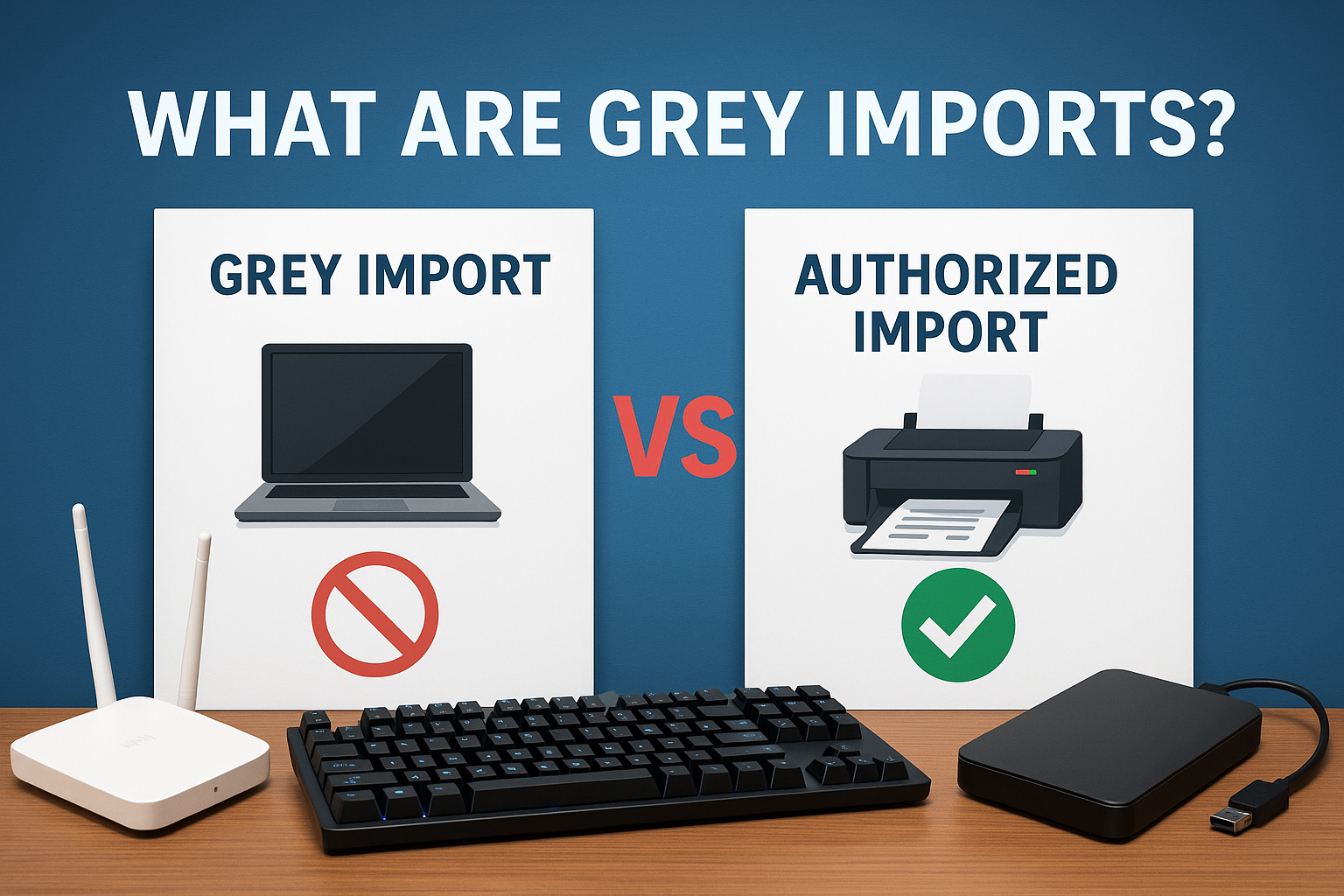
Not all “genuine” products reach Sri Lanka the same way. Some enter via authorized brand channels; others arrive as grey (parallel) imports—genuine goods imported outside the brand’s official local distributor. Understanding the difference protects your wallet, warranty, and peace of mind.
Quick Definitions
Licensed Imports (Compliant Importers): Genuine products imported by a business that follows Sri Lankan licensing, permits, customs classification, and VAT rules (even if they are not the brand’s official distributor). These importers clear goods using correct HS codes, obtain any required approvals (e.g., TRCSL for telecom/RTTE equipment), and issue proper VAT (Tax) invoices. Sri Lanka Customs+1trc.gov.lk+1ird.gov.lk
Grey (Parallel) Imports: Genuine branded goods legally bought overseas and brought into Sri Lanka outside the brand’s official local channel. They may still be legal if taxes are paid and goods aren’t restricted—but often skip approvals, under-declare, or don’t provide local warranty. International Trademark AssociationBraumiller Law
Note: In Sri Lanka, import compliance is governed by Customs and the Imports and Exports Control regime. Many categories require permits or clearances; telecom/RTTE gear needs TRCSL approvals; and VAT rules apply to taxable supplies. Trade.govtreasury.gov.lktrc.gov.lkKPMG Assets
The Side-by-Side Comparison
Feature
Licensed Imports (Compliant Importers)
Grey (Parallel) Imports
Import route
Via importer who follows Sri Lankan laws (Customs, Import & Export Control, any required TRCSL/sector approvals).
Brought in outside brand’s Sri Lankan distributor; sometimes without the full set of approvals.
Customs & HS codes
Declared under correct HS codes determined per Customs guidance; duties/levies paid.
May be mis-classified, under-declared, or cleared informally to lower costs.
Licences/Permits
Obtains necessary permits (e.g., TRCSL type approval/import clearance for RTTE/network equipment; other sector NOCs where applicable).
Often lacks the required approvals for controlled categories (e.g., telecom/RTTE, certain surveillance/other controlled goods).
VAT/TAX Invoice
Issues proper TAX INVOICE (VAT) if registered; supports input VAT credit for eligible businesses.
Typically no VAT invoice (or refuses to issue one), preventing input credits for businesses.
Warranty
Local warranty is clear and serviceable; parts and support are aligned to the Sri Lankan market.
Warranty may be valid only in the original country; local centers often decline grey stock.
Specs/Compliance
Models configured for Sri Lanka (plug types, firmware, documentation, labels).
May have different regions’ firmware, plugs, manuals; risk of region locks.
Consumer protection posture
Transparent pricing/tax; traceable after-sales.
Higher risk of disputes; weak recourse if warranty/support is refused.
Why Grey Imports Look Cheaper (and When They’re Not)
Skipped approvals/testing: Avoiding TRCSL or other regulatory steps cuts time/cost—until something breaks or gets detained. trc.gov.lk+1
Mis-classification/under-declaration: Using the wrong HS code or under-valuing lowers duties illegally. Customs treats this seriously. Sri Lanka Customs+1
No VAT invoice: Not charging/issuing VAT reduces sticker price but deprives business buyers of input VAT credits. ird.gov.lk
Non-Sri Lanka models: Region-specific firmware/accessories cause compatibility or service issues. (Common risk documented globally with parallel imports.) International Trademark Association
What Sri Lankan Rules Actually Require (Plain-English)
Customs Classification (HS): Goods must be declared with the correct HS code; Sri Lanka Customs’ Commodity Classification Branch guides proper classification. Sri Lanka Customs
Import Licences/Permits: Sri Lanka requires import licences for many items; procedures are published via the Sri Lanka Trade Portal and “Step-by-Step Trade” guidance. Trade.govSrilanka Trade PortalStep by Step Trade
TRCSL for Telecom/RTTE: Any telecom/RTTE equipment (e.g., network/terminal apparatus) needs type approval and import clearances from TRCSL. trc.gov.lk+1
VAT (Tax Invoices): VAT-registered suppliers must issue TAX INVOICES (with prescribed particulars) and file VAT returns. ird.gov.lk+1
Important: Whether a parallel import is per se illegal depends on the category, approvals, and how it’s declared. Academic and policy commentary note that “parallel imports” are a legal grey zone worldwide, but non-compliance with Sri Lankan permits/taxes is clearly unlawful. ResearchGateInternational Trademark Association
Consumer & Reseller Risks with Grey Imports
No local warranty or refusals at service centers.
Firmware/region lock or incompatible accessories.
Tax risk for businesses (no VAT invoice → lost input credit).
Seizure/penalties if Customs finds mis-declaration or missing permits. Sri Lanka Customs
How to Spot a Grey Import (Checklist)
The seller won’t issue a VAT “TAX INVOICE.”ird.gov.lk
Packaging/manuals/labels are not localized; warranty card lacks Sri Lanka coverage.
Price is far below market with no clear promotion reason.
Where “Licensed but Non-Official Distributor” Fits
Under Sri Lanka’s open market approach, a company can be fully compliant and licensed—clearing Customs correctly, obtaining TRCSL approvals where applicable, and issuing VAT Tax Invoices—without being the brand’s exclusive distributor. For consumers and resellers, this often means:
Fair, value-for-money pricing (competition against monopoly pricing).
Legally sound documentation for businesses (VAT credit, warranty clarity).
Local-market compatible stock and traceable after-sales processes. Trade.govtrc.gov.lk
FAQs
Q1: Are grey imports illegal in Sri Lanka? A: Not automatically. The term describes channel (outside the official distributor). Legality hinges on permits, approvals, correct HS declaration, and taxes. Skipping these makes an import non-compliant and exposes buyers/sellers to risk. Sri Lanka CustomsSrilanka Trade Portal
Q2: Why do some shops refuse to issue VAT invoices? A: They may not be VAT-registered or are avoiding VAT. If you’re VAT-registered, a proper TAX INVOICE is essential for input credits. ird.gov.lk
Q3: When do I need to worry about TRCSL approval? A: For telecom/RTTE/network devices—e.g., routers, PABXs, modems, and any terminal equipment connecting to networks—type approval/import clearance is required. trc.gov.lk
Q4: Can Customs stop my purchase if it’s a grey import? A: Customs can detain or penalize mis-declared or restricted goods lacking proper permits. Always ask the seller to confirm approvals and classification. Sri Lanka Customs
Practical Buying Tips
Ask for a VAT “TAX INVOICE.” If the supplier is VAT-registered, they must issue one. ird.gov.lk
Confirm approvals for controlled categories (e.g., TRCSL for RTTE/telecom equipment). trc.gov.lk
Be wary of extreme under-pricing. It often signals skipped steps you’ll pay for later (no warranty, no VAT credit, compliance risks). Sri Lanka Customs
Bottom Line
Licensed imports (even from non-official distributors) give you legal certainty, documentation, and predictable after-sales support.
Grey imports may look cheaper but frequently shift risk to the buyer—through missing approvals, absent VAT invoices, and denied local warranty.
For businesses and households alike, the smart value is a properly licensed importer who competes on price and compliance.
References & Further Reading
Sri Lanka Customs – Importing Goods / HS Classification (how imports must be declared; HS guidance and importer registration). Sri Lanka Customs+1
Protect your home or small office, record what matters, and stay compliant with Sri Lanka’s new data protection rules.
Quick Take
Best for most homes: 2–4 × 4MP (2K) IP PoE dome cameras + 1 × NVR (1–2 TB) + router VLAN, with 7–14-day retention.
Budget/apartment setups: 2 × Wi-Fi cameras with microSD + cloud backup on motion.
Legal must-dos (2025): Put up a notice, limit what you record, secure footage, set a deletion window, and be ready for access requests under the PDPA. dpa.gov.lkParliament of Sri Lanka
1) Camera Types (What to buy—and when)
Type
When to choose
Pros
Watch-outs
IP PoE (wired) Dome/Bullet
Houses, small offices, long-term reliability
Stable, higher quality, one cable (power+data), neat NVR setup
Needs cabling + PoE switch
Wi-Fi (plug-in)
Rentals, apartments, quick installs
Fast setup, cheap, app access
Wi-Fi dropouts, needs good signal, more cloud reliance
Doorbell cams
Gate/door knock detection
Visitor logs, two-way talk
Battery charging or wiring; check rain rating
PTZ (pan-tilt-zoom)
Large yards, car parks
Wide coverage, active tracking
Costly; moving parts wear out
Outdoor bullet
Perimeter, driveways
Longer lens options, visible deterrent
More conspicuous (vandal risk)
Indoor dome
Living areas, lobbies
Discreet, wider FoV
Don’t face bedrooms/bathrooms (privacy)
Specs that matter in Sri Lanka
Resolution: 4MP (2K) is the sweet spot; 8MP (4K) if you need plate clarity at distance.
Night vision: IR 20–40 m; ColorVu/ColorNight sensors help in low light.
WDR (120 dB+): Handles glare from gates/streets at noon.
IP67 + metal housing: Survives monsoon and coastal spray.
Vandal rating (IK10): For low-mount outdoor cams.
Audio: Only enable where appropriate; audio has extra consent considerations (see Legal). Parliament of Sri Lanka
2) Recording & Storage (How long, where, and how much)
Option
Best for
How it works
Pros
Cons
Typical cost (LKR)
NVR + HDD (on-prem)
Houses/offices with ≥2 cams
All cams record to one box
Reliable, central, no monthly fees
NVR is a single point of failure
35,000–70,000 (NVR) + 15,000–25,000 (1–2 TB HDD)
MicroSD in-camera
1–2 Wi-Fi cams
Records to the camera itself
Cheap, easy
If stolen/damaged, footage gone
3,000–10,000 per card (64–256 GB)
Cloud storage
Apartments, remote access
Clips uploaded on motion
Off-site backup, easy sharing
Ongoing fee; bandwidth use
500–1,200 per cam/month (brand-dependent)
Hybrid (NVR + Cloud clips)
Evidence resilience
Local 24/7 + cloud events
Best of both worlds
Cost + config
NVR + 300–800 per cam/month
Retention: 7–14 days covers most incidents for homes; small offices often choose 14–30 days. After that, auto-delete to reduce risk and storage cost. (This also aligns with data minimization under the PDPA.) Parliament of Sri Lanka
3) Network & Power (Make it stable)
PoE over Wi-Fi if you can: fewer dropouts, cleaner installs.
Separate camera VLAN on your router; block cameras from the open internet unless cloud is required.
Strong passwords + 2FA in camera/NVR apps.
UPS/backup: 650–1000 VA keeps NVR + router up for brief outages.
Cable: Use outdoor-rated Cat6 for runs; protect with conduit in sun/rain.
Prices vary by brand, cable length, heights/risers, and wall drilling. Ask for a site survey for an exact quote.
6) Legal Basics for Home & Small-Office CCTV in Sri Lanka (2025)
Sri Lanka’s Personal Data Protection Act, No. 9 of 2022 (PDPA) is now in force (operationalized 18 March 2025). Recording identifiable people (visitors, staff, customers) is personal data processing—even at home or a small office—so follow these essentials: dpa.gov.lkParliament of Sri Lanka
Your responsibilities (plain English)
Have a clear purpose Only record to deter/identify crime, manage entry, or protect safety—don’t use footage for unrelated reasons. (Purpose limitation.) Parliament of Sri Lanka
Tell people they’re on camera Put a visible notice at the gate/entrance (“CCTV in operation: for security & safety. Contact: 07X-XXXXXXX”). This supports transparency obligations. Parliament of Sri Lanka
Minimize what you capture Don’t aim at private spaces (bathrooms/bedrooms/neighbor’s interior). Use privacy masks if your camera sees beyond your boundary. (Data minimization.) Parliament of Sri Lanka
Keep it secure Strong passwords, access controls, and encryption where possible. Limit who can view/export footage. (Security safeguards.) Parliament of Sri Lanka
Delete on a schedule Set an auto-deletion period (e.g., 14–30 days) unless footage is needed for an incident. (Storage limitation.) Parliament of Sri Lanka
Be ready for access requests If a person asks for footage of themselves (a data subject request), be prepared to respond reasonably. Blur others if needed. (Data subject rights.) Parliament of Sri Lanka
Audio recording = more sensitive Only enable microphones if truly needed and your notice mentions it. Audio can raise additional consent/expectation issues. (Fair processing.) Parliament of Sri Lanka
If you use cloud storage Choose reputable providers and check where data is stored. Cross-border transfers must follow PDPA’s rules/instruments once specified by the regulator. dpa.gov.lk
Note: The PDPA framework is evolving (there’s a 2025 amendment bill and new directives/guidelines). Keep an eye on the official Data Protection Authority website for updates. documents.gov.lkdpa.gov.lk
7) A simple CCTV policy you can copy (home or SME)
Purpose: Security and safety for occupants, visitors, and property. Scope: Cameras cover entrances, perimeter, and common areas only. Signage: “CCTV in operation” notice at entrances; contact number listed. Access: Footage viewable only by [Owner/Manager]; exports are logged. Retention: Auto-delete after 14/21/30 days unless needed for an incident/police request. Sharing: Only with law enforcement upon written request or if required by law. Review: Annual check of camera angles, passwords, retention, and signage.
8) Buying Checklist (print this)
Camera type/brand chosen (PoE vs Wi-Fi), 4MP or higher
Night vision range adequate (20–40 m), WDR enabled
Privacy masks configured to avoid neighbors’ interiors
Simple written CCTV policy saved and shared with staff/tenants
9) Frequently Asked Questions
Q1. Is it legal to record my gate and the public road? Yes, generally—but follow PDPA transparency and minimization: notify via signage and avoid unnecessary capture of neighbors’ private spaces. Parliament of Sri Lanka
Q2. Can I point a camera at a shared corridor in my apartment? Yes if it’s for security, with signage and limited angles. Avoid pointing into other units. Keep retention short. Parliament of Sri Lanka
Q3. How long should I keep footage? Keep the shortest window that still meets your security need (7–30 days for most homes/offices). Longer retention must be justified. Parliament of Sri Lanka
Q4. What if the police ask for footage? Provide relevant clips upon a formal request and log what you shared and why. Keep unrelated faces protected where practical. Parliament of Sri Lanka
Q5. Do I need to register my home CCTV? No general registration for private CCTV—just comply with PDPA obligations and any condo/office building by-laws. Watch for regulator directives. dpa.gov.lk
10) Need help picking and installing the right system?
LankaFix can design, supply, and install the right-sized CCTV with a compliant setup (signage, retention, access controls)—and we’ll train you to use it.
Call: 0770440404
WhatsApp: 0719888848
Book online: lankafix.com
Sources & references
Data Protection Authority of Sri Lanka – PDPA commencement (Mar 18, 2025). dpa.gov.lk
Personal Data Protection Act, No. 9 of 2022 (scope, principles, rights). Parliament of Sri Lanka
Imagine slipping on a sleek smartwatch in the morning, only to receive a gentle vibration by noon alerting you to irregular heart rhythms that could signal an impending cardiac event—days before symptoms strike. Or picture a subtle earpiece analyzing your voice patterns during a casual conversation, flagging early markers of Alzheimer’s with chilling accuracy. In 2025, this isn’t a scene from a futuristic thriller; it’s the everyday reality of health tech, where wearables fused with artificial intelligence (AI) are revolutionizing early disease detection. As global healthcare shifts from reactive treatment to proactive prevention, these technologies are poised to save millions of lives and slash costs by billions. With the wearable health market projected to exceed $200 billion and AI in healthcare reaching $148 billion by 2029, 2025 marks the tipping point where your wrist becomes your personal health sentinel. Buckle up as we explore the cutting-edge trends, breakthrough applications, and the promise (and pitfalls) of this wearable-AI synergy—crafted to empower you with insights that could one day save your life.
The Dawn of Proactive Healthcare: Key Trends Shaping 2025
Health tech in 2025 is all about anticipation over reaction. Driven by advancements in AI algorithms, sensor miniaturization, and edge computing, wearables are evolving from fitness trackers to diagnostic powerhouses. According to industry reports, AI-enabled wearables are set to reduce hospital costs by 16% through early interventions, while integrating with Internet of Medical Things (IoMT) for seamless data flow. Core trends include:
Multimodal Monitoring: Devices now track beyond steps and heart rate—measuring blood oxygen, ECG, stress via skin conductance, and even hydration levels in real-time.
AI-Powered Predictive Analytics: Machine learning sifts through vast datasets to spot anomalies, predicting risks like heart attacks or cancer with up to 94% accuracy.
Integration with Genomics and Precision Medicine: Wearables sync with genetic data for personalized alerts, such as tailored cancer screenings.
Voice and Neurological Biomarkers: Emerging tools analyze speech for early signs of Parkinson’s or dementia, turning casual chats into diagnostic goldmines.
These trends aren’t isolated; they’re interconnected, creating ecosystems where data from your smart ring feeds into hospital AI for holistic care.
Wearables: Your Body’s Silent Guardians
Wearables in 2025 are far more than gadgets—they’re vigilant companions embedded with biosensors that monitor physiological signals non-invasively. From smartwatches like the Apple Watch Series 10 (with advanced ECG) to patches like the Zio XT for cardiac monitoring, these devices collect continuous data on vital signs, activity, and biomarkers. Key innovations include:
Advanced Sensors: ECG for arrhythmias, SpO2 for respiratory issues, and even retinal scanning via smart glasses for early Alzheimer’s detection.
Chronic Disease Management: For diabetes, continuous glucose monitors (CGMs) like Dexcom G7 predict hypoglycemia; for asthma, smart inhalers track usage and environmental triggers.
Mental Health Tracking: Devices measure stress through heart rate variability (HRV) and suggest interventions, reducing risks of related conditions like hypertension.
In preventive cardiology, wearables like the Oura Ring or Fitbit Sense 2 detect atrial fibrillation (AFib) early, potentially averting strokes.
AI: The Brain Behind the Brawn
AI supercharges wearables by transforming raw data into actionable insights. Using machine learning (ML) and generative AI, systems like those from Google Health or IBM Watson analyze patterns to forecast health events. Highlights for 2025:
Early Detection Algorithms: AI scans wearables’ data for subtle changes, like voice tremors for neurological issues or irregular rhythms for heart disease, with tools achieving 90%+ accuracy in cancer detection via imaging.
Predictive Modeling: Platforms simulate “digital twins” to test lifestyle changes, as seen in cardiology pilots at ASPC 2025.
Hybrid Systems: AI integrates with IoMT for remote monitoring, flagging risks in real-time and auto-messaging patients or doctors.
Generative AI also crafts personalized treatment plans, accelerating drug discovery and tailoring therapies.
Spotlight on Applications: From Heart to Brain
In 2025, wearables and AI shine in specific domains:
Cardiology
Wearables monitor ECG and predict AFib or heart failure, with AI reducing false positives. Example: BMW’s integration in factories, adapted for health, shows 25% better outcomes in pilots.
Oncology
AI analyzes wearable data for early cancer signs, like abnormal vitals or genomic patterns, enabling pre-symptom interventions.
Lucem Health: Mines data for high-risk patients, partnered with Mayo Clinic.
Zio Patch: 14-day cardiac monitoring with AI analytics.
X discussions highlight pilots like ASPC 2025’s AI twins for cardiology.
Beyond 2025: A Vision of Ubiquitous Health
By 2030, wearables could predict organ aging or integrate with neural interfaces for brain health monitoring. Expect blockchain for secure data, 3D-printed organs aided by AI, and global health passports. The “Biological Digital Identity Framework” could emerge, blending health with identity—raising profound societal questions.
Conclusion: Strap In for a Healthier Tomorrow
In 2025, wearables and AI aren’t just trends—they’re lifesavers, turning data into destiny-altering insights. From spotting cancer shadows to averting heart crises, this tech empowers us to outpace disease. Yet, as we embrace it, let’s prioritize ethics, equity, and privacy. What’s your take—would you wear a device that predicts your health future? Share below and join the revolution toward a world where prevention is the ultimate cure.
Stay cool, save money, and extend your AC’s life with the right service schedule.
Why AC Servicing in Colombo Matters
Colombo’s tropical climate means air conditioners work almost year-round, especially in homes, small offices, and retail spaces. While many owners wait until cooling performance drops or units make strange noises, regular servicing is far cheaper than emergency repairs.
A well-maintained AC:
Cools faster & more evenly
Uses less electricity (lower CEB bills)
Lasts longer before needing costly part replacements
Improves indoor air quality, reducing dust, mould, and allergens
What Should Be Serviced in Your AC?
A professional AC service covers more than just “washing the filters.” In Colombo’s dusty and humid environment, these are the main tasks to include:
Imagine a world where creating a stunning video, analyzing data trends, or even building a smart assistant doesn’t require a PhD in computer science or a hefty budget. In 2025, this isn’t a dream—it’s the reality of AI democratization, where advanced technology once locked behind corporate gates is now in the hands of everyday creators, students, entrepreneurs, and hobbyists. Picture a farmer in rural Sri Lanka using free AI to optimize crop yields, or a high school student generating art that rivals professionals. With global AI investments surging and no-code platforms exploding, 2025 is the year AI truly becomes “for the people.” But how do you, as a beginner, dive in without drowning in jargon? This article is your lifeline: packed with practical tips, a curated list of free tools, and insights to spark your AI journey. Let’s unlock the power of AI together—because the future isn’t just automated; it’s empowered.
Unpacking AI Democratization: From Elite Tech to Everyday Magic
AI democratization refers to the process of making artificial intelligence accessible, affordable, and usable for non-experts. It’s about breaking down barriers—technical, financial, and educational—so anyone can harness AI’s potential. In 2025, this shift is driven by cloud-based services, open-source models, and user-friendly interfaces that abstract away complex coding. No longer confined to tech giants like Google or OpenAI, AI is seeping into small businesses, education, and personal projects, fostering innovation from the ground up.
Key drivers include:
Low-Code/No-Code Platforms: Tools that let you build AI apps via drag-and-drop, democratizing development for non-programmers.
Open-Source Boom: Free models like those from Hugging Face allow customization without starting from scratch.
Cloud Accessibility: Services from AWS, Google Cloud, and Azure offer free tiers, putting enterprise-level AI in your browser.
Ethical and Inclusive Focus: As AI spreads, emphasis on bias mitigation and accessibility ensures broader societal benefits.
The impact? Stanford’s 2025 AI Index reports a 21.3% rise in global AI legislation, reflecting its pervasive role in economies and daily life. Forbes highlights how this lowers costs and boosts efficiency, but warns of ethical pitfalls like data privacy.
Why 2025 Marks the Tipping Point for AI Accessibility
2025 isn’t just another year—it’s when AI shifts from hype to hyper-adoption. Accenture’s Tech Vision predicts AI agents acting autonomously at the enterprise core, while multimodal AI (handling text, images, and video) becomes standard. Workplace integration surges: Coursera notes 46% of executives scaling AI for optimization.
Trends shaping this:
Decentralized AI: Less compute-intensive models enable edge devices, making AI run on smartphones without cloud dependency.
GenAI Integration: Tools embedding AI in apps like email or design software, accelerating scientific discovery and productivity.
Economic Ripple Effects: From job creation in AI ethics to displacement in routine tasks, democratization promises growth but demands upskilling.
Global Reach: In regions like Sri Lanka, AI tools aid agriculture and education, bridging digital divides.
IBM forecasts a major shift toward optimization, with 46% of organizations scaling AI. Thrive Learning calls 2025 the year of true democratization, empowering individuals worldwide.
Beginner Tips: Your Step-by-Step Guide to Mastering AI in 2025
Diving into AI can feel overwhelming, like learning a new language in a foreign country. But with the right roadmap, it’s exhilarating. Here’s a curated list of 10 essential tips for beginners, drawn from expert advice and 2025 trends—start small, build momentum, and watch your skills soar.
Start with the Basics—Embrace Free Resources: Begin by understanding AI fundamentals. Enroll in Andrew Ng’s Coursera course on Machine Learning or DeepLearning.AI’s free intro series. No prior knowledge needed—just curiosity.
Master Python (or Skip Coding Altogether): Python is AI’s lingua franca. Install it via Anaconda and follow free tutorials on Codecademy. For no-code lovers, use tools like Zapier to automate without a line of code.
Play with AI Tools Daily: Experiment! Use ChatGPT to brainstorm ideas or automate tasks. Build habits by integrating AI into routines, like summarizing emails.
Build Small Projects: Hands-on is key. Create a simple sentiment analyzer with Python and Hugging Face, or a chatbot via Google AI Studio. Start with beginner projects on Kaggle.
Focus on Prompt Engineering: AI loves specifics. Craft detailed prompts: “Explain quantum computing like I’m 10, with analogies.” Practice on platforms like PromptBase.
Join Communities: Reddit’s r/learnmachinelearning or Discord groups offer support. Follow podcasts like Lex Fridman’s for inspiration.
Learn Math Gradually: Brush up on linear algebra and stats via Khan Academy. Don’t overwhelm—apply as you go.
Automate Boring Tasks: Use AI for real-life wins, like organizing notes with Notion AI or editing videos with CapCut.
Stay Updated: Read blogs like Towards Data Science and follow X influencers for trends.
Ethical Mindset: Understand biases and privacy. Resources like AI Ethics Guidelines from UNESCO help navigate responsibly.
As one Medium guide puts it, “Keep learning: AI changes fast.”
Free Tools for Beginners: Your 2025 AI Arsenal
In 2025, free doesn’t mean basic—these tools pack pro-level punch. Here’s a top 10 list, categorized for ease, with how-to tips for beginners.
AI Chatbots and Assistants
ChatGPT (OpenAI): Free tier for text generation, coding help, and brainstorming. Tip: Use for learning—ask it to explain concepts step-by-step.
Google AI Studio: Build custom AI apps for free. Beginner-friendly for experimenting with models.
Creative and Design Tools
Canva AI: Magic Studio for image generation and editing. Perfect for non-designers creating graphics.
Midjourney (via Discord): Free trials for AI art. Tip: Join servers for community prompts.
Productivity and Automation
Zapier Chatbots: No-code automation. Connect apps like Gmail to AI for workflows.
Notion AI: Free for note-taking with AI summaries and brainstorming.
Video and Media
Synthesia: Free AI video generator for avatars and scripts.
KlingAI: Free for faceless video creation, ideal for YouTubers.
Learning and Search
Perplexity AI: Free AI search engine with citations. Great for research.
Hugging Face: Free models for ML projects. Beginner spaces for no-code demos.
X users rave about these: “Don’t buy software—try 12 free AI tools,” shares one post.
The Upsides and Hurdles: Weighing AI’s Democratic Promise
Benefits abound: Enhanced efficiency (37% cost reduction for marketers), innovation, and inclusivity. Challenges? Data privacy, job shifts, and ethical biases—CoreSite stresses governance. Overcome by starting ethical and upskilling.
Real-World Wins: Stories from the AI Frontier
YouTube Creators: Using free tools like VidIQ and Canva, one creator hit $15K/month with faceless channels.
Marketers: 91% use AI; tools like Copy.ai boost ROI by 39%.
Entrepreneurs: X threads highlight earning via AI tools without investment.
Looking Ahead: AI Democratization Beyond 2025
By 2030, expect ubiquitous AI in wearables and decentralized systems. Trends like agentic AI will further empower users. The key? Continuous learning amid rapid evolution.
Conclusion: Your AI Adventure Awaits
In 2025, AI democratization isn’t just a trend—it’s an invitation to innovate. With these tips and free tools, you’re equipped to start. Pick one tool, try a tip, and build something today. What’s your first AI project? Share in the comments—let’s democratize knowledge together!
Picture this: A shadowy figure in a dimly lit room, not wielding a crowbar, but harnessing the raw power of a quantum computer to shatter the digital locks guarding your most sensitive data. Sounds like a thriller plot? In 2025, it’s edging closer to reality. As quantum computing leaps from labs to practical prototypes, traditional encryption methods like RSA and ECC are teetering on the brink of obsolescence. Enter post-quantum cryptography (PQC)—the cryptographic shield designed to withstand the quantum storm. With NIST’s freshly minted standards and global adoption accelerating, 2025 marks the year organizations must act or risk “harvest now, decrypt later” attacks. This article unpacks PQC’s essentials, delivers actionable tips, and explores its transformative potential, all while keeping you hooked with real-world insights and forward-looking visions.
## Decoding Post-Quantum Cryptography: The Basics
Post-quantum cryptography, also known as quantum-resistant or quantum-safe cryptography, is the next evolution in securing data against the computational might of quantum machines. Unlike today’s algorithms, which rely on problems like integer factorization (easy for quantum computers via Shor’s algorithm), PQC builds on mathematical challenges that remain hard for both classical and quantum systems.
At its heart, PQC addresses two threats:
– **Quantum Attacks on Public-Key Cryptography:** Algorithms like Grover’s could halve symmetric key strengths, while Shor’s could break asymmetric ones entirely.
– **Harvest Now, Decrypt Later (HNDL):** Adversaries stockpiling encrypted data today for future quantum decryption.
PQC isn’t about replacing everything overnight—it’s about crypto-agility: systems that can swap algorithms seamlessly. As Gartner highlights, PQC tops 2025 tech trends, driven by NIST’s standardization push.
## The Quantum Clock Ticks: Why 2025 is the Pivotal Year
Quantum computing isn’t a distant dream. In 2025, advancements like IBM’s error-corrected qubits and Google’s quantum supremacy claims signal we’re nearing “Q-Day”—when quantum computers crack current crypto. The U.S. Department of Homeland Security warns that without preparation, critical infrastructure could crumble.
NIST’s milestones define 2025:
– August 2024: Release of FIPS 203 (ML-KEM from CRYSTALS-Kyber for key encapsulation), FIPS 204 (ML-DSA from CRYSTALS-Dilithium for digital signatures), and FIPS 205 (SLH-DSA from SPHINCS+ for signatures).
– March 2025: Selection of HQC (code-based) as the fifth algorithm, with draft standards expected soon and finalization by 2027.
– Ongoing: NIST IR 8545 reports on the fourth round, emphasizing hybrid implementations.
Industry echoes this urgency: Sectigo predicts PQC will reshape PKI in 2025, with governments mandating transitions. The NCSC urges immediate planning, noting migration could take years.
## Core Algorithms: The Building Blocks of Quantum-Resistant Security
PQC draws from diverse families to mitigate risks if one proves vulnerable:
– **Lattice-Based:** CRYSTALS-Kyber (now ML-KEM) for key exchange—efficient and versatile. CRYSTALS-Dilithium (ML-DSA) for signatures, balancing speed and security.
– **Hash-Based:** SPHINCS+ (SLH-DSA)—stateless and proven secure, ideal for signatures where key size isn’t critical.
– **Code-Based:** HQC—newly selected, excels in key encapsulation with strong security margins.
These aren’t drop-in replacements; key sizes can be larger (e.g., Kyber keys are 2-3x RSA’s), impacting performance. Hybrid modes—combining PQC with classical crypto—offer a bridge.
## Essential Tips to Secure Your Data in 2025: A Practical Guide
Transitioning to PQC isn’t daunting if approached methodically. Here are 10 essential tips, drawn from NIST, DHS, and industry experts, to fortify your defenses:
1. **Conduct a Crypto Inventory:** Map all cryptographic assets—keys, certificates, protocols. Tools like Cryptosense or OpenSSL can help identify vulnerable RSA/ECC usages.
2. **Prioritize High-Risk Assets:** Focus on long-lived data (e.g., financial records) and critical systems. DHS recommends risk-based prioritization.
3. **Adopt Hybrid Cryptography:** Use PQC alongside legacy algorithms for backward compatibility. AWS and IBM offer hybrid TLS setups.
4. **Update Libraries and Frameworks:** Integrate OpenQuantumSafe or Bouncy Castle libraries supporting NIST standards. Test in sandboxes first.
5. **Engage Vendors and Partners:** Query manufacturers about PQC roadmaps. Cisco and Oracle provide guidance for network and cloud transitions.
6. **Implement Crypto-Agility:** Design systems for easy algorithm swaps. NIST’s IR 8547 outlines strategies like modular crypto modules.
7. **Train Your Team:** Upskill on PQC via webinars (e.g., GSA’s June 2025 session) or certifications. Understand performance trade-offs.
8. **Monitor for Threats:** Use quantum-risk scanners and stay updated via NIST’s PQC forum. Address HNDL by re-encrypting old data.
9. **Test Thoroughly:** Pilot PQC in non-production environments. Events like RWPQC 2025 showcase real-world testing.
10. **Plan for Long-Term Compliance:** Align with mandates like NSM-10. Budget for migrations—experts predict 5-10 years for full adoption.
## Real-World Applications: PQC in Action
PQC is moving from theory to practice in 2025:
– **Cloud and Enterprise:** AWS simplifies PQC in services like KMS, protecting data in transit. IBM integrates it into mainframes for finance.
– **Networks and IoT:** Cisco’s quantum-safe routers secure infrastructure. Aliro Quantum demos quantum-safe IPsec for VPNs.
– **Government and Critical Sectors:** DHS guides federal transitions; conferences like RWC 2025 discuss implementations like post-quantum DNSSEC.
– **Case Study: Banking Sector:** Institutions pilot Dilithium for signatures, reducing breach risks amid AI-powered cryptanalysis.
## The Upsides: Benefits of Embracing PQC
PQC isn’t just defensive—it’s a strategic advantage:
– **Future-Proof Security:** Resists quantum and classical attacks, safeguarding data for decades.
– **Compatibility and Efficiency:** Many algorithms integrate with existing setups, minimizing disruption.
– **Integration Complexity:** Retrofitting legacy systems is costly—start with crypto-agile designs.
– **Standardization Gaps:** While NIST leads, global harmonization lags; monitor updates.
– **Resource Strain:** Small teams may struggle; leverage open-source tools and partnerships.
Solutions? Phased migrations and community events like PKI Consortium’s 2025 conference.
## Peering into the Future: PQC Beyond 2025
By 2030, PQC could be ubiquitous, intertwined with quantum key distribution for unbreakable security. Expect more algorithms (e.g., from NIST’s ongoing rounds) and AI-assisted cryptanalysis defenses. Sectors like IoT and 6G will demand lightweight PQC, driving innovation.
## Conclusion: Lock Down Your Digital Future Today In 2025, post-quantum cryptography isn’t optional—it’s your data’s lifeline against the quantum tide. By understanding its foundations, implementing our tips, and learning from pioneers, you can turn potential vulnerabilities into fortified strengths. Don’t wait for Q-Day; start your migration now. What’s your first step—inventorying assets or testing a hybrid setup? Share below and join the quantum-resistant revolution!
Imagine a world where your morning coffee isn’t just brewed by a smart machine, but anticipated by an AI that scans your calendar, checks traffic, and even orders groceries based on your dwindling supplies—all without a single prompt from you. This isn’t science fiction; it’s the dawn of agentic AI in 2025, where autonomous systems aren’t just tools, but proactive partners reshaping how we work, innovate, and live. As we navigate this pivotal year, agentic AI is emerging as the game-changer, evolving from passive chatbots to intelligent entities that plan, decide, and execute with minimal human oversight. With market projections soaring from $7.28 billion in 2025 to over $41 billion by 2030, the question isn’t if this technology will transform workflows—it’s how quickly businesses adapt or risk being left behind.
In this article, we’ll dive deep into the mechanics of agentic AI, explore its explosive growth in 2025, and uncover how it’s revolutionizing industries. Buckle up as we journey through real-world applications, benefits, challenges, and a glimpse into the future—crafted to spark your curiosity and equip you with actionable insights.
What is Agentic AI? Breaking Down the Buzz
At its core, agentic AI represents a seismic shift in artificial intelligence: from reactive systems that respond to commands to autonomous agents that exhibit “agency”—the ability to set goals, reason through problems, and take independent actions. Think of it as upgrading from a loyal assistant who waits for instructions to a savvy colleague who anticipates needs and handles tasks end-to-end.
Key Components of Agentic AI:
Reasoning and Planning: Powered by advanced large language models (LLMs) like GPT-4.5 or beyond, these agents break down complex goals into subtasks, much like a project manager outlining a roadmap.
Tool Integration: Agents interact with external tools—APIs, databases, or even physical devices—via frameworks like LangChain or AutoGPT, enabling them to “act” in the real world.
Memory and Learning: Unlike forgetful chatbots, agentic systems retain context across interactions, learning from outcomes to improve future performance through reinforcement learning.
Autonomy Levels: From “human-in-the-loop” (oversight required) to fully autonomous, where agents operate with “human-on-the-loop” supervision for strategic tweaks.
This isn’t just hype; Deloitte predicts that 25% of companies using generative AI will pilot agentic solutions in 2025, doubling to 50% by 2027. Gartner goes further, forecasting that by 2029, these agents will resolve 80% of common customer service issues independently, slashing operational costs by 30%. In essence, agentic AI turns AI from a helper into a doer, bridging the gap between human intent and machine execution.
The Evolution of Agentic AI: Why 2025 is the Tipping Point
Agentic AI didn’t appear overnight—it’s the culmination of decades of AI research, turbocharged by recent breakthroughs. Early roots trace back to 1950s concepts of intelligent agents, but the real acceleration came with LLMs in the 2020s. Tools like OpenAI’s GPT series and Anthropic’s Claude paved the way for “function calling,” where AI could invoke tools autonomously.
Enter 2025: A confluence of factors is propelling agentic AI into the mainstream.
Technological Leaps: Enhanced LLMs with better contextual reasoning, coupled with edge computing for real-time processing, allow agents to handle dynamic environments.
Market Momentum: Investments exceeding $2 billion in the past two years have fueled startups like Reflection (Asimov) and established players like Salesforce (Agentforce).
Adoption Surge: 93% of U.S. IT executives express high interest, with early pilots in enterprises showing 2.5x revenue growth for adopters.
From Single to Multi-Agent Systems: The trend is toward “teams” of agents collaborating—like a digital orchestra—handling workflows from sales to supply chain.
As IBM notes, 2025 isn’t about experimentation; it’s about scaling impact, with agents leveraging proprietary data for differentiated ROI. This evolution is democratizing AI, making it accessible via no-code platforms like Zapier or Flowise.
How Agentic AI is Transforming Workflows: Industry Spotlights
Agentic AI isn’t a one-size-fits-all; it’s a workflow wizard adapting to diverse sectors. By automating multi-step processes, it frees humans for creativity while boosting efficiency. Here’s how it’s reshaping key industries in 2025.
Business and Enterprise Operations
In corporate settings, agentic AI acts as a “digital workforce.” Salesforce’s Agentforce automates CRM tasks, from lead qualification to deal closure, while ServiceNow’s agents orchestrate IT workflows with minimal intervention. Imagine an AI “Chief of Staff” managing schedules, prioritizing emails, and even drafting reports—reducing administrative overhead by up to 50%.
Manufacturing and Supply Chain
BMW’s smart factories exemplify agentic magic: AI agents monitor production, predict failures, and reroute tasks in real-time, minimizing downtime. In logistics, agents optimize routes, manage inventory, and respond to disruptions autonomously, transforming rigid automation into adaptive ecosystems.
Healthcare and Finance
In healthcare, agents analyze patient data for personalized treatment plans or automate administrative tasks like claims processing. Finance sees agents handling compliance, fraud detection, and investment decisions—Lucinity’s platform, for instance, streamlines anti-money laundering with agentic workflows.
Software Development
Tools like GitHub Copilot X evolve into full agents that code, debug, and deploy autonomously. Google’s AlphaEvolve invents algorithms, slashing R&D time. Developers shift from coding to overseeing agent “teams.”
Across these, agentic AI enables hyper-personalization, faster innovation, and cost savings—McKinsey highlights its role in goal-driven execution.
The Compelling Benefits: Why Adopt Now?
The allure of agentic AI lies in its tangible gains:
Productivity Boom: Automates 20-50% of knowledge work, allowing humans to focus on strategy.
Scalability and Efficiency: Handles complex tasks at scale, reducing errors and accelerating processes.
Innovation Edge: Enables real-time insights and adaptive decision-making, fostering creativity.
Cost Reduction: Gartner predicts 30% operational savings in customer service alone.
As Accenture notes, agentic systems “choreograph entire workflows,” amplifying human-AI synergy.
Challenges and Ethical Horizons: Navigating the Risks
No revolution is without hurdles. Agentic AI’s autonomy raises concerns:
Reliability and Bias: Agents can err in edge cases; rigorous testing is essential.
Security and Privacy: Integrating with APIs demands robust governance to prevent breaches.
Job Displacement: While automating mundane tasks, it could reshape roles—experts urge upskilling.
Ethical Dilemmas: Who’s accountable for an agent’s decisions? Frameworks like “human-on-the-loop” oversight are key.
Addressing these through transparency and regulation will ensure equitable benefits.
Real-World Pioneers: Case Studies Lighting the Way
BMW’s Agentic Factory: Multi-agents optimize production, adapting to shortages dynamically.
Salesforce Agentforce: Automates sales workflows, boosting close rates by 25% in pilots.
Abacus.AI’s DeepAgent: Enterprise agents automate tasks across Slack, emails, and docs.
OpenAI’s Swarm: Experimental multi-agent coordination for collaborative tasks.
These examples showcase agentic AI’s practical prowess, from prototypes to production.
Beyond 2025: A Vision of Ubiquitous Agents
Looking ahead, agentic AI will integrate with the physical world via edge AI, powering smart cities and personalized companions. By 2030, agents could dominate SaaS, contributing trillions economically. The “Age of AI Agentics” promises billions of agents, but success hinges on ethical deployment and human-AI collaboration.
Conclusion: Embrace the Agentic Revolution
In 2025, agentic AI isn’t just transforming workflows—it’s redefining possibility. From autonomous factories to intelligent executives, these agents empower us to dream bigger, work smarter, and innovate faster. But the true magic lies in partnership: AI as an extension of human ingenuity. If you’re in business, tech, or simply curious, now’s the time to explore—pilot a tool, upskill your team, or rethink your processes. The future is agentic; are you ready to lead it? Share your thoughts in the comments—what workflow would you automate first?
From Classrooms to Colombo Traffic: Real Ways AI Is Already Part of Your Day
Once thought of as futuristic fiction, Artificial Intelligence (AI) is now a very real—and fast-growing—force in Sri Lanka. From your morning TikTok feed to the way you get medical appointments, AI is quietly changing how we live, work, learn, and shop in 2025.
Whether you’re a student in Kandy, a business owner in Colombo, or a farmer in Kurunegala, AI is already shaping your everyday life—often without you even realizing it.
In this article, we’ll explore:
What AI is (in simple terms)
Real-world examples of AI already at work in Sri Lanka
How AI is transforming jobs, education, health, and security
The risks and challenges Sri Lanka faces with AI adoption
Where it’s all headed in the next few years
🧠 Table of Contents
What is AI (Really)?
AI in Your Daily Life: Real Examples in Sri Lanka
Smart Classrooms & AI Tutors
AI in Healthcare: Diagnoses, Appointments & Beyond
Retail & E-Commerce: AI Recommendations, Smart Chatbots
Agriculture: AI Forecasts & Smart Farming
Traffic & Public Transport Optimization
AI Risks: Misinformation, Job Displacement & Bias
Sri Lanka’s AI Policy & Regulation Outlook
Final Thoughts: Embracing AI the Right Way
🧠 1. What is AI (Really)?
Artificial Intelligence (AI) refers to machines or software that can “think” or make decisions like humans—learning from data, improving over time, and making predictions.
Types of AI:
Narrow AI (like ChatGPT, Siri, or Spotify recommendations)
Machine Learning (ML) – learns from patterns and improves
Computer Vision – used in cameras and facial recognition
Natural Language Processing (NLP) – powers translation tools, chatbots, and assistants
🎯 In Sri Lanka, we mostly interact with Narrow AI, but its impact is huge.
📱 2. AI in Your Daily Life: Real Examples in Sri Lanka
AI Use Case
Where You See It
Social Media Algorithms
TikTok, YouTube, Facebook Reels – AI curates your feed
Frimi, MintPay – AI credit scoring for Buy Now Pay Later (BNPL) offers
🔍 AI increases conversion rates by showing the right product at the right time.
🌾 6. Agriculture: AI Forecasts & Smart Farming
Agriculture is still the backbone of Sri Lanka’s rural economy—and AI is slowly transforming it.
Tools:
AI-powered weather prediction (via Dialog Weather or GSM-based apps)
Drones with computer vision to assess crop health
AI models used to predict pest outbreaks and recommend fertilizers
🚜 Ongoing collaboration with University of Peradeniya and international partners for precision agriculture tools.
🚦 7. Traffic & Public Transport Optimization
AI in Urban Mobility:
Colombo traffic management using camera-based analytics and smart signals (pilot projects in Rajagiriya)
AI in route optimization for SLTB buses and railway freight management
AI used by PickMe to dynamically price fares during peak hours
🧠 Google Maps in Sri Lanka also uses crowd-sourced AI to update traffic patterns in real-time.
⚠️ 8. AI Risks: Misinformation, Job Displacement & Bias
AI isn’t perfect—and it comes with challenges:
Risk
Impact in Sri Lanka
🔎 Misinformation
AI-generated fake news, deepfakes (especially during elections)
👩💼 Job Displacement
Clerks, call center roles under threat from automation
⚖️ Algorithmic Bias
Biased data = unfair results in finance, healthcare, hiring
🧠 Over-dependence
Youth over-relying on AI tools for learning or decisions
🛡️ Experts stress the need for responsible AI, education, and regulation.
📜 9. Sri Lanka’s AI Policy & Regulation Outlook
In 2024, the Information and Communication Technology Agency (ICTA) introduced a draft National AI Strategy focusing on:
Building AI skills and R&D capacity
Supporting ethical AI development
Promoting AI startups and investment
Integrating AI into government services
In parallel, data protection laws like the Personal Data Protection Act (PDPA) will govern how AI handles personal information.
🌟 10. Final Thoughts: Embracing AI the Right Way
AI is not a magic button, but it is one of the most powerful tools available in 2025. It can enhance lives, save time, optimize systems, and create massive new opportunities in Sri Lanka—if used wisely.
“The future of AI in Sri Lanka isn’t just about importing technology. It’s about developing local solutions, understanding our own data, and empowering the next generation to build smarter.”
How Digital Retail & Neighborhood Delivery Are Changing the Way We Shop in 2025
In the past five years, Sri Lanka’s shopping habits have transformed dramatically. From basic online orders during the pandemic to today’s AI-driven, hyperlocal delivery systems, e-commerce in Sri Lanka is booming like never before.
In 2025, whether you live in Colombo, Kandy, or Kurunegala, ordering a printer cartridge, laptop charger, or even a service visit via an app is just a few taps away.
This article dives deep into:
Why the e-commerce sector in Sri Lanka is surging
How hyperlocal logistics is shaping consumer behavior
What businesses (like LankaFix) must do to thrive
Key platforms, trends, and growth projections for 2025
📈 Table of Contents
E-Commerce Growth in Sri Lanka: 2020–2025
What is Hyperlocal Shopping?
Why Hyperlocal is Thriving in Sri Lanka
Consumer Trends: What Are Sri Lankans Buying Online?
Key Platforms Leading the Shift
E-Commerce Tech: AI, Payments & Mobile Apps
Challenges: Delivery, Trust & Logistics
What SMEs & Retailers Must Do to Compete
The Role of LankaFix in This Revolution
Final Thoughts: What’s Next for 2026?
🌐 1. E-Commerce Growth in Sri Lanka: 2020–2025
The e-commerce market in Sri Lanka is expected to cross USD 2.5 billion by 2025, with over 8 million active online shoppers, according to ecommercedb.com and local industry insights.
Key Stats:
Mobile-first market: 82% of online orders happen via smartphones
Cash-on-delivery still dominant, but digital payments like LankaQR, Frimi, and Internet Banking are rising fast
Major growth in Tier 2 & Tier 3 towns like Anuradhapura, Galle, and Matale
📍 2. What is Hyperlocal Shopping?
Hyperlocal commerce refers to delivering goods or services from local businesses directly to nearby customers — often within a few kilometers and under 3 hours.
Examples:
Ordering a Canon printer from LankaFix and getting it delivered in Dehiwala in 90 minutes
Booking a mobile repair service in Kandy via app
Getting groceries, electronics, and medicines from vendors within 5km
🛵 Key driver: Proliferation of delivery services like PickMe Flash, Koombiyo, and Domex Local
🚀 3. Why Hyperlocal Is Thriving in Sri Lanka
🔑 Reasons:
Urban congestion makes it difficult to visit physical stores
Consumers want same-day delivery and local trust
Small vendors can now list products without needing national logistics
Rising fuel costs = preference for localized delivery
Local platforms like LankaFix, Kapruka, and Daraz Local offer affordable, fast delivery
🛒 4. Consumer Trends: What Are Sri Lankans Buying Online?
– Building websites that not only look great but work for everyone.
In 2025, web design is no longer just about aesthetics. It’s about experience, inclusivity, speed, and personalization. Whether you’re building an e-commerce platform like LankaFix, launching a blog, or creating a service portal, your website needs to be accessible, intelligent, and interactive.
Websites today are not static pages—they’re smart, emotional, and human-centric platforms that must perform across devices and demographics.
Let’s dive into the top web design trends of 2025, especially relevant for Sri Lankan businesses, developers, and digital strategists.
🧠 Table of Contents
Why Web Design in 2025 Matters
Trend 1: Accessibility Is a Must, Not a Bonus
Trend 2: AI-Powered Personalization Takes Center Stage
Trend 3: Micro-Interactions for Deeper Engagement
Trend 4: Motion UI & Smart Animations
Trend 5: Voice UI & Conversational Navigation
Trend 6: Dark Mode & Eye-Friendly Interfaces
Trend 7: Ultra-Fast Loading with Lightweight Frameworks
Trend 8: Modular, Scalable Design for E-Commerce
Final Tips for Sri Lankan Designers & SMEs
🌍 1. Why Web Design in 2025 Matters
68% of Sri Lankan users access websites via mobile ([TRCSL, 2024 Data])
Web bounce rates increase by 32% if page load exceeds 3 seconds
Over 80% of users won’t return to a poorly designed or hard-to-navigate site
The Google Page Experience and Core Web Vitals update prioritize real-world user experience
Whether you’re selling printers or promoting a tech service, your site’s design impacts SEO, trust, and conversion.
♿ 2. Accessibility Is a Must, Not a Bonus
What It Means:
Designing websites that everyone can use, including people with visual, cognitive, or motor disabilities.
Key Features to Include:
Keyboard-only navigation
Alt text for all images
Sufficient color contrast
Captioned videos
Language toggles (English, Sinhala, Tamil)
Sri Lankan Context:
Many public and education sector tenders now require WCAG 2.1 compliance.
🔧 Tools:
Wave Accessibility Tool
Google Lighthouse Audit
🎯 Tip: LankaFix could offer a “Made Accessible” badge for partners who meet standards.
🤖 3. AI-Powered Personalization Takes Center Stage
AI is reshaping how websites adapt to users:
Product recommendations based on behavior
Chatbots that remember preferences
Dynamic content delivery (e.g., showing different homepages to students vs. corporate users)
💡 Example: A student from Kandy visiting LankaFix sees ink-efficient printer offers, while a corporate user sees bulk toner deals.
🛠️ Tools:
OpenAI GPT-powered chatbots
Google Optimize (for A/B personalization)
Shopify’s Liquid engine for smart filtering
✨ 4. Micro-Interactions for Deeper Engagement
Micro-interactions are small animations or effects that respond to user actions.
Examples:
Heart icon animating when liked
Button color changing on hover
Progress bar loading with a bounce effect
“Add to Cart” button shaking if user hesitates
🎨 These small touches guide user behavior and build emotional connection.
📌 Frameworks to Use:
Lottie by Airbnb
Framer Motion
GSAP (GreenSock Animation Platform)
🎬 5. Motion UI & Smart Animations
In 2025, animations are used strategically, not just for flair.
Smart animations:
Guide user flow
Provide feedback (e.g., “Loading…” with skeleton loaders)
Tell brand stories (e.g., animated logos or banners)
⚠️ But avoid overdoing it—animations should never slow down page load or distract.
💻 Tools:
SVG animation
Adobe After Effects + Lottie
TailwindCSS + Animate.css
🎙️ 6. Voice UI & Conversational Navigation
As voice assistants grow in Sri Lanka, websites are starting to offer voice search, navigation, and support.
Trends include:
“Tap to Talk” on mobile
Voice-enabled FAQ search
Speech-to-text form input
🎯 Useful for visually impaired users and multi-lingual access.
🛠️ APIs to Explore:
Google Web Speech API
Wit.ai
Alan AI
🌘 7. Dark Mode & Eye-Friendly Interfaces
Users now expect light/dark mode toggles — especially for prolonged reading or low-light use.
Benefits:
Reduces eye strain
Saves battery (on OLED devices)
Looks modern and sleek
🎨 Bonus: Ensure your brand colors (like LankaFix’s green/blue) adapt well to dark backgrounds.
⚡ 8. Ultra-Fast Loading with Lightweight Frameworks
In 2025, speed is king.
Use:
JAMStack or Headless CMS (like Strapi, Sanity)
Preloading and lazy loading
CDN delivery
Image compression (WebP format)
Google’s Core Web Vitals prioritize:
LCP (Largest Contentful Paint < 2.5s)
FID (First Input Delay < 100ms)
CLS (Cumulative Layout Shift < 0.1)
📌 If your site takes longer than 3 seconds to load, 53% of users bounce.
🛒 9. Modular, Scalable Design for E-Commerce
E-commerce sites need layouts that scale with inventory and categories.
By LankaFix Tech Tips & Trends – Bridging the digital divide, one satellite at a time.
🔭 1. What Is Starlink and Why It Matters?
Starlink, a satellite internet service by SpaceX, operates through a constellation of thousands of low-Earth orbit (LEO) satellites. It offers high-speed, low-latency internet to locations without traditional fiber or mobile infrastructure The Economic Times+5lankabiznews.com+5LinkedIn+5.
Sri Lanka’s regulatory environment has evolved rapidly:
July 2, 2025: Official launch of services in Sri Lanka Wikipedia
🌎 2. How Starlink Works
LEO satellites (≈550 km altitude) ensure download speeds of 50–150 Mbps and latency around 20–40 ms (in global regions) Starlink+2Wikipedia+2VivaLanka+2
Self-install kit: Dish, router, mounting—all you need, just plug in and point north Starlink+1Starlink+1
Unlimited data plans designed for residential and business usersStarlink
🚀 3. Why Rural Sri Lanka Stands to Benefit Most
🔹 Connectivity Gaps
Many villages, hill country zones, and coastal regions still lack reliable fiber or strong 4G signal Reuters+12LinkedIn+12VivaLanka+12.
🔹 Educational Uplift
LEO tech can bridge the digital divide, enabling quality e-learning even where ground infrastructure is weak Wikipedia.
🔹 Economic Growth in SMEs & Tourism
Reliable internet allows rural entrepreneurs—guesthouses, eco-lodges, small farms—to tap into global markets Tesla Mag+1TS2 Space+1.
🔹 Resilience During Disasters
During power failures, floods, or cyclones, satellite internet remains operational—critical for emergency communications TS2 Space.
⚙️ 4. Real-World Comparisons: Starlink vs Traditional ISPs
Disaster readiness: maintain connectivity when terrestrial systems fail
Tourism & global integration: better guesthouse services, online booking, and marketing
⚠️ 8. Challenges & Considerations
🌧️ Requires clear sky—not under trees or high hills
🛡️ Must comply with national spectrum and oversight regulations
💵 Higher cost barrier compared to local fixed broadband; may need co-op or shared usage
🔋 Backup power essential—dish/router needs stable supply
✅ 9. How You Can Take Advantage
Community or school projects: partner with LankaFix for shared billing and setup
SMEs & lodges: highlight reliable high-speed connectivity as a USP
Remote clinics: implement telemedicine via video conferencing
Government/Education institutions: trial Starlink for bridging connectivity gaps
LankaFix can arrange pre-launch evaluations and pilot demos in rural regions.
🧠 10. Final Thought
Starlink brings a leap forward for Sri Lanka’s digital landscape—especially outside dense urban centers. It offers a future where no village is left offline.
If you’re in a remote area with poor internet access, this is your chance to be an early adopter—before Starlink becomes a household name nationwide.
By LankaFix Tech Tips & Trends – Simplifying government payments—secure, fast, and transparent.
In February 2025, Sri Lanka took a major step toward digital governance with the launch of GovPay, a centralized payment gateway created by ICTA and LankaPay in collaboration with the Central Bank and Ministry of Digital Economy. Available via internet banking, fintech, and upcoming mobile apps, GovPay aims to revolutionize the way citizens and businesses pay for public services LankaPay+15Wikipedia+15LNW Lanka News Web+15.
🧭 1. What Is GovPay?
GovPay is a web-based, cross-platform portal enabling payments for up to 700 government services, including taxes, traffic fines, utility bills, tuition, court fees, and more—without needing extra apps Newswire+2GovInsider+2GovPay+2.
Initially launched for 16 departments, GovPay now covers 50+ organisations as of July 2025, including police, courts, customs, universities, municipal councils, Sri Lanka Ports Authority, and more—handling around 7,000 transactions totalling LKR 65.6 millionClassifyLanka+15SAMENA Council+15GovInsider+15.
Embedded into broader Digital Public Infrastructure (DPI), linking with upcoming National Digital ID and data exchange platforms Biometric Update+3GovInsider+3GovInsider+3
Adopt earliest card payment integration when available
📝 Final Takeaway
GovPay is a game-changer in how Sri Lankans make public payments—seamless, secure, and efficient. As it scales across more services and agencies, GovPay is not just a payment channel—it’s the backbone of Sri Lanka’s digital government transformation.
By LankaFix Tech Tips & Trends – Because fixing your laptop doesn’t always require a repair center.
Laptops are essential for students, professionals, entrepreneurs, and families across Sri Lanka. But with heavy daily use, even high-end models like HP, Dell, Lenovo, Asus, or Apple can face frustrating issues.
Before you rush to a service center, many laptop problems can be fixed at home with the right tools and knowledge.
Here’s your 2025 expert guide to the Top 10 Most Common Laptop Issues — and practical steps to fix them without spending a rupee (or at least without visiting a technician).
🧠 Table of Contents
Laptop Overheating
Slow Performance
Battery Not Charging
Wi-Fi Not Connecting
Black Screen on Startup
Keyboard Not Responding
Laptop Not Turning On
Unusual Noises or Beeps
USB Ports Not Working
Laptop Freezes or Randomly Restarts
🔥 1. Laptop Overheating
📍Common Symptoms:
Fan runs constantly
Laptop gets very hot near the keyboard or underneath
Shuts down suddenly or throttles performance
✅ Fix at Home:
Clean air vents using a blower or vacuum
Place laptop on a hard, flat surface — avoid beds or cushions
Use a cooling pad
End background processes: Ctrl+Shift+Esc → Task Manager → End high CPU apps
🛠️ Tools:
Air blower or small brush
HWMonitor or CoreTemp (for checking heat levels)
📌 Ideal CPU temp: 45–70°C (Idle), under 90°C (Heavy use)
Most laptop problems start small but become bigger if ignored. With the right tools and basic knowledge, you can fix many issues from home — and avoid costly delays.
Stay proactive, stay updated — and when you need expert help, LankaFix is just a call away.
By LankaFix Tech Tips & Trends – Because printing shouldn’t be a paper chase.
A printer paper jam is one of the most frustrating technical issues — especially when it happens midway through an urgent report, exam paper, or invoice batch. Whether you’re using a Canon, HP, Epson, or Brother printer in your home, office, or shop, paper jams can strike at the worst possible time.
But here’s the truth: most printer jams are preventable, and knowing the causes can save you time, money, and unnecessary service calls.
In this 2025 guide, we break down why your printer keeps jamming and give you practical tips to stop it from happening — plus insider advice for Sri Lankan users.
🔍 1. What Is a Paper Jam?
A paper jam occurs when paper gets stuck or misaligned inside the printer’s paper path — typically during feeding, printing, or output.
You might see:
⚠️ “Paper Jam” or “E3 Error” on the printer display
🧾 Half-printed sheets stuck halfway
🛑 Strange noises or grinding during operation
⚠️ 2. Most Common Causes of Paper Jams
📄 a) Poor-Quality or Damaged Paper
Sri Lankan weather = humidity, which causes paper to curl, stick, or absorb moisture, leading to jams.
✅ Use:
High-quality 70–100 GSM A4 paper
Branded reams like Double A, Navigator, or Trident
❌ Avoid:
Damp or reused paper
Torn, folded, or uneven stacks
📦 b) Overfilled or Misaligned Paper Tray
If you cram too much paper into the tray or don’t align the guides properly, the printer may pull multiple sheets or feed unevenly.
✅ Always:
Fan the paper stack
Align the edges
Keep within the marked paper capacity (usually 100–150 sheets for home printers)
⚙️ c) Worn-Out or Dirty Rollers
Feed rollers grip the paper — but if they’re worn, dusty, or hardened, they can’t pull the sheets properly.
Symptoms:
Printer pulls multiple pages
Starts, then stops
Feeds at an angle
🧰 Clean with:
A lint-free cloth + isopropyl alcohol
Replace rollers every 1–2 years in high-use machines
📄 d) Using Non-Standard Paper Types
Using:
Glossy or photo paper in wrong tray
Thick card stock not supported by printer
Envelopes with glue seams
❌ May jam in the rollers or fuse unit
🎯 Always check your printer’s supported media types (in user manual or on the tray).
🔄 e) Printing with Dusty or Old Toner Cartridges
Toner/ink overflow, poorly aligned cartridges, or leaking aftermarket cartridges can:
Cause internal buildup
Smear toner inside the paper path
Jam paper inside the fuser
🛑 Cheap or non-certified cartridges = higher jam risk.
✅ Use genuine cartridges or SmartFix-tested compatibles with ISO-certified yield and quality.
🧠 3. Where Do Jams Commonly Occur?
Area of Printer
Cause
How to Fix
📥 Paper tray
Overfilling, warped sheets
Remove excess paper, fan sheets
🔄 Pickup rollers
Dust, hardened rubber
Clean or replace rollers
🔥 Fuser unit
Excess heat, sticky toner buildup
Needs professional cleaning
📤 Output path
Bending, improper stacking
Avoid overstacking, clear exit tray
🖨️ Duplexer (if any)
Thick paper + humid air = curl issues
Switch to simplex or better paper quality
🛠️ 4. How to Fix a Paper Jam (Step-by-Step)
✅ Step 1: Turn off and unplug the printer
Safety first — reduce risk of electric shock or gear damage.
✅ Step 2: Open all access doors
Check:
Rear door
Top cover
Front loading path
Duplexer (if installed)
✅ Step 3: Gently remove the jammed paper
Pull in the direction of paper travel
Use both hands to avoid tearing
Avoid sharp tugs
❌ Never use metal tweezers or sharp objects
✅ Step 4: Check rollers and path for debris
Remove loose scraps
Clean rollers with soft cloth
Rotate manually if needed
✅ Step 5: Reset the printer
Close all doors properly
Power on the printer
Recalibrate if needed (some printers auto-reset)
🔧 5. Preventive Tips to Avoid Future Paper Jams
Tip
Why It Works
✅ Use dry, fresh A4 sheets
Prevents curl and double-feeding
✅ Store paper in airtight folder
Sri Lanka’s humidity affects paper quality
✅ Clean printer monthly
Removes toner dust, reduces roller issues
✅ Use SmartFix or genuine toner
Prevents buildup, ensures smooth operation
✅ Avoid overfilling trays
Reduces pressure on pickup mechanism
✅ Turn off printer when not in use
Reduces heat stress & misfeeds in small units
🔍 6. Are Certain Printers More Prone to Jams?
Yes. Based on LankaFix field data:
Model Segment
Risk Level
Notes
Inkjet (Canon E410, HP DeskJet)
Moderate
Misfeeds due to paper quality and rear loading
Entry Laser (Canon LBP 6030, HP M12a)
Low–Moderate
Strong feed, but jams if overfilled
High-speed Duplex Printers
High
More moving parts = more possible misfeeds
Aftermarket-modified printers
Very High
Especially ink tank conversions without guides
💡 Buying the right printer for your usage is critical. An underpowered printer used for heavy printing will jam often.
Most printer jams are avoidable with the right paper, proper loading, and regular cleaning. Don’t let a 10-rupee paper sheet or a low-cost toner ruin your 50,000-rupee printer.
Print smarter. Print stress-free. And when in doubt, call LankaFix before you rip the paper tray off.
By LankaFix Tech Tips & Trends – Because the future isn’t coming. It’s already here.
From digitized classrooms in Kurunegala to solar-powered households in Galle, Sri Lanka’s tech landscape is undergoing a quiet revolution. In 2025, the nation is shifting beyond just smartphones and laptops — into smarter living, sustainable power, secure communication, and AI-driven convenience.
Whether you’re a consumer, SME, student, or tech enthusiast, here’s your ultimate 2025 trendwatcher guide: what’s gaining ground, where innovation is headed, and how you can prepare for what’s next.
📡 1. 5G Rollout Expands Across Key Cities
Sri Lanka’s long-awaited 5G journey is finally scaling up in 2025, with Dialog, SLT-Mobitel, and Hutch deploying commercial 5G in:
📍 Colombo Metro
📍 Gampaha (Negombo, Ja-Ela)
📍 Kandy
📍 Galle Fort area
📍 Batticaloa (pilot zones)
What it means:
⚡ 10x faster downloads and real-time streaming
🕹️ Smooth online gaming, AR/VR support
📦 Smart IoT ecosystems (CCTV, routers, meters)
🧠 Note: Only selected 5G-compatible phones and devices (e.g., Galaxy S22+, iPhone 13+, Xiaomi 12 series) can access it.
💡 2. AI-Powered Tools Enter Everyday Life
AI is no longer just a buzzword — it’s in your phone, your TV, and your business systems.
Top AI use cases trending in Sri Lanka:
Sector
AI Application
📱 Smartphones
AI photo filters, voice-to-text
🏠 Smart Homes
Automated lighting, energy-saving routines
🛒 E-commerce
Personalized recommendations, chatbots
👨💻 Customer Service
Sinhala/Tamil AI chat interfaces
🏫 Education
AI tutoring, automated grading
🎯 Tools like ChatGPT, Midjourney, and Gemini are now widely used by content creators and tech-savvy students across Colombo, Kandy, and Jaffna.
💰 3. Rise of Digital Wallets & Contactless Payments
2025 marks a major shift from cash to mobile payments in Sri Lanka.
Trending Platforms:
LankaQR (via banks and PayHere)
FriMi, Genie, Q+, PickMePay, TapPay
WhatsApp Pay (expected soft launch later this year)
Impacts:
🏪 SMEs using QR codes for everyday sales
👩🎓 University canteens, salons, parking adopting tap-to-pay
📈 Digital transactions now grow by 18% YoY
💡 Watch for more Buy Now, Pay Later (BNPL) features for e-commerce by Q3 2025.
☀️ 4. Smart Solar + Battery Integration Gains Popularity
With rising CEB tariffs and frequent blackouts, Sri Lankans are going solar — but now smarter.
What’s trending:
🌞 Hybrid inverters with app-based monitoring
🔋 Lithium battery storage for night-time use
📱 Real-time usage alerts and AI-based solar optimization
LankaFix predicts over 50,000+ new household solar connections by the end of 2025 — with Gampaha, Matara, and Kurunegala leading the way.
🛡️ 5. Cybersecurity Becomes a Household Need
Online scams, WhatsApp hijacks, and phishing emails have made cyber awareness essential — even for home users.
What’s rising:
🔐 2FA and biometric logins on phones and laptops
📱 Kids’ devices being monitored via Google Family Link
👨👩👧 More parents installing parental control software
Sri Lanka CERT reports a 31% increase in consumer-level cyber complaints compared to 2023.
🏠 6. Smart Home Tech Goes Mainstream
No longer a luxury, smart home tech is entering middle-income homes across urban and semi-urban areas.
Popular Products in 2025:
💡 Smart bulbs (Syska, Mi, TP-Link)
🔌 Wi-Fi plugs (for iron, fan, rice cooker)
🔔 Smart video doorbells & AI CCTVs
🎙️ Voice assistants in Sinhala/English (coming soon via Google)
LankaFix has seen a 60% rise in smart plug and camera queries in Q1 2025 alone.
📱 7. Budget Smartphone Boom
Inflation and tighter budgets haven’t slowed tech adoption — instead, sub-50K smartphone sales are booming.
2025 is not about just upgrading your gadgets — it’s about upgrading your digital lifestyle.
From smarter energy to smarter payments, smarter parenting to smarter business, Sri Lanka is catching up fast with global tech waves. And with platforms like LankaFix connecting consumers to tools, services, and solutions — you don’t need to wait to level up.
🌟 Stay informed. Stay empowered. Stay ahead — with LankaFix.
By LankaFix Tech Tips & Trends – Because energy freedom starts at home.
As electricity prices continue to rise and power cuts still affect parts of Sri Lanka, solar power has emerged as one of the smartest investments for modern homeowners. Whether you’re in Colombo, Galle, Kandy, or even Anuradhapura, solar energy isn’t just for businesses anymore — it’s now affordable, reliable, and scalable for homes.
This article will help you understand the basics of solar power, how systems work, and — most importantly — how much you can save with a rooftop solar installation in Sri Lanka.
🔋 Why Solar Now?
In 2025, there are 3 key reasons solar power is gaining momentum in Sri Lankan households:
High Electricity Bills: Tariff hikes now cost some households LKR 20,000+ monthly.
Government Net Plus / Net Accounting Incentives
Price Drop in Solar Technology: Panels and inverters are more affordable than ever.
🌞 1. What Is a Home Solar Power System?
A home solar system captures sunlight and converts it into electricity using solar photovoltaic (PV) panels installed on your roof.
There are 3 types of systems commonly used in Sri Lanka:
✅ Grid-Tied System
Connects to CEB/LECO grid
No batteries — uses solar during the day, grid at night
Excess power sent to grid (Net Metering / Net Plus)
💡 Most urban homes use this setup
✅ Hybrid System
Grid + Solar + Batteries
Stores extra power for night-time or power cuts
Ideal for areas with frequent outages
✅ Off-Grid System
100% solar + battery
No connection to grid
Used in remote or off-grid areas (high cost)
🧠 2. Key Components of a Home Solar System
Component
Function
Solar Panels
Capture sunlight and convert to DC electricity
Inverter
Converts DC to AC (usable electricity)
Net Meter
Tracks power fed into & drawn from the grid
Battery (optional)
Stores excess power for later use
Mounting System
Fixes panels to roof at optimal angle
💰 3. How Much Does It Cost in Sri Lanka?
System Size
Daily Output
Monthly Avg Units
Estimated Price (LKR)
Ideal For
1.5 kW
6–7 units
~180 units
575,000 – 625,000
Small homes, 2–3 people
3 kW
12–14 units
~360–420 units
875,000 – 990,000
Medium homes, A/C & fridge users
5 kW
20–24 units
~600–750 units
1.35M – 1.65M
Large families & partial business
10 kW
40+ units
1,200+ units
2.6M+
Villas, businesses, factories
⚠️ Prices may vary based on brand (e.g., JA Solar, Trina, Growatt, GoodWe), battery inclusion, and structural installation needs.
📉 4. How Much Can You Save?
Let’s break it down for a 3 kW system, which is the most popular among Sri Lankan homeowners:
Category
Value
Monthly solar output
~400 units
Current CEB cost (avg)
LKR 48/unit (Tiered rate)
Monthly savings
LKR 19,200 (approx.)
Annual savings
LKR 230,000+
ROI Payback Period
4 – 5 years
Panel lifespan
20 – 25 years
🎯 Over 20 years, you save LKR 4.6 million or more — with zero fuel, zero noise, and minimal maintenance.
📑 5. Available Tariff Models (CEB/LECO 2025)
Model
How It Works
Net Metering (Old)
Offset units generated vs consumed
Net Plus
You buy grid power normally, but sell excess at fixed rate
Net Accounting
You consume solar first, then buy grid power if needed
📌 As of 2025, Net Plus at LKR 37.50 per unit (selling rate) is the most common program for new users (Source: PUCSL, Sri Lanka Energy Ministry)
🛠️ 6. Maintenance & Support
Task
Frequency
Cost/Details
Panel cleaning
Every 3–4 months
DIY or LKR 1,000–2,000 locally
Inverter check
Yearly
Covered under 5-year warranty
Battery maintenance
Depends on type
Lithium = maintenance-free
Monitoring app usage
Real-time
Most systems offer mobile apps
🌍 7. Is Your Home Suitable for Solar?
✅ You need:
400–700 sq. ft roof space (depending on system size)
South-facing or East–West roof slope preferred
Roof without shade (trees, taller buildings)
CEB/LECO connection (for grid-tied/hybrid)
🏠 Ideal homes: 2-storey or single-floor houses, clear rooftops, open exposure between 9AM–3PM
🧾 8. Is There Financing or Leasing in Sri Lanka?
Yes! As of 2025, several banks and institutions offer:
Leasing or Green Loans (up to 7 years)
Rates from 9.5% to 14% annually
EMI as low as LKR 17,000/month for a 3kW system
Providers: HNB, Commercial Bank, Seylan, DFCC, and People’s Bank
🎯 LankaFix can assist with bank documentation and proposals
✅ 9. Why Solar is a Long-Term Investment, Not a Cost
Feature
Impact
Rising electricity tariffs
Makes solar ROI even faster
Property value
Increases resale value of home
Environmental impact
Reduces CO₂ footprint by ~1,000 kg/year/system
Energy independence
Less reliance on CEB & power cuts
🏆 10. LankaFix Solar Solutions (2025 Launch)
Looking to switch to solar the smart way?
LankaFix will soon offer:
🌞 Branded solar panel installations
🔋 Hybrid systems with battery backup
🛠️ On-site assessments & energy audits
📱 Mobile app monitoring & warranty tracking
🏦 EMI & bank facilitation for eligible customers
📞 Call 071 988 8848 or visit www.lankafix.com to pre-register for a free rooftop evaluation
Solar is no longer the future — it’s your next smart move. With rising bills, better tech, and faster ROI, 2025 is the perfect year to go solar in Sri Lanka.
Start small. Save big. Shine brighter — with LankaFix.
In 2025, our children are growing up online — from YouTube and TikTok to WhatsApp, Zoom, Google Classroom, and mobile games. While the internet brings knowledge and creativity, it also opens the door to digital threats that many Sri Lankan parents are still unaware of.
Cyberbullying, inappropriate content, online predators, gaming addiction, and data exploitation are real risks facing children in Sri Lanka — even in households with strict parenting.
This guide is designed to educate, empower, and equip Sri Lankan parents to take control of their child’s digital life before it’s too late.
🎯 Why Cyber Safety Matters More Than Ever in Sri Lanka
📱 Smartphone usage among children aged 6–16 has doubled since 2020
🏫 Online tuition, exams, and homework are now common — even in rural areas
🌐 Many kids own personal devices or unsupervised access
🚨 National CERT (Sri Lanka Computer Emergency Readiness Team) reports a rise in child-targeted phishing and harassment cases
🔍 In short: The risks are increasing, but awareness is lagging behind.
⚠️ 1. Common Online Threats Faced by Children in Sri Lanka
👥 a) Cyberbullying
Mean messages, threats, or rumors via WhatsApp, Instagram, or game chats
Can cause anxiety, depression, or withdrawal from studies
📊 CERT reports that 1 in 5 Sri Lankan teens experience online bullying before age 16
🔞 b) Exposure to Inappropriate Content
Accidental or intentional access to violence, pornography, or drug-related content
Common platforms: YouTube, TikTok, Telegram groups, Reddit, and unfiltered search engines
💬 c) Online Grooming & Predators
Strangers posing as “friends” on Instagram, games, or even Zoom tuition groups
Can lead to sharing of personal photos, blackmail, or worse
🎮 d) Addiction to Games & Screen Time
Gaming for 4–10 hours daily (often late at night)
Sleep issues, poor grades, and aggressive behavior may follow
🛑 e) Scams, Phishing & Data Theft
Fake scholarship links, gaming vouchers, or “free diamonds” in games
Children unknowingly share personal info, OTPs, or banking data
🧠 2. What Sri Lankan Parents Must Understand
Myth
Reality
“My child is too young for these risks”
Kids as young as 8 have been cyberbullied or targeted
“I monitor their phone”
Most kids hide usage via dual apps or delete histories
“They’re just playing games”
Games often include chat features, friend requests, and ads
“We live in a village, it’s safe”
Online risks are location-independent
🎯 Parents must engage, not spy — and build digital trust alongside boundaries.
🛡️ 3. Practical Cyber Safety Measures for Sri Lankan Families
✅ a) Use Parental Control Apps & Tools
Tool
Platform
Features
Google Family Link
Android
App monitoring, screen limits, web filters
Apple Screen Time
iOS
Time limits, app block, activity reports
YouTube Kids
Android/iOS
Safe curated videos for children
Safe Search
Chrome/Google
Filters explicit content from search
💡 Enable these tools during initial device setup, not after problems occur.
✅ b) Talk Early — and Often
Start conversations about online safety as early as age 7–8
Encourage kids to report any uncomfortable or suspicious messages
Avoid overreaction — stay approachable
👂 Kids are more likely to open up if they don’t fear punishment.
✅ c) Keep Devices in Shared Spaces
Avoid personal devices in bedrooms or closed spaces
Set rules like:
“No phones after 9PM”
“Online only in common areas”
📵 Studies show this reduces secret browsing, chat risks, and screen addiction
✅ d) Set Screen Time Boundaries
Age Group
Recommended Daily Screen Time (UNICEF)
5–8 years
1 hour max
9–12 years
2 hours max
13–18 years
2–3 hours (excluding school use)
📱 Use built-in screen time reports to monitor and reset limits weekly.
✅ e) Know What Apps They Use
Popular risky platforms in Sri Lanka:
TikTok
Instagram
Free Fire / PUBG / Roblox (with chat features)
Telegram (used to share +18 content)
Omegle-like anonymous chat apps
🧠 Parents should install and explore these apps themselves to understand the features and risks.
✅ f) Protect Sensitive Data
Teach kids never to share:
NIC, phone numbers, school name
Home address or photos in uniform
Family financial info
🔐 Setup 2FA (Two-Factor Authentication) on social apps and devices
The internet is powerful — but parenting must be more powerful.
Cyber safety in 2025 is not about blocking your kids. It’s about building a smarter connection with them — both online and offline.
Start early. Talk openly. Guide wisely.
📞 Want help setting up parental controls or digital boundaries at home? Visit www.lankafix.com or call 071 988 8848 We offer home setup packages and safety workshops for parents.
By LankaFix Tech Tips & Trends – Because privacy begins at home.
In the era of binge-watching and voice commands, Smart TVs have become the new norm in Sri Lankan homes. But behind the stunning 4K visuals, smooth streaming, and smart apps, there’s an unsettling truth:
Your Smart TV might be watching you back — and collecting more data than you realize.
From Samsung and LG to Android-based brands like Xiaomi, Sony, TCL, and Hisense, many smart TVs track your viewing behavior, location, device usage, and even voice activity.
This guide exposes how Smart TVs might be spying on you, what they collect, and how to stop it — especially for Sri Lankan households in 2025.
🕵️♂️ What Kind of Data Does a Smart TV Collect?
Type of Data Collected
What It Means for You
👀 Viewing habits
Tracks what shows, apps, channels you watch
🎤 Voice commands
Stores or transmits your spoken inputs (if voice-enabled)
📡 Network/device info
Maps devices on your home network
📍 Location data (IP-based)
Estimates your area or ISP
🔗 App usage & interactions
What you click, pause, rewind, skip
📷 Camera/microphone (some models)
May activate without consent (rare, but possible)
🔎 Many TVs use a technique called ACR (Automatic Content Recognition) — it scans what’s playing on screen (including DVDs or HDMI input), not just the apps.
⚠️ Real Privacy Risks in 2025
Targeted Ads: Your watch habits are sold to 3rd-party advertisers
Cross-device profiling: TV shares behavior with your phone or smart speaker
Security flaws: Hackers can exploit unpatched firmware
Microphone access: Some TVs can “wake up” when they hear trigger words
📌 In 2023, several LG and Samsung models were reported to send data every few seconds to their servers — even when idle. (Source: Consumer Reports, Privacy International)
🇱🇰 Why It Matters for Sri Lankan Users
📡 Most users don’t configure privacy settings after first setup
🔄 Many buy Smart TVs from grey markets without firmware updates
🧓 Seniors & children use smart remotes without understanding data risks
⚠️ Our homes now have multiple smart devices — from phones to cameras to TVs
🔧 How to Stop Your Smart TV from Spying on You
✅ 1. Disable ACR (Automatic Content Recognition)
Samsung TVs (Tizen OS):
Settings → Support → Terms & Policies
Turn OFF:
Viewing Information Services
Voice Recognition Services
Interest-Based Ads
LG TVs (webOS):
Settings → All Settings → General → About This TV → User Agreements
Also go to Settings → Google → Ads → Opt out of Ads Personalization
✅ 2. Restrict Internet Access (Router Firewall or Manual)
If you’re using the TV only for HDMI or YouTube:
Block the TV’s MAC address or IP via your router firewall
Or disconnect Wi‑Fi completely when not in use
🧠 Use a smart plug to cut power automatically after a certain time
✅ 3. Disable Voice Recognition
If your remote has a mic:
Unpair it or disable voice control in TV settings
Check if there’s a physical mic mute button (some remotes have it)
🎙️ Note: Voice recordings can be stored on cloud servers if not disabled
✅ 4. Don’t Log in with Google, Samsung, or LG Accounts (unless needed)
Avoid syncing:
Contacts
Calendar
Google Assistant
Gmail or Drive
Use limited guest accounts where available, and avoid voice-based search setup unless necessary.
✅ 5. Turn Off Camera & Microphone (if present)
Some TVs (mostly high-end models) come with built-in cameras/mics for:
Video calls
Motion gestures
Facial recognition
Disable them from the system settings or cover physically with tape if unsure.
🛑 If your TV didn’t come with a camera, don’t plug in external webcams unless needed.
✅ 6. Always Perform Firmware Updates
New updates may patch privacy bugs and fix vulnerabilities. Go to:
Settings → Support → Software Update → Check for updates
Do this monthly or after a major privacy report release
✅ 7. Read Privacy Policy Before Setup (Yes, Really!)
Look for:
Terms like “data sharing”, “third-party advertisers”, “user behavior tracking”
How long data is retained and whether it’s encrypted
🧠 If possible, choose brands that are transparent and allow data opt-out at setup.
🛡️ BONUS: Set Up a Smart Home with Privacy in Mind
Tip
How it Helps
Use a separate Wi‑Fi network for Smart Devices
Stops data crossover from phones/laptops
Enable router-level firewall
Blocks unwanted background tracking
Power-cycle your TV weekly
Clears memory, resets network cache
Choose open-source streamers (e.g., Kodi)
More control, fewer trackers
🔎 Popular Privacy-Friendly TV Brands (2025 Ranking)
Brand
Privacy Control Level
Notes
Sony (Google TV)
High (full opt-outs)
Google account required, but customizable
LG (webOS)
Moderate
Still sends anonymized usage data unless disabled
Samsung (Tizen)
Moderate
Some settings buried deep
Xiaomi / Realme
Low
Heavy tracking unless manually configured
Roku / TCL
Very Low
Most aggressive in ad tracking
🟢 LankaFix Tip: Always choose TVs with transparent setup screens offering data control.
🧠 Final Thought
Just because it’s a “smart” device doesn’t mean it respects your privacy.
Your Smart TV could be your personal cinema… or a digital spy in your living room. By taking a few simple steps, you can enjoy modern entertainment without sacrificing your digital freedom.
📞 Need help configuring privacy settings on your Smart TV? Visit www.lankafix.com or call 071 988 8848 We’ll guide you remotely or send a tech to set it up safely.
By LankaFix Tech Tips & Trends – Because your connection determines your productivity.
In 2025, internet connectivity is no longer a luxury in Sri Lanka — it’s a necessity.
From online classes to remote work, TikTok lives to cloud-based CCTV, your daily digital experience depends on one core factor:
Is Fiber Internet better than 4G — or is 4G still good enough?
With providers like SLT, Dialog, Airtel, LankaBell, and Hutch battling it out, let’s dive into a side-by-side breakdown of Fiber vs. 4G, tailored specifically for Sri Lankan households and businesses.
🎯 Quick Comparison: Fiber vs 4G in Sri Lanka
Feature/Criteria
🧵 Fiber Internet
📡 4G Mobile Broadband
⚡ Speed (Avg Real-World)
50–100 Mbps (can reach 1000 Mbps)
5–35 Mbps (peaks at 75 Mbps)
📶 Stability
Very stable (physical connection)
Varies with signal, weather, location
🏘️ Coverage (SL)
Expanding urban/suburban areas
Available island-wide
🎮 Gaming & Streaming
Best for low-latency apps
Occasional lags & buffering
📉 Latency (Ping)
2–8 ms
30–90 ms
📦 Data Limitations
Unlimited or high fair use limits
Capped (10GB–200GB per month)
💸 Price (Avg Monthly)
LKR 3,490 – 9,990
LKR 799 – 4,990
🔌 Power Dependency
Needs electricity & router backup
Can be used with power banks
🔍 What Is Fiber Internet?
Fiber uses optic cables to deliver ultra-fast broadband directly to your home or office. It’s known for:
High speed (up to 1 Gbps)
Stable performance, even during peak hours
Ideal for heavy users, multi-device homes, and businesses
Major Providers:
SLT Fibre (SLT Mobitel)
Dialog Home Broadband (Dialog Fibre)
LankaBell Fibre
Airtel Xstream Fiber(rolling out in phases)
📡 What Is 4G Broadband?
4G broadband uses mobile towers to connect your router or device wirelessly — similar to mobile data.
It’s popular in:
Rural areas with no fiber access
Temporary setups (rentals, hostels, shops)
Users needing portability
Popular 4G Options in SL:
Dialog 4G Home Broadband
SLT 4G LTE Router Plans
Hutch 4G Routers
Airtel 4G Pocket WiFi
Mobitel 4G Broadband Dongle
🧠 Which Is Better for Each Use Case?
🧑🏫 1. Students (Online Learning)
| ✅ Recommended: Fiber | 🎓 Reason: Stable video calls, LMS, Zoom, Google Classroom | ❌ 4G may buffer during peak times or weather issues
👩💼 2. Remote Workers & Freelancers
| ✅ Recommended: Fiber | 💼 Reason: Lower latency, supports large file transfers, better VPN reliability | ❌ 4G may cause dropped calls or app crashes in poor signal zones
📺 3. Streaming, Netflix, YouTube, IPTV
| ✅ Both Work, But Fiber Wins | 📱 Reason: 4K-ready streaming with no buffering | 🔄 4G: Fine for 720p/1080p but may buffer on multiple devices
🎮 4. Gaming
| ✅ 100% Fiber | 🕹️ Reason: Online games like COD, Valorant, and PUBG require <30ms ping | ❌ 4G = high ping spikes, lag, and disconnections
🏕️ 5. Rural & Outstation Homes
| ✅ Recommended: 4G (for now) | 🌄 Reason: Fiber not yet available in many villages | ✅ Use high-gain external antennas for better 4G signal
💸 2025 Pricing Snapshot: Sri Lankan Market
📶 4G Data Plans
Provider
Package (GB)
Monthly Cost (LKR)
Dialog
100GB
1,490 – 1,990
SLT LTE
60GB
1,350
Hutch 4G
75GB
1,250
Airtel
Unlimited (FUP ~150GB)
1,798 – 2,298
🧵 Fiber Plans
Provider
Speed
Monthly Price (LKR)
SLT Fibre
100 Mbps
4,990 – 6,990
Dialog Fibre
50 – 100 Mbps
4,290 – 9,990
LankaBell
60 Mbps
3,990 – 6,500
🎯 Pro Tip: Fiber users should also install a UPS or power bank for the router, especially during power cuts.
🛠️ Real-World User Insights (2024–2025)
Region
Fiber Availability
4G Reliability
Colombo
✅ Widely available
✅ Stable
Gampaha
✅ Expanding
✅ Stable
Kandy
✅ City coverage
✅ Moderate
Kurunegala
❌ Limited
✅ Strong 4G
Galle
✅ Partially ready
✅ Good
Nuwara Eliya
❌ Sparse
⚠️ Weather-sensitive
💡 Fiber or 4G — What Should You Choose?
User Profile
Ideal Choice
Student on budget
4G 100GB Plan
Family with 3+ devices
Fiber 100 Mbps
Rural area with poor lines
4G LTE + signal booster
Gamer or video editor
Fiber (low ping)
Small business/home office
Fiber 100 Mbps+
Frequent mover
4G (portable router)
✅ LankaFix Expert Tips
📶 Use a dual-band router for better performance (2.4GHz + 5GHz)
🔌 Always install a UPS for fiber routers — avoid disconnects during power cuts
📱 Install NetSpeed, Speedtest.net, or Fast.com to monitor speeds
📦 If using 4G, place router close to windows or high-up walls for best signal
🎯 Final Verdict
Fiber is the future — if it’s available, go for it. But don’t underestimate 4G: with a good plan, external antenna, and router, it can power small homes effectively in rural Sri Lanka.
💡 And with 5G expanding slowly, LankaFix recommends choosing flexible plans & future-ready routers.
📍 Need Help Choosing?
Call our team at 071 988 8848 or visit www.lankafix.com We’ll help you:
By LankaFix Tech Tips & Trends – Because peace of mind is priceless.
Whether you’re working from home, traveling in a crowded bus, studying in a noisy house, or simply escaping the hustle of Colombo’s streets, the right headphones can be your sanctuary.
But with dozens of models flooding the Sri Lankan market, you’re probably wondering:
“Should I buy noise-cancelling headphones or stick with standard ones?”
Let’s break it down — feature by feature, budget by budget — to help you decide what’s really worth your money in 2025.
🎯 TL;DR: Quick Comparison
Feature
Noise-Cancelling Headphones
Normal Headphones
🔇 Background Noise
Eliminated or greatly reduced (ANC)
Blocked only by ear cushion (passive)
🎶 Sound Clarity
Better at low volume
May require high volume in noisy places
🧠 Focus/Productivity
Significantly improved
Moderate
🔋 Battery Required
Yes (active circuit)
No (unless wireless)
💰 Price Range (SL)
LKR 15,000 – 85,000+
LKR 3,000 – 30,000
🧳 Ideal For
Travelers, remote workers, students
Casual listeners, gamers, light users
🏅 Comfort & Build
Premium & padded
Varies by price
🌡️ Sri Lankan Climate Impact
Can get warm after long use
Lighter, more breathable
🔍 1. What Is Noise Cancelling & How Does It Work?
There are two types of noise reduction in headphones:
a) Passive Noise Isolation (Normal Headphones)
Uses physical design to block external noise. Think thick ear cushions or in-ear silicone tips. ✅ Works well for mid-range noise ❌ Fails with ambient sound like engines, wind, or background chatter
b) Active Noise Cancelling (ANC)
Uses microphones to pick up outside noise → creates an “anti-noise” signal → cancels it out in real-time. ✅ Cancels constant sounds: traffic, fans, AC, engines ✅ Let’s you enjoy audio at lower volume ❌ Requires power (battery or USB charge)
🎧 Example: Sony WH-1000XM5, Bose QC45, Apple AirPods Pro, JBL Tune 760NC
🌏 2. Why Sri Lankan Users Are Switching to ANC
Sri Lanka has no shortage of ambient noise:
🛺 Loud tuk-tuks and buses
🔊 Street sellers, horns, construction
🏠 Noisy neighbors, fans, TV
🏫 Students struggling to study during power cuts
This is why ANC headphones are gaining popularity fast among:
📚 A/L & university students
👩💻 Remote workers & freelancers
✈️ Travelers & daily commuters
🎧 Audiophiles who want uninterrupted music
🛠️ 3. Use-Case Comparison: Sri Lanka Edition
🧑🎓 Students at Home
Problem: Can’t focus due to family noise, TV, or fan sounds
✅ Go for ANC: Blocks repetitive sounds (fan, hums) and boosts concentration
✅ Go for ANC + Bluetooth: Helps you hear podcasts/music clearly without cranking volume
👩💻 WFH Professionals
Problem: Zoom meetings + distractions
✅ ANC Headset with mic ensures clear audio + focused environment
🎮 Mobile Gamer / Casual Listener
Problem: Needs good audio at lower cost
✅ Standard Over-Ear or In-Ear Headphones are sufficient
🎯 Pro Tip: Look for passive-isolating models like Realme Buds, JBL wired headsets
💸 4. Price Comparison in Sri Lanka (2025)
🥇 Active Noise Cancelling (ANC) Headphones
Brand & Model
Type
Price Range (LKR)
Sony WH-CH720N
Over-Ear
37,000 – 42,000
JBL Tune 760NC
Over-Ear
32,000 – 38,000
Bose QuietComfort 45
Over-Ear
78,000 – 85,000
Realme Buds Air 5 Pro
In-Ear (TWS)
18,000 – 22,000
Apple AirPods Pro (2nd Gen)
In-Ear (TWS)
75,000+
🥈 Normal Headphones (Wired/Wireless)
Brand & Model
Type
Price Range (LKR)
Realme Buds 2 Neo
Wired In-Ear
2,200 – 3,000
JBL TUNE 510BT
Wireless On-Ear
14,000 – 17,500
OneOdio A70
Wired + BT
16,000 – 20,000
Boat Rockerz 550
Wireless Over-Ear
12,000 – 15,500
✅ Available via LankaFix marketplace, with genuine warranty.
🔋 5. Battery Life & Charging
ANC headphones: 20–60 hours (varies)
Standard Bluetooth headphones: 15–30 hours
Wired headphones: No battery needed
🪫 Pro Tip: Use ANC only when needed to save battery!
🧠 6. Health & Ear Safety
ANC headphones protect your ears because:
You don’t need high volume to hear clearly
Reduces long-term damage due to exposure
👂 Normal headphones may tempt users to increase volume dangerously in noisy environments.
🧰 7. What to Consider Before Buying in Sri Lanka
Question
If Yes, Choose…
Do you work/study in noisy surroundings?
ANC Headphones
Do you take long public commutes?
ANC Bluetooth model
Are you on a tight budget?
Normal headphones
Do you travel frequently by air/train?
ANC with over-ear fit
Is your use mostly casual/gaming/music?
Standard wired/wireless
🏆 LankaFix Expert Verdict
🎧 If you value silence, clarity, and sanity — ANC is absolutely worth your money. 🎧 If you’re an everyday listener, good-quality passive headphones will do just fine.
💡 In 2025, ANC is no longer a luxury — it’s becoming an essential for students, professionals, and anyone with a busy lifestyle in Sri Lanka.
🛍️ Ready to Buy?
✅ Shop genuine Sony, JBL, Realme, Bose, Apple, and more at www.lankafix.com
🎧 Exclusive offers for students and professionals 🛒 Cash on Delivery | Island-wide Delivery | After-sales Support
By LankaFix Tech Tips & Trends – Because power cuts shouldn’t cut your peace of mind.
In Sri Lanka, where power cuts are still part of daily life in many areas, your inverter battery is more than a backup — it’s a lifeline for your fan, lights, router, and appliances.
But over time, even the best batteries lose strength, fail without warning, or become dangerously unstable.
This 2025 expert guide reveals the top warning signs your inverter battery is on its last legs — and exactly how to test it like a pro (or with a technician). Whether you’re using Exide, Amaron, Luminous, DCPower, or other brands, this guide applies to all.
🚨 Why You Shouldn’t Ignore a Weak Battery
A failing inverter battery isn’t just an inconvenience — it can:
⚠️ Leak dangerous acid
🧯 Cause overheating and fire hazards
🔌 Damage your connected appliances
💸 Waste electricity with inefficient charging
If your home relies on 24/7 uptime for work, kids’ study, security, or medical needs — you must know the early signs.
🔍 1. Top 10 Warning Signs Your Inverter Battery Needs Replacing
1. 🔋 Reduced Backup Time
Your inverter used to run 6–8 hours — now it barely lasts 30 minutes?
🔌 Disconnect from inverter if not in use for weeks
🧯 Battery Safety Tips for Sri Lankan Homes
Keep battery away from kids & pets
Never cover battery with clothes or plastic
Don’t place near cooking gas, stove, or direct sunlight
Always install on a wooden base or battery trolley
🎯 Final Verdict
Your inverter is only as good as your battery.
A weak battery won’t just fail you during a power cut — it can put your devices, data, and safety at risk. Stay proactive. Know the signs. Test regularly. Replace before it’s too late.
By LankaFix Tech Tips & Trends – Because every charge should last longer.
Are you waking up to a 100% battery… only to see it hit 20% before lunch?
Whether you use a Samsung, Xiaomi, Oppo, Apple, or any other brand, fast battery drain is one of the most frustrating issues faced by smartphone users in Sri Lanka. And no — you don’t always need a new phone or battery replacement.
Here’s your ultimate 2025 expert guide with powerful tips to fix the problem — many of which you can do in under 60 seconds.
🚨 First, Let’s Understand Why It Happens
The Most Common Battery Drainers:
🧠 Background apps running non-stop
🔆 High screen brightness & refresh rate
📡 Constant use of mobile data, GPS, or Bluetooth
🌐 Poor signal strength — especially in rural or hilly areas
🔄 Auto-sync from apps like Gmail, WhatsApp, Facebook
📷 Overactive camera and social media usage
🔋 Aging lithium-ion battery (>18 months old)
🔍 Fact: Most mobile batteries start degrading after 500 charge cycles. That’s about 1.5 years of regular use!
✅ 1. Check What’s Draining Your Battery — Fast!
📱 On Android:
Go to: Settings → Battery → Battery Usage See what’s using the most juice (Screen, Apps, System, Network).
🍎 On iPhone:
Go to: Settings → Battery → Battery Health & Usage Look at battery activity and screen-on time.
👉 Apps like Facebook, TikTok, Instagram, and Snapchat are common culprits.
🔧 2. Expert Fixes You Can Do Right Now
🧼 a) Kill Background Apps You Don’t Need
Close all background apps every 2–3 hours
For Android: Settings → Apps → Running Services → Force Stop unnecessary apps
For iPhone: Swipe up → Close apps you’re not using
⚠️ Some apps (like Facebook, Messenger, Zoom) stay active even after closing.
🔆 b) Lower Your Screen Brightness & Timeout
Use Auto-Brightness or Adaptive Brightness
Set screen timeout to 30 seconds or 1 minute
Turn off Always-on Display if your phone has it
🧠 Screen is usually the #1 battery killer on modern phones.
🌐 c) Turn Off Wi‑Fi, Bluetooth & GPS When Not Needed
Swipe down control panel → disable unused connections
GPS: Only turn on “While Using App” mode for Maps or Ride Apps
✅ Even idle Bluetooth or GPS sensors drain power over hours.
🌌 d) Switch to Dark Mode
Dark mode reduces power usage on AMOLED screens (Samsung, some Xiaomi, Pixel)
Also easier on eyes and reduces screen strain
Go to: Settings → Display → Theme → Dark
🕵️ e) Disable App Auto-Refresh & Background Sync
Apps like Gmail, WhatsApp, Google Drive, Facebook constantly sync.
Android: Settings → Accounts → Auto-sync Data → OFF Then manually refresh when needed.
iPhone: Settings → General → Background App Refresh → OFF for specific apps
🔋 You’ll immediately see improvement in battery life.
📶 f) Turn on Battery Saver or Power Saving Mode
All major brands now include built-in modes:
Brand
Battery Saving Feature
Samsung
Adaptive Power Saving + Ultra Mode
Xiaomi
Battery Saver & Ultra Battery Saver
Oppo/Vivo
Smart Power Saving
iPhone
Low Power Mode
🟢 Use it daily after 30% or when idle for long periods.
🚫 g) Uninstall Unnecessary or Suspicious Apps
If you installed any of these recently:
RAM boosters
“Battery optimizer” apps (often scams)
Unknown games or file-sharing apps
Remove them.
❗ They usually do the opposite of what they promise and run background ads or steal data.
🧪 3. Pro Tips for Battery Health & Longevity
🔋 a) Keep Charge Between 20% and 80%
Avoid going to 0% or charging till 100% every day. 🧠 This extends lithium battery lifespan dramatically.
❄️ b) Avoid Extreme Heat or Cold
Don’t leave your phone:
On the car dashboard in the sun
Next to hot appliances
Charging on the bed under pillows
🔥 Overheating kills batteries faster than usage!
⚡ c) Use Original Chargers or Certified Accessories
Using cheap chargers may:
Overcharge your device
Damage charging IC or motherboard
Cause slow charging & heat
✔ Use genuine chargers or certified brands like Anker, Baseus, UGREEN.
🛠️ 4. Advanced Fixes (For Tech-Savvy Users)
📥 a) Reset App Preferences
If system services are buggy:
Android: Settings → Apps → Menu → Reset App Preferences
iPhone: Reset All Settings (non-data reset)
🧹 b) Clear Cache Partition (Android only)
Especially after major Android updates:
Power off the device
Boot into recovery mode (Volume Up + Power)
Select “Wipe Cache Partition”
Reboot
🧠 This clears hidden junk & system clutter that may slow things down.
🔄 c) Update Your Software
Old OS versions may have battery bugs. Always:
Go to Settings → Software Update
Install all patches or security fixes
🧯 5. Still Not Working? When to Replace the Battery
Your phone battery may need replacement if:
Battery health below 80% (iPhone users can check this)
Phone heats up during normal use
Battery drops suddenly from 30% to 5%
Swollen back cover or bulging screen
📦 LankaFix Smart Battery Replacement Service Get genuine batteries for major brands with 90-day warranty & same-day service: 📞 071 988 8848 or visit: www.lankafix.com/mobile-services
📱 Recommended Battery Care Apps
App Name
Platform
Features
AccuBattery
Android
Battery health, charge analysis
Greenify
Android
App hibernation & background kill
Coconut Battery
iOS/Mac
iPhone & Mac battery diagnostics
Battery Life Doctor
iOS
Health status & usage alerts
🎯 Final Takeaway
“You don’t need a new phone. You need a smarter way to use the one you already have.”
Smartphones are now part of our lives — and so is smart charging, smart usage, and smart care. Try these tips, and you’ll be surprised how much longer your phone lasts, day after day.
🔗 Related Articles
[Secure Your WhatsApp: Advanced Privacy & Anti-Scam Tips]
[Best Power Banks for Sri Lankan Users in 2025]
[Top 5 Fast Charging Myths You Should Stop Believing]
By LankaFix Tech Tips & Trends – Because every charge should last longer.
Are you waking up to a 100% battery… only to see it hit 20% before lunch?
Whether you use a Samsung, Xiaomi, Oppo, Apple, or any other brand, fast battery drain is one of the most frustrating issues faced by smartphone users in Sri Lanka. And no — you don’t always need a new phone or battery replacement.
Here’s your ultimate 2025 expert guide with powerful tips to fix the problem — many of which you can do in under 60 seconds.
🚨 First, Let’s Understand Why It Happens
The Most Common Battery Drainers:
🧠 Background apps running non-stop
🔆 High screen brightness & refresh rate
📡 Constant use of mobile data, GPS, or Bluetooth
🌐 Poor signal strength — especially in rural or hilly areas
🔄 Auto-sync from apps like Gmail, WhatsApp, Facebook
📷 Overactive camera and social media usage
🔋 Aging lithium-ion battery (>18 months old)
🔍 Fact: Most mobile batteries start degrading after 500 charge cycles. That’s about 1.5 years of regular use!
✅ 1. Check What’s Draining Your Battery — Fast!
📱 On Android:
Go to: Settings → Battery → Battery Usage See what’s using the most juice (Screen, Apps, System, Network).
🍎 On iPhone:
Go to: Settings → Battery → Battery Health & Usage Look at battery activity and screen-on time.
👉 Apps like Facebook, TikTok, Instagram, and Snapchat are common culprits.
🔧 2. Expert Fixes You Can Do Right Now
🧼 a) Kill Background Apps You Don’t Need
Close all background apps every 2–3 hours
For Android: Settings → Apps → Running Services → Force Stop unnecessary apps
For iPhone: Swipe up → Close apps you’re not using
⚠️ Some apps (like Facebook, Messenger, Zoom) stay active even after closing.
🔆 b) Lower Your Screen Brightness & Timeout
Use Auto-Brightness or Adaptive Brightness
Set screen timeout to 30 seconds or 1 minute
Turn off Always-on Display if your phone has it
🧠 Screen is usually the #1 battery killer on modern phones.
🌐 c) Turn Off Wi‑Fi, Bluetooth & GPS When Not Needed
Swipe down control panel → disable unused connections
GPS: Only turn on “While Using App” mode for Maps or Ride Apps
✅ Even idle Bluetooth or GPS sensors drain power over hours.
🌌 d) Switch to Dark Mode
Dark mode reduces power usage on AMOLED screens (Samsung, some Xiaomi, Pixel)
Also easier on eyes and reduces screen strain
Go to: Settings → Display → Theme → Dark
🕵️ e) Disable App Auto-Refresh & Background Sync
Apps like Gmail, WhatsApp, Google Drive, Facebook constantly sync.
Android: Settings → Accounts → Auto-sync Data → OFF Then manually refresh when needed.
iPhone: Settings → General → Background App Refresh → OFF for specific apps
🔋 You’ll immediately see improvement in battery life.
📶 f) Turn on Battery Saver or Power Saving Mode
All major brands now include built-in modes:
Brand
Battery Saving Feature
Samsung
Adaptive Power Saving + Ultra Mode
Xiaomi
Battery Saver & Ultra Battery Saver
Oppo/Vivo
Smart Power Saving
iPhone
Low Power Mode
🟢 Use it daily after 30% or when idle for long periods.
🚫 g) Uninstall Unnecessary or Suspicious Apps
If you installed any of these recently:
RAM boosters
“Battery optimizer” apps (often scams)
Unknown games or file-sharing apps
Remove them.
❗ They usually do the opposite of what they promise and run background ads or steal data.
🧪 3. Pro Tips for Battery Health & Longevity
🔋 a) Keep Charge Between 20% and 80%
Avoid going to 0% or charging till 100% every day. 🧠 This extends lithium battery lifespan dramatically.
❄️ b) Avoid Extreme Heat or Cold
Don’t leave your phone:
On the car dashboard in the sun
Next to hot appliances
Charging on the bed under pillows
🔥 Overheating kills batteries faster than usage!
⚡ c) Use Original Chargers or Certified Accessories
Using cheap chargers may:
Overcharge your device
Damage charging IC or motherboard
Cause slow charging & heat
✔ Use genuine chargers or certified brands like Anker, Baseus, UGREEN.
🛠️ 4. Advanced Fixes (For Tech-Savvy Users)
📥 a) Reset App Preferences
If system services are buggy:
Android: Settings → Apps → Menu → Reset App Preferences
iPhone: Reset All Settings (non-data reset)
🧹 b) Clear Cache Partition (Android only)
Especially after major Android updates:
Power off the device
Boot into recovery mode (Volume Up + Power)
Select “Wipe Cache Partition”
Reboot
🧠 This clears hidden junk & system clutter that may slow things down.
🔄 c) Update Your Software
Old OS versions may have battery bugs. Always:
Go to Settings → Software Update
Install all patches or security fixes
🧯 5. Still Not Working? When to Replace the Battery
Your phone battery may need replacement if:
Battery health below 80% (iPhone users can check this)
Phone heats up during normal use
Battery drops suddenly from 30% to 5%
Swollen back cover or bulging screen
📦 LankaFix Smart Battery Replacement Service Get genuine batteries for major brands with 90-day warranty & same-day service: 📞 071 988 8848 or visit: www.lankafix.com/mobile-services
📱 Recommended Battery Care Apps
App Name
Platform
Features
AccuBattery
Android
Battery health, charge analysis
Greenify
Android
App hibernation & background kill
Coconut Battery
iOS/Mac
iPhone & Mac battery diagnostics
Battery Life Doctor
iOS
Health status & usage alerts
🎯 Final Takeaway
“You don’t need a new phone. You need a smarter way to use the one you already have.”
Smartphones are now part of our lives — and so is smart charging, smart usage, and smart care. Try these tips, and you’ll be surprised how much longer your phone lasts, day after day.
🔗 Related Articles
[Secure Your WhatsApp: Advanced Privacy & Anti-Scam Tips]
[Best Power Banks for Sri Lankan Users in 2025]
[Top 5 Fast Charging Myths You Should Stop Believing]
In the bustling classrooms, online tuition hubs, and self-study corners of Sri Lanka, one question echoes louder than ever: “Should I buy a Chromebook or a Windows laptop for my child?”
With remote learning, digital textbooks, and exam platforms becoming the norm, the right device isn’t a luxury anymore — it’s a necessity. But the decision is tricky. Windows is a trusted name, while Chromebooks are lightweight and often cheaper.
Let’s unravel this tech dilemma for Sri Lankan students in 2025.
🎯 At a Glance: Key Comparison Table
Feature/Criteria
Chromebook
Windows Laptop
💸 Price
Starts LKR 75,000 – 130,000
Starts LKR 95,000 – 180,000+
🏋️ Weight
Ultra-light, ~1.2kg
Usually heavier, ~1.5–2.2kg
🔋 Battery Life
10–12 hours (optimized for web)
5–8 hours (varies widely)
📚 Ideal For
Web-based learning, Google Classroom
Software-heavy study (coding, design)
🧠 Learning Curve
Very easy (like using a browser)
Moderate (traditional PC experience)
📶 Internet Dependency
High (needs Wi‑Fi for full function)
Low–Medium (offline software available)
🎮 Gaming/Graphics
Minimal support
Wide support, from basics to gaming rigs
⚙️ Software Availability
Limited to Android & Web Apps
Full access to Windows programs
🔐 Security
Very high (cloud-based, auto-updated)
Good (with antivirus/firewall)
🧑🎓 Real-Life Use Case: Meet Two Students
🟢 Kavindu (Age 13) – Gampaha
Kavindu attends online tuition via Google Meet, uses YouTube for science revision, and submits homework on Google Classroom. ➡ Chromebook is perfect: fast boot, lightweight, and synced to Google Workspace.
🔵 Dilini (Age 17) – Colombo
Dilini is studying ICT for A/Ls, uses MS Excel, runs Python code, and works on Adobe Photoshop for her school magazine. ➡ Windows laptop is essential: supports full software, offers flexibility for future university needs.
🧠 Understanding the Platforms
💻 What Is a Chromebook?
A Chromebook runs on ChromeOS, a Google-designed operating system that functions almost entirely through the internet. It relies on web apps and Google tools like:
Google Docs, Sheets, Slides
Gmail, YouTube, Meet
Google Classroom
Android apps via Google Play
🔒 Security Bonus: Automatic updates, sandboxing, and cloud backups make it virtually virus-proof.
🪟 What Is a Windows Laptop?
A Windows laptop runs Microsoft’s full operating system, which allows installation of powerful applications such as:
MS Office (Word, Excel, PowerPoint)
Adobe Suite (Photoshop, Illustrator)
Coding platforms (Python, Java, C++)
Statistical tools (SPSS, MATLAB)
🧰 Windows offers offline functionality and customizability, making it ideal for advanced users.
💰 Pricing & Value in Sri Lanka
Chromebooks:
LKR 75,000 – 130,000
Brands: Lenovo, HP, ASUS
Available through special education-focused vendors
Windows Laptops:
LKR 95,000 – 180,000+
Brands: Dell, HP, ASUS, Acer, MSI
Wide variety available through LankaFix marketplace
Tip: Avoid fake imports. Look for models with a 1-year warranty, local support, and genuine Windows license.
🌐 Internet Connectivity Consideration
In areas with:
Strong and stable internet → Chromebook is a smart, low-maintenance choice.
Limited or irregular internet → Windows laptop allows learning even when offline.
📶 With Wi‑Fi availability increasing (SLT Fiber, Dialog, and Airtel 4G), Chromebooks are becoming more practical in metro regions.
👨🏫 School Compatibility
Platform/Tool
Chromebook
Windows
Google Classroom
✅
✅
Zoom/Google Meet
✅
✅
Microsoft Teams
✅ (Web)
✅ (App)
Sri Lanka E-learning Portals (e-thaksalawa, Guru.lk)
✅ via browser
✅ via browser/app
Edexcel/Cambridge Online Exams
❌ (Some platforms block ChromeOS)
✅
⚠ Important: For students in British curriculum or Edexcel exams—check with your school if ChromeOS is allowed for online assessments.
🧩 Which Student Should Choose What?
Student Type
Best Option
Why
Grade 6–10 (Web learners)
Chromebook
Light, secure, Google-based learning tools
A/L ICT, Graphics, Coding students
Windows
Supports heavy software & offline access
University Students
Windows
Professional compatibility, project tools
Budget-Conscious Parents
Chromebook
Affordable and easy to use
Students in Rural Areas
Windows
Less reliant on constant internet
🔐 Security & Parental Controls
Chromebook:
✅ Built-in Google Family Link ✅ Parental control on apps/sites ✅ Auto virus protection ✅ No need for antivirus software
Windows:
✅ Can add third-party antivirus (e.g., Kaspersky, Bitdefender) ✅ Requires more user vigilance ✅ Full control with Microsoft Family Safety (extra setup)
🚀 Final Verdict: LankaFix Recommendation
If You Are Looking For…
Go With…
Lightweight device for basic learning (Gr.6–10)
Chromebook
Full-fledged computer for school + university
Windows Laptop
Low-maintenance and virus-proof system
Chromebook
Flexibility, offline access, and long-term use
Windows Laptop
🎯 Editor’s Pick: LankaFix Best Buys (2025)
Best Chromebook for Students: Lenovo IdeaPad Flex 3 Chromebook – LKR 98,500
Best Entry-Level Windows Laptop: ASUS Vivobook 15 – LKR 125,000
Intel i3 12th Gen, 8GB RAM, 256GB SSD, Windows 11 Home
Best for ICT & Coding Students: HP Pavilion x360 – LKR 175,000
Intel i5, 8GB RAM, 512GB SSD, Touchscreen, MS Office included
📦 All available with warranty & service through www.lankafix.com
📝 Final Thought
Education is going digital — but not all devices are created equal. Whether it’s a Chromebook or a Windows laptop, the best computer is the one that matches your learning goals, your budget, and your lifestyle.
🎓 Equip your child to thrive — not just survive — in the digital classroom.
Published by LankaFix Tech Tips & Trends Because your conversations matter.
In today’s connected world, WhatsApp isn’t just a messaging app—it’s a lifeline for personal chats, family updates, banking OTPs, business deals, and even government communications in Sri Lanka. But as usage skyrockets, so do threats: scams, account hacks, impersonations, and data theft are more common than ever.
👉 This 2025 guide uncovers advanced privacy settings you must enable—and smart anti-scam practices to protect your identity, data, and money.
🚨 Why You Should Care: The Rise of WhatsApp Scams in Sri Lanka
Scammers are getting smarter. From fake lottery links to WhatsApp hijacking and business impersonations, Sri Lankans are becoming prime targets due to:
📱 High mobile phone penetration
💸 Dependence on cash-based digital transactions
🔐 Low adoption of privacy controls
According to cybersecurity firm Kaspersky, messaging apps like WhatsApp are now the #1 attack vector for phishing and impersonation scams across South Asia.
✅ PART 1: Must-Enable WhatsApp Privacy Settings (2025)
🔑 1. Turn on Two-Step Verification
This is your digital seatbelt.
Go to Settings → Account → Two-Step Verification
Enable it and set a 6-digit PIN
Add an email address to recover your account
🔒 This prevents SIM hijackers from registering your WhatsApp on another device.
🕵️ 2. Control Your ‘Last Seen’ & Online Status
Go to Settings → Privacy → Last Seen & Online
Set “Who can see my last seen” to My Contacts or Nobody
Disable “Show when you’re online”
This stops unknown numbers and stalkers from tracking your activity.
🧍♂️ 3. Restrict Profile Photo, About & Status
These details help scammers craft convincing impersonations.
Go to Settings → Privacy
Set Profile Photo, About, and Status to My Contacts only
Bonus tip: Use a non-identifiable photo (not a clear face or ID card pic).
👁️ 4. Disable Read Receipts (Optional)
Go to Settings → Privacy → Read Receipts
Turn it OFF
This adds a layer of privacy in group and personal conversations—but note: you won’t see when others read your messages either.
📍 5. Control Group Invitations
Stop getting added to random spam groups:
Go to Settings → Privacy → Groups
Set to My Contacts or My Contacts Except…
You can even block known spammers from adding you to groups.
🔔 6. Lock WhatsApp with Fingerprint or Face ID
Go to Settings → Privacy → Fingerprint Lock
Enable it and choose lock timing
✅ This adds a final layer of physical security.
🛑 PART 2: Scam-Proof Your WhatsApp in Sri Lanka
🐟 1. Beware of Phishing Messages
Look out for:
Messages from unknown numbers claiming prizes or government refunds
Bit.ly or goo.gl links asking to verify identity
Requests for bank details or OTPs
🛡 Tip: Never tap a link unless you trust the sender. Even from a known number, always confirm via call.
📛 2. Protect Yourself from Impersonation Scams
A growing trend: Scammers use someone else’s profile picture and name to trick others.
What to do:
If a known person messages you from a new number asking for money—always verify through a voice call.
Encourage family members to also restrict their profile visibility.
📌 Real-life case: In 2024, dozens of Sri Lankans reported fake messages from “brothers” asking for top-ups or bank transfers.
🔐 3. Don’t Share OTPs or PINs—Even with “Support” Staff
WhatsApp, banks, or telecom providers will never ask for:
Verification codes
Two-step PIN
Passwords or NIC numbers
If someone claims they’re from “WhatsApp Support” on chat—it’s a scam.
💣 4. Leave Suspicious Groups Immediately
Spammers often add random users to:
Cryptocurrency pump groups
Erotic or clickbait content
Loan or giveaway channels
Exit fast. Then:
Report the group
Block the group admin
📞 5. Silence Unknown Callers
WhatsApp now lets you mute calls from unknown numbers:
Go to Settings → Privacy → Calls
Enable Silence Unknown Callers
Your phone won’t ring, but you’ll see missed calls from blocked contacts in call history.
🔎 6. Use ‘View Once’ & Disappearing Messages Wisely
WhatsApp now offers:
View Once photos/videos: Vanishes after viewing
Disappearing messages: Auto-deletes after 24 hours / 7 days
Enable this in sensitive conversations by clicking contact name → “Disappearing Messages”.
💡 Bonus Tips for Families & Businesses
👨👩👧 For Families
Teach your kids not to share personal info via messages
Add elderly relatives to a “safe” WhatsApp group where family can help verify scams
Use complicated device PINs for senior users
💼 For Businesses
Register with a verified WhatsApp Business profile
Educate staff on scams using official group messages
Never send bank details or invoices via unsecured chat
👉 Consider switching to WhatsApp Business API for secure automation and verified identity.
Report the number inside the chat via “More Options → Report”
Use the LankaFix community to spread awareness: www.lankafix.com/tech-tips-trends
🔚 Final Thought
You wouldn’t leave your home unlocked—don’t leave your WhatsApp open either. In the digital world, privacy is power. And awareness is your best defense.
Printers remain an essential tool for businesses, schools, and individuals across Sri Lanka. Whether it’s printing professional documents, assignments, or reports, the quality of your output largely depends on the type of cartridge or toner you use. With the growing demand for printing solutions, many people often struggle to find reliable and affordable sources for printer supplies that don’t compromise on quality.
That’s whereLankaFix steps in. As one of the most dependable suppliers of printer cartridges and toners in Sri Lanka, LankaFix is committed to offering high-performance products for popular brands like HP, Canon, Epson, Brother, and more. Whether you’re looking for OEM or compatible options, we ensure that every product meets industry standards, is budget-friendly, and is backed by reliable service and support.
Why Quality Matters in Cartridges and Toners
Using low-grade or mismatched cartridges can lead to a host of problems including faded prints, leaking ink, and even hardware issues. High-quality cartridges not only improve your printing results but also enhance the overall longevity of your printer. That’s why it’s important to purchase from a trusted source that prioritizes product standards and compatibility.
LankaFix: Your Trusted Cartridge and Toner Supplier
At LankaFix, we take pride in offering premium printer cartridges and toners compatible with leading brands such as HP, Canon, Epson, Brother, Samsung, and more. Whether you prefer original products (OEM) or cost-effective compatible options, each item we provide is:
Carefully tested for performance
Guaranteed to work with specific printer models
Available with technical guidance from our experts
Our team works closely with clients to help identify the best cartridge or toner for their needs be it for occasional home printing or heavy-duty office use.
Affordable Pricing Without Compromising Quality
We believe that everyone should have access to high-quality printer supplies without breaking the bank. LankaFix offers affordable pricing structures, making it easy for individuals and businesses alike to find the right solution within their budget. Our pricing model also includes:
Bulk discounts for institutions and businesses
Special loyalty offers
More Than a Supplier – Your All-in-One Printing Partner
Beyond cartridges and toners, LankaFix offers comprehensive support for all your printing needs. Our additional services include:
Professional printer diagnostics and repair
Printer parts and accessory replacements
Remote assistance for minor issues
With our team’s expertise, you can keep your printing systems running efficiently and avoid unnecessary downtime.
Islandwide Delivery for Your Convenience
No matter where you’re based in Sri Lanka, LankaFix ensures that your orders reach you quickly and securely. Our islandwide delivery service is reliable and timely, so you don’t have to worry about delays affecting your workflow.
Why Choose LankaFix?
Trusted by customers across Sri Lanka
High-quality, genuine products
Competitive pricing for every budget
Technical expertise and friendly support
Reliable delivery to any part of the island
Contact LankaFix Today
If you’re searching for a dependable and affordable place to buy printer cartridges and toners in Sri Lanka, look no further than LankaFix. Our team is ready to guide you through your options and ensure your printing setup is always performing at its best.
Contact us today and experience the LankaFix difference, where quality meets reliability!
In today’s digital age, where threats like malware, ransomware, and phishing attacks are constantly evolving, having reliable antivirus software is no longer optional. it’s essential. Whether you’re a student, a remote worker, or a business owner, protecting your devices and sensitive data from cyber threats is crucial.
That’s where LankaFix comes in. As a trusted online store for virus guards in Sri Lanka, LankaFix offers a wide range of genuine antivirus software for home and business use. From globally recognized names to tailor-made packages for your unique needs, LankaFix ensures you’re getting authentic virus protection with proper licensing, support, and peace of mind.
Why You Need a Genuine Virus Guard
Using genuine virus guards ensures full protection and proper updates. Pirated or fake antivirus software often comes without regular patches, leaving your system vulnerable to new threats. When you invest in a licensed product from a reputable virus guard supplier in Sri Lanka, you benefit from:
Real-time threat detection and removal
Regular updates against the latest threats
Better performance and lower risk of system crashes
Full customer support and warranty
LankaFix: Your Go-To Source for Antivirus Software in Sri Lanka
At LankaFix, we specialize in providing authentic virus guard software from top-rated brands such as Kaspersky, Bitdefender, ESET, Norton, McAfee, and more. Whether you’re protecting a single PC or need business-level cybersecurity, our team helps you choose the best solution based on your device count, usage needs, and budget.
Why Buy Virus Guards from LankaFix?
100% Genuine Software Licenses
Affordable Pricing on Leading Brands
Expert Recommendations & Support
Easy Online Purchase & Instant Delivery
Islandwide Delivery in Sri Lanka
We understand that every user is different. That’s why we offer options for:
Single Device or Multi-Device Licenses
Home, Office, or Enterprise-Level Protection
One-year and Multi-year Plans
No more worrying about fake antivirus software or unreliable sources.
Affordable Virus Guard Deals for All Users
LankaFix constantly runs special offers on virus guards and bundle deals to give you better value for your money. Whether you’re buying for your personal laptop, a school computer lab, or an entire business network, we’ve got packages to suit every scale and budget.
Safe Online Shopping with Fast Delivery
Worried about visiting stores? We make it simple. With safe online payment options and islandwide delivery, you can buy your virus guard online and get it delivered to your doorstep quickly and securely.
Final Thoughts
If you’re looking for thebest place to buy genuine virus guards in Sri Lanka, look no further than LankaFix. From affordable pricing to top-tier products and trusted support, we are committed to helping you stay protected in a digital-first world.
Whether you’re building a home theater, upgrading an officemeeting room, or setting up presentations for your growing business, investing in a reliable projector can make all the difference. But with so many models available in the market, choosing the right one can feel overwhelming especially when you’re looking for quality, performance, and affordability all in one.
That’s where LankaFix comes in. As a trusted supplier of home, office, andbusiness projectors in Sri Lanka, LankaFix offers a handpicked selection of top-performing models that meet the needs of home users, corporate professionals, and educational institutions alike. Whether you’re searching for a compact unit for your living room or a powerful projector for your boardroom, we’ve got you covered.
Why Choose a Projector in 2025?
From movies and gaming at home to business presentations and classroom learning, projectors offer:
Bigger, immersive display sizes
Portability and space-saving setup
Cost-effective alternative to large TVs
Professional image quality for work and media
With advancements in display technology, today’s projectors deliver sharper images, better brightness, and long-lasting lamp life making them ideal for both casual and professional use.
For Home Use: Create Your Personal Cinema
Looking for a homeprojector in Sri Lanka? Whether it’s for family movie nights or streaming Netflix in HD, LankaFix has options that fit your space and budget. Choose from compact LED projectors with built-in speakers or HD-ready models ideal for small to medium-sized rooms.
Recommended features for home projectors:
Minimum 720p or Full HD resolution
2000+ lumens brightness
Built-in HDMI, USB, and audio ports
Quiet operation and easy setup
For Office and Business Use: Impress with Every Presentation
When clarity and reliability matter most, a high-quality business projector is essential. At LankaFix, you’ll find projectors suitable for boardrooms, training centers, retail spaces, and more. Present your ideas clearly and professionally, whether you’re projecting spreadsheets, charts, or client proposals.
Recommended features for office projectors:
Full HD or higher resolution
High contrast ratio for clear visuals
Wireless or HDMI connectivity
Long lamp life and low maintenance
For Education and Classroom Use
Teachers and trainers need dependable equipment. A bright, user-friendly classroom projector enhances learning experiences and keeps students engaged. LankaFix provides cost-effective models ideal for schools, tuition centers, and training academies.
Top Brands & Trusted Models at LankaFix
Explore projectors from leading global brands, including:
Epson
BenQ
ViewSonic
Acer
Optoma
Whether you’re after LED, LCD, or laser projectors, LankaFix helps you compare specs, prices, and customer reviews all in one place.
Affordable Prices + Genuine Products
LankaFix is committed to offering competitive projector prices in Sri Lanka without compromising on quality. You can choose from entry-level to high-end models depending on your needs and enjoy:
Genuine manufacturer warranties
Expert advice and support
Bulk deals for offices and schools
Special offers updated for 2025
Convenient Online Shopping with Islandwide Delivery
With safe online payment and islandwide delivery across Sri Lanka, your ideal projector is just a few clicks away.
Why Choose LankaFix?
Trusted supplier for electronics and accessories
Wide selection of top-rated projectors in Sri Lanka
Affordable pricing with warranty and support
Excellent customer service and expert guidance
Reliable delivery to your doorstep
Final Thoughts
Whether you’re setting up a home theater, running a business, or delivering lessons in a classroom, projectors remain a powerful, flexible display solution in 2025. And with LankaFix, you get access to some of the best projectors in Sri Lanka, genuine, affordable, and backed by professional support.
Shop the Latest Projectors Today
Browse LankaFix’s full collection of projectors hereStill unsure which model to choose? Contact our team today. we’re happy to help you pick the perfect projector for your needs and budget.
Realistic money counting machine composition with isolated view of modern banking appliance loaded with cash banknotes vector illustration SSUCv3H4sIAAAAAAACA01RwU7DMAz9FcvnioG47Yg0kDihwW3i4CZeay2NpyTtmKb+O063IW5+9rP9/HzBlrI4XF9QQhhzSVREI66fGmQvRZNQwPXj3GAuVMbM2biGHBXurLrg+5DdpeZxjV/s+qhBuzNa49haahPYlaRRXMa5uRNfxiyRc169SqTo+I9+xXX5/N0gdRzduW621YkD0yJkZ6XDqXAabqom8azXkEYvNcRJHQWrP1fVdqEONdslOvbikkycKvacnQW4ZQqSizgYNPIZnI6xSOxgINebVEsMR81SXYKTlB4kazAzPEzCJ9C9NXpOEVqKh9pIx2OQehsEJW+8pctR7hdK1MIZJjNHE/z/wQNs7AHUBobNxydQ9LDlaKNBIrx/vMFe02AmNlh+qpXY3Dy9zsorz07rqKm6qgf76TzPv24qMJPxAQAA
Managing cash effectively is crucial for any business that deals with daily transactions. Whether you own a retail store, supermarket, bank, or any cash-driven business, investing in a reliable Cash Counting Machine can save time, reduce errors, and increase efficiency. But the key question is where can you buy high-quality Cash Counting Machines in Sri Lanka?
Why Does Your Business Need a Cash Counting Machine?
Handling cash manually is both time-consuming and prone to mistakes. Here’s why businesses prefer Cash Counting Machines:
Faster cash counting
Minimized human error
Detection of counterfeit notes
Accurate results within seconds
Improved cash management and security
Types of Cash Counting Machines Available for Businesses
Before purchasing, it’s essential to know the different types of Cash Counting Machines available in Sri Lanka:
1. Basic Money Counters
Perfect for small businesses that need fast and accurate counting without advanced features.
2. Mixed Denomination Cash Counting Machines
These advanced Cash Counting Machines can count and detect different currency denominations automatically.
3. Cash Counter with Fake Note Detection
Ideal for businesses that want additional security against counterfeit notes.
4. Portable Cash Counting Machines
Lightweight and suitable for mobile businesses or cash collection teams.
Where to Buy Cash Counting Machines in Sri Lanka?
LankaFix – The Trusted Online Store for Cash Counting Machines
If you’re searching for a reliable place to buy Cash Counting Machines in Sri Lanka, look no further than LankaFix. They offer a wide range of premium quality Cash Counting Machines at competitive prices.
Why Choose LankaFix for Your Cash Counting Machine Needs?
1. High-Quality Products
LankaFix provides only genuine and top-performing Cash Counting Machines from trusted brands.
2. Affordable Prices
Get the best deals on Cash Counting Machines without compromising on quality.
3. After-Sales Support
Their customer-friendly service ensures smooth installation, training, and maintenance.
4. Warranty Assurance
Most Cash Counting Machines from LankaFix come with warranty coverage for peace of mind.
Key Features to Look for When Buying a Cash Counting Machine
When selecting a Cash Counting Machine, consider these essential features:
Note Counting Speed
Fake Note Detection Technology
Currency Compatibility
Hopper & Stacker Capacity
Noise Level
User-Friendly Display
Portability
Investing in a high-quality Cash Counting Machine is a smart decision for any business handling cash transactions. With advanced features like counterfeit detection, mixed denomination counting, and fast processing, these machines enhance your business efficiency and accuracy.
If you’re looking for trusted and durable Cash Counting Machines in Sri Lanka, LankaFix is your go-to online store. Their excellent product range, customer support, and competitive pricing make them a top choice for many businesses islandwide.
Ready to Upgrade Your Cash Handling Process?
Visit https://lankafix.com/ today and explore the best deals on Cash Counting Machines for your business needs.
In today’s fast-paced world, a reliable printer is an essential tool for both personal and business use. Whether you’re printing documents at home or handling large volumes of printing at your office, choosing the right printer is crucial. For those in Sri Lanka searching for quality printers at competitive prices, LankaFix stands out as the go-to destination.
Why Choose LankaFix for Your Printer Needs?
LankaFix offers an extensive range of printers suited for various needs, from home users to large businesses. Whether you’re in the market for a budget-friendly laser printer, a high-performance color printer, or a compact mini printer, LankaFix has you covered. They stock trusted brands such as Canon, Epson, HP, and Brother, ensuring top-notch quality for all your printing requirements.
1. Wide Selection of Printers
LankaFix provides a variety of printer models tailored to specific uses. Some of their popular models include:
Canon Printers: Known for their reliability and quality, Canon printers are perfect for both home and office environments. Models like the Canon G1010 are great for personal use, while the Canon G3010 is perfect for those who need printing, scanning, and copying functionality in one device.
Epson Printers: Epson’s ink tank technology offers high efficiency at a low cost per print. The Epson L3110 is a popular choice for home users, while the Epson LQ310 is a robust dot matrix printer for high-volume business use.
HP Printers: Offering fast and reliable printing solutions, HP printers like the HP LaserJet Pro are perfect for businesses with large-scale printing needs. For home use, the HP DeskJet Series provides affordable, compact, and user-friendly options.
Brother Printers: Brother is renowned for producing reliable, high-quality printers for offices. Models like the Brother HL-L2320D and Brother MFC-J995DW cater to different business and personal needs, with features such as wireless printing and easy setup.
2. Affordable Prices
One of the key reasons to choose LankaFix is their competitive pricing. Whether you’re looking for an entry-level laser printer or a high-end color printer, you’ll find models that fit your budget. Prices for laser printers start at around LKR 10,000, while color printers are available from LKR 15,000. Even mini printers, ideal for personal use, are priced as low as LKR 5,000.
3. Reliable and High-Quality Products
At LankaFix, the focus is on providing quality products. They only stock printers from well-known brands like Canon, Epson, HP, and Brother, ensuring that customers get printers that are durable and capable of delivering high-quality prints every time. Whether you need crisp black-and-white text or vibrant color prints, you can trust that the printers at LankaFix will meet your expectations.
4. Convenience of Shopping
LankaFix makes it easy to shop for printers in Sri Lanka. You can browse and purchase printers directly from their website, which offers detailed product descriptions and specifications. If you prefer an in-person experience, you can visit their physical store to see the printers up close and even test out some models before making your decision.
5. Expert Advice and Support
Choosing the right printer can be a daunting task with so many options available. At LankaFix, the team is ready to assist you in selecting the best printer based on your specific needs. Whether you’re unsure about which model to buy or need help setting up your new printer, the LankaFix staff is there to guide you every step of the way.
Benefits of Buying a Printer from LankaFix
Wide Range of Brands and Models: You’ll find options from all the major printer brands, including Canon, Epson, HP, and Brother.
Expert Assistance: The LankaFix team is knowledgeable and offers great customer support.
Affordable Prices: Get the best printer deals in Sri Lanka without compromising on quality.
Convenient Shopping: Shop online and enjoy home delivery or visit the store for a hands-on experience.
Trusted Quality: All printers are sourced directly from top manufacturers, ensuring excellent performance.
Popular Printer Models Available at LankaFix
Here are a few of the standout models that you can find at LankaFix:
Canon G1010: A budget-friendly ink tank printer ideal for basic home use.
Epson L3110: A highly efficient ink tank printer perfect for everyday printing needs.
HP LaserJet Pro MFP M130fw: A versatile monochrome laser printer with fax, scan, and copy capabilities.
Brother HL-L2320D: A reliable monochrome laser printer, ideal for home offices.
Conclusion
If you’re in the market for a printer in Sri Lanka, LankaFix should be your first stop. With an extensive selection of printers, affordable prices, and expert advice, you’re sure to find the perfect printer for your needs. Whether you need a high-speed laser printer for your office or a compact mini printer for your home, LankaFix has got you covered.
Visit LankaFix by Smart Office today and take advantage of their wide range of printers, competitive pricing, and excellent customer support. Your next printer is just a few clicks away!
In an era where smartphones, tablets, TVs, and gaming consoles are an integral part of our lives, managing kids’ screen time has become one of the biggest challenges for modern families. While technology offers valuable learning and entertainment opportunities, excessive screen time can negatively impact sleep, physical activity, social development, and mental health.
This 2025 guide to digital wellbeing for families is designed to help Sri Lankan parents and caregivers strike a healthy balance between online engagement and offline living.
👀 Why Managing Screen Time Matters
According to the World Health Organization (WHO):
Children aged 2–5 should not exceed 1 hour of screen time per day
Excessive screen exposure has been linked to attention issues, poor sleep, and anxiety
In Sri Lanka, smartphone penetration has surpassed 60%, with children as young as 3 accessing devices daily. It’s more important than ever to develop healthy digital habits early on.
🛑 Common Challenges Parents Face
“My child throws tantrums when I limit screen time.”
“Online classes turned into gaming sessions.”
“I don’t know how to block harmful content.”
“I’m not tech-savvy enough to set up restrictions.”
The good news? You’re not alone—and solutions are available.
🛠️ Top Tools & Apps for Screen Time Management
1. Google Family Link (Android)
Monitor daily screen time
Set bedtime schedules
Approve or block app downloads
2. Apple Screen Time (iOS)
Weekly activity reports
Set app time limits
Block content based on age rating
3. YouTube Kids
Curated video content for children
Time limits and search restrictions
4. Microsoft Family Safety
Monitor device usage across Windows, Xbox, and Android
Filter websites and block inappropriate content
5. Qustodio / Norton Family (Advanced)
Set time limits per app
Track location and calls
Monitor social media activity (paid features)
📋 Simple Rules to Set at Home
Rule
Why It Works
No screens during meals
Encourages conversation and mindful eating
1-hour device-free time before bed
Improves sleep quality and attention
Use devices in shared spaces only
Allows natural supervision
Weekend-only video games
Builds discipline and makes playtime special
Screen-free Sundays
Resets family dynamics and encourages bonding
🎯 Age-Based Screen Time Recommendations (General Guide)
Age Group
Daily Limit
Focus Areas
2–5 years
Max 1 hour
Educational videos, supervised use
6–12 years
1–2 hours
Homework, games, video calls
13–18 years
2–3 hours
School work, social media, streaming
👪 How to Build a Family Digital Wellbeing Plan
Discuss Openly – Involve kids when setting rules
Model Good Behavior – Parents should follow limits too
Reward Good Habits – Praise or incentivize reduced screen usage
Create Tech-Free Zones – Bedrooms, dinner table, and bathrooms
Encourage Offline Activities – Books, board games, outdoor play
🧠 Helpful Tips for Parents
Use timers or clocks instead of yelling to end screen sessions
Watch content together to understand what your child sees
Teach your kids about digital citizenship and online safety
Be consistent, but also flexible during exams or holidays
💬 Final Thoughts
Digital devices aren’t the enemy—it’s about how, when, and why they’re used. Teaching children digital balance prepares them for a healthy, tech-savvy future.
🎯 Remember: You’re not trying to remove screens from your child’s life—you’re teaching them to use it wisely.
Written by the LankaFix Editorial Team Explore more family tech guides and smart parenting tips at www.lankafix.com/tech-tips-trends
In today’s fast-paced digital world, achieving restful sleep, maintaining mental clarity, and managing stress are more challenging than ever. Fortunately, a range of apps are designed to support these aspects of well-being. This guide highlights top-rated apps that can help you improve sleep quality, enhance focus, and reduce anxiety.
😴 Sleep Better: Top Sleep-Enhancing Apps
1. Calm
Features: Offers a vast library of sleep stories, meditations, and soothing music.
Highlights: Narrated by celebrities like Matthew McConaughey, Calm’s content is designed to lull users into restful sleep.
The global sleep tracker market is projected to double by 2029, indicating a growing reliance on technology for sleep improvement.
Apps like Calm and Headspace have millions of users worldwide, reflecting their effectiveness in promoting mental well-being. A3LogicsWikipedia+2Wikipedia+2Lifewire+2
🌟 Final Thoughts
Integrating these apps into your daily routine can lead to significant improvements in sleep quality, mental clarity, and stress management. By leveraging technology, you can take proactive steps toward a healthier, more balanced life.
In today’s highly competitive job market, your resume is often the first impression you make on potential employers. Whether you’re applying for your first internship, switching careers, or aiming for a promotion, having a professionally designed CV can make all the difference.
Luckily, in 2025, there are plenty of free resume builders and templates that can help you create a standout document without needing design or formatting skills. Here’s a comprehensive guide to the top platforms you should explore if you’re a job seeker in Sri Lanka—or anywhere in the world.
🧾 Why Use a Resume Builder?
✅ Saves time with pre-designed templates
✅ Ensures professional formatting and ATS (Applicant Tracking System) compatibility
✅ Includes built-in writing tips and examples
✅ Allows easy updates and exporting in PDF/Word formats
🏆 Top 10 Free Resume Builders (With Templates)
1. Canva
Best for: Customizable, visually appealing resumes
Features: Drag-and-drop interface, modern templates, export to PDF
Bonus: Free templates for CVs, cover letters, and portfolios
Use common section titles (e.g., “Education,” “Experience”)
Save as PDF unless specified otherwise
Test your resume with Jobscan for keyword matching
🧠 Final Thoughts
A polished and modern resume can open doors—even before you say a word. With the right tools, creating one doesn’t have to be expensive or difficult. Whether you’re applying locally in Sri Lanka or internationally, these free resume builders and templates can give you the professional edge you need.
🎯 Remember: You only need one great opportunity. Make your first impression count.
Written by the LankaFix Editorial Team Stay tuned to www.lankafix.com/tech-tips-trends for more career, tech, and productivity tips.
In a world driven by digital transformation, artificial intelligence, and smart automation, the tech industry continues to offer some of the most rewarding and future-proof careers. Whether you’re a student, a recent graduate, or a professional considering a career switch in Sri Lanka, 2025 is the perfect time to break into tech.
Here’s a comprehensive guide to the top tech careers to watch in 2025 and how you can get started—right from where you are.
🌐 1. Data Analyst / Data Scientist
What they do: Analyze data to identify trends, insights, and business opportunities
Why it’s hot: Every company needs data to drive decisions
Average Global Salary: USD 70,000–120,000
How to Get Started:
Learn Python, SQL, Excel, and Power BI
Take free courses on Coursera, DP Education, or Google Data Analytics Certificate
Practice with real datasets (Kaggle.com)
🤖 2. AI / Machine Learning Engineer
What they do: Build systems that can learn and make decisions
Why it’s hot: AI is revolutionizing industries from health to finance
Average Global Salary: USD 100,000+
How to Get Started:
Study Python, TensorFlow, and basic statistics
Use free courses on Khan Academy, Coursera, or DeepLearning.ai
Build small projects like AI chatbots or image classifiers
💻 3. Full-Stack Developer (Web & App)
What they do: Build both front-end and back-end parts of websites and applications
Why it’s hot: Every business today needs a digital presence
Average Global Salary: USD 60,000–110,000
How to Get Started:
Learn HTML, CSS, JavaScript, React, Node.js
Use platforms like freeCodeCamp.org or UoM Open Learning
Build a portfolio website and publish on GitHub
🛡️ 4. Cybersecurity Analyst
What they do: Protect networks and systems from cyber threats
Why it’s hot: Cybercrime in Sri Lanka and globally is increasing rapidly
Average Global Salary: USD 65,000–110,000
How to Get Started:
Study ethical hacking, network security, firewalls
Start with CompTIA Security+, IBM Cybersecurity Analyst courses
Follow Sri Lanka CERT for local updates and workshops
📱 5. UI/UX Designer
What they do: Design user-friendly websites, apps, and interfaces
Why it’s hot: Great design = better user experience = more sales
Average Global Salary: USD 50,000–90,000
How to Get Started:
Learn Figma, Adobe XD, Canva, user research techniques
Use free tutorials on YouTube, DesignCourse, and Coursera
Build your own case studies and design portfolio
🧠 6. Cloud Engineer / DevOps Specialist
What they do: Manage and deploy systems on cloud platforms like AWS, Azure, GCP
Why it’s hot: Cloud computing powers modern businesses
Average Global Salary: USD 85,000–140,000
How to Get Started:
Learn Linux, Docker, Kubernetes, CI/CD pipelines
Get free certifications from AWS Educate, Microsoft Learn, or Qwiklabs
Experiment on free-tier cloud services
🧾 7. Tech Content Creator / Educator
What they do: Create tutorials, tech reviews, and educational content on platforms like YouTube, TikTok, and blogs
Why it’s hot: Digital learning and infotainment are booming
Learn video editing, public speaking, and storytelling
Use your smartphone, Canva, CapCut, and YouTube Studio
Share content consistently and grow your following
🎓 Recommended Free Learning Platforms for Sri Lankans
Platform
Best For
DP Education
Local language, beginner courses
Coursera
University-level certification
freeCodeCamp
Web development, Data Science
Udemy (Free)
Wide range of tech skills
YouTube Channels
Practical and creative guidance
🚀 Final Thoughts
Whether you want to become a software engineer, cybersecurity expert, AI developer, or tech entrepreneur—2025 is your year to start. Many of these roles can be learned online, with zero cost, and practiced right from your home.
💡 Pick one skill, stick with it for 6 months, and build a project. That alone can change your future.
Written by the LankaFix Editorial Team Follow us at www.lankafix.com/tech-tips-trends for more tech career guides, tools, and updates.
Artificial Intelligence (AI) is no longer a futuristic concept—it’s a practical, everyday tool revolutionizing how we learn, teach, and create. Whether you’re a student preparing for exams, a teacher designing engaging lessons, or a creative professional developing content, AI can make your workflow faster, smarter, and more productive.
Here’s a comprehensive guide to the best AI tools every Sri Lankan student, educator, and content creator should know about in 2025.
🎓 For Students
1. Grammarly (Free & Premium)
What it does: Grammar correction, style enhancement, tone detection
Why use it: Helps write better essays, reports, and assignments
Trello + Butler AI – Task automation for project management
SlidesAI.io – Turn text into presentation slides instantly
Murf.ai – Text-to-speech with realistic voiceovers
💡 Final Thoughts
AI tools aren’t here to replace people—they’re here to enhance creativity, streamline tasks, and unlock new levels of productivity. Whether you’re learning, teaching, or creating, these tools can save time, boost confidence, and help you do more with less.
🎯 Start experimenting with one or two tools today. The future of work and education is not coming—it’s already here.
In today’s digital age, acquiring new skills and knowledge has never been more accessible. For Sri Lankans seeking to enhance their careers, pursue personal growth, or explore new interests, a plethora of free online courses are available. These courses, offered by reputable institutions, provide flexibility and quality education without the burden of tuition fees.
🎓 Why Embrace Free Online Learning?
Affordability: Access high-quality education without financial constraints.
Flexibility: Learn at your own pace, fitting studies around your schedule.
Diverse Subjects: Explore a wide range of topics, from technology to arts.
Career Advancement: Enhance your resume and open doors to new opportunities.
Personal Growth: Pursue passions and hobbies, enriching your personal life.
🌐 Top Platforms Offering Free Online Courses
1. DP Education Digital University
Overview: A Sri Lankan initiative providing free courses in engineering, business, agriculture, computer science, and more.
Highlights:
Collaborations with global universities.
Courses in Sinhala, Tamil, and English.
Self-paced learning with certificates upon completion.
Embracing free online courses is a strategic move towards personal and professional development. With the abundance of resources available, Sri Lankans have the opportunity to upskill, reskill, and stay competitive in today’s dynamic world. Start your learning journey today and unlock new possibilities for your future.studyway.lkOpenLearn+1DP Digital University+1